AQA · A-Level · History
Course version: 7042 · Version from Sept 2017
Calvin: influences on early life and the evolution of doctrine;…
Full specification wording
2C The Reformation in Europe, c1500–1564 (A-level only) – The second wave of Protestant Reform, 1541–1564: Calvin: influences on early life and the evolution of doctrine; publications; early reform work and ministry in Strasbourg
John Calvin’s early life was shaped by humanism and legal studies at Orléans, fostering a highly systematic approach to theology.
Checked against the AQA 7042 specification (opens in a new tab) on .
- Point 1 of 4
- 4 key terms
Study notes
From the checked teaching notes for this specification point.
The idea
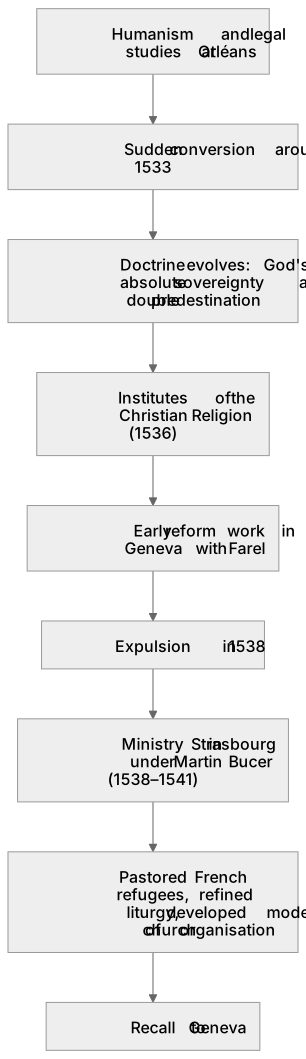
John Calvin’s early life was shaped by humanism and legal studies at Orléans, fostering a highly systematic approach to theology. Following a sudden conversion around 1533, his doctrine evolved from Erasmian reform to a distinct Protestantism focused on God's absolute sovereignty and double predestination. This culminated in his seminal publication, Institutes of the Christian Religion (1536), offering a structured defence of his faith. His early reform work in Geneva with Farel faced fierce resistance, causing his 1538 expulsion. Calvin then undertook a transformative ministry in Strasbourg (1538–1541) under Martin Bucer. Here, he pastored French refugees, refined his liturgy, and developed his model of church organisation before his eventual recall to Geneva.
What earns the marks
- Assess the impact of Calvin's humanist education and legal training on the logical structure of his theology.
- Explain the evolution of his doctrine, particularly the development of double predestination and the absolute sovereignty of God.
- Evaluate the significance of the Institutes of the Christian Religion (1536) in providing a comprehensive, systematic Protestant theology.
- Analyse the reasons for the failure of his early reform work in Geneva and his subsequent expulsion in 1538.
- Discuss how his ministry in Strasbourg under Bucer influenced his later approach to church discipline and liturgy.
Common mistakes and how to put them right
Claiming Calvin founded Protestantism in Geneva without prior influences.
Put it right: Acknowledge that Guillaume Farel had already begun the reform work in Geneva before Calvin arrived.
Confusing Calvin's early doctrine with Luther's by ignoring predestination.
Put it right: Emphasise that while both believed in justification by faith, Calvin's doctrine uniquely evolved to centre on double predestination.
Overlooking the Strasbourg period as a mere exile.
Put it right: Treat the Strasbourg ministry as a crucial developmental phase where Calvin learned practical church administration from Martin Bucer.
Exam tips
- Link Calvin's legal background directly to the highly structured and systematic nature of the Institutes.
- When discussing his early reform work, contrast the initial failure in Geneva with the practical experience he later gained in Strasbourg.
- Use the Institutes of the Christian Religion as evidence of how Calvin's doctrine evolved to provide a unifying theological framework for Protestants.
Try the lesson
The start of the 2C The Reformation in Europe, c1500–1564 (A-level only) – The second wave of Protestant Reform, 1541–1564: Calvin: influences on early life and the evolution of doctrine; publications; early reform work and ministry in Strasbourg lesson, made from checked teaching notes for this specification point.
Have a go first
Which of the following was John Calvin's most significant theological publication, first published in 1536, which systematically outlined his Protestant doctrines?
Listen
John Calvin’s early life was shaped by humanism and legal studies at Orléans, fostering a highly systematic approach to theology. Following a sudden conversion around 1533, his doctrine evolved from Erasmian reform to a distinct Protestantism focused on God's absolute sovereignty and double predestination. This culminated in his seminal publication, Institutes of the Christian Religion (1536), offering a structured defence of his faith. His early reform work in Geneva with Farel faced fierce resistance, causing his 1538 expulsion. Calvin then undertook a transformative ministry in Strasbourg (1538–1541) under Martin Bucer. Here, he pastored French refugees, refined his liturgy, and developed his model of church organisation before his eventual recall to Geneva. A strong answer earns marks for these points. Assess the impact of Calvin's humanist education and legal training on the logical structure of his theology. Explain the evolution of his doctrine, particularly the development of double predestination and the absolute sovereignty of God. Evaluate the significance of the Institutes of the Christian Religion (1536) in providing a comprehensive, systematic Protestant theology. Analyse the reasons for the failure of his early reform work in Geneva and his subsequent expulsion in 1538. A common slip: Claiming Calvin founded Protestantism in Geneva without prior influences. Instead, Acknowledge that Guillaume Farel had already begun the reform work in Geneva before Calvin arrived. Exam tip: Link Calvin's legal background directly to the highly structured and systematic nature of the Institutes.
See it
Key words
Say what each word means before you turn the card.
Humanism and education
Try answering aloud or in your head before turning the card.
Theological evolution
Try answering aloud or in your head before turning the card.
Church organisation
Try answering aloud or in your head before turning the card.
Exile and practical ministry
Try answering aloud or in your head before turning the card.
See every definition
- Humanism and education
- Shaped Calvin's early life and fostered a highly systematic approach to theology.
- Theological evolution
- His doctrine evolved from Erasmian reform to a distinct Protestantism focused on God's absolute sovereignty and double predestination.
- Church organisation
- A model developed during his Strasbourg ministry before his eventual recall to Geneva.
- Exile and practical ministry
- A transformative ministry in Strasbourg under Martin Bucer, pastoring French refugees and refining his liturgy.
Label the diagram
Some boxes have lost their names. Pick the right name for each number.
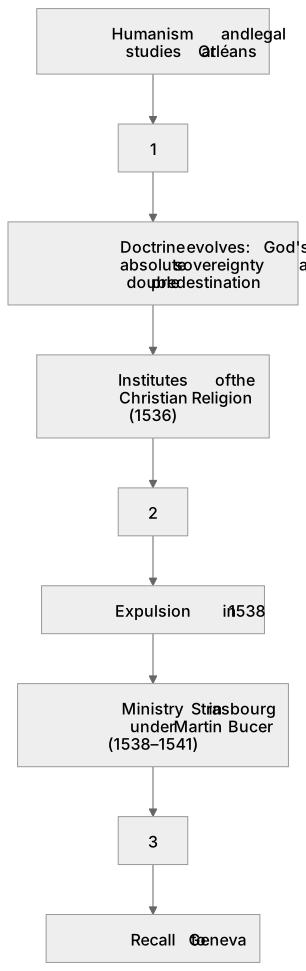
1Box 1
2Box 2
3Box 3
There is more to this lesson
The full lesson goes on to check your understanding and help you earn the marks. Create a free account to carry on, with your progress saved.
A week of Premium from your first lesson · Then the free plan continues · No card, no charge
Test your understanding of 2C The Reformation in Europe, c1500–1564 (A-level only) – The second wave of Protestant Reform, 1541–1564: Calvin: influences on early life and the evolution of doctrine; publications; early reform work and ministry in Strasbourg
Active recall beats re-reading. Take an instant quiz now to test what you’ve learned and lock it into long-term memory.
A week of Premium from your first lesson · Then the free plan continues · No card, no charge