AQA · A-Level · History
Course version: 7042 · Version from Sept 2017
The state of the Church and belief by 1547: disagreements over doctrine…
Full specification wording
2D Religious conflict and the Church in England, c1529– c1570 – Change and reaction, 1536–1547: The state of the Church and belief by 1547: disagreements over doctrine and practice; relations with France and Scotland and their impact; the growing influence of the Seymour faction and Cranmer; the importance of the succession
By Henry VIII’s death in 1547, the Church in England was structurally severed from Rome but remained doctrinally divided.
Checked against the AQA 7042 specification (opens in a new tab) on .
- Point 4 of 4
- 4 key terms
Study notes
From the checked teaching notes for this specification point.
The idea
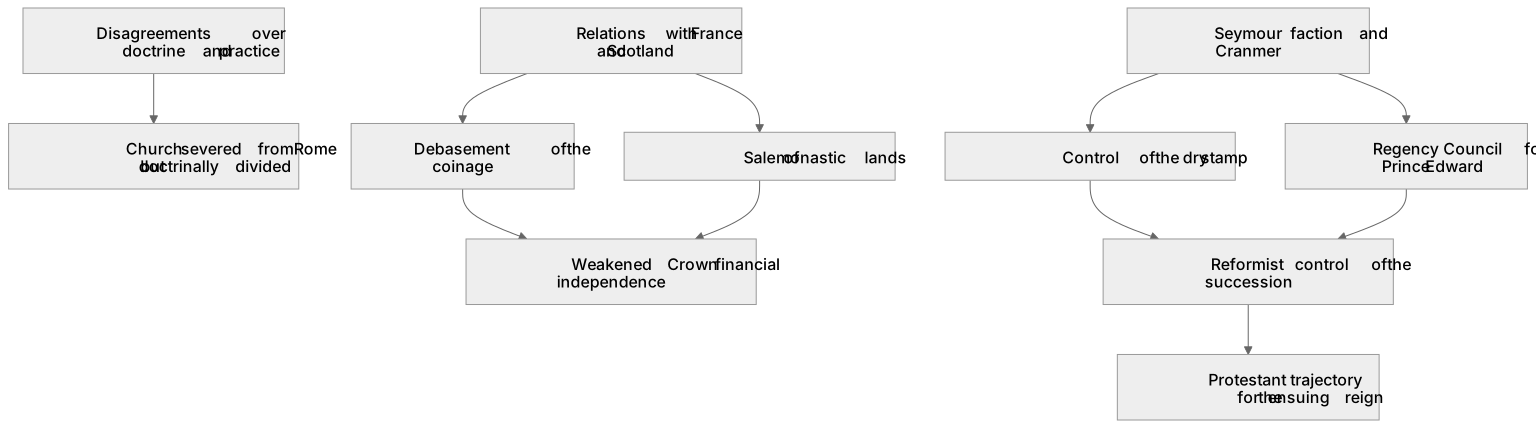
By Henry VIII’s death in 1547, the Church in England was structurally severed from Rome but remained doctrinally divided. Disagreements over doctrine and practice persisted, with traditional Catholic rituals coexisting alongside reformist ideas. Foreign policy heavily impacted domestic politics; costly wars and strained relations with France and Scotland necessitated the debasement of the coinage and the sale of monastic lands, weakening the Crown's financial independence. At court, the reformist Seymour faction, allied with Archbishop Cranmer, gained decisive influence over the ailing king. This factional triumph was crucial for the succession. By securing control of the dry stamp and the Regency Council for the young Prince Edward, the Seymours ensured that the ensuing reign would pursue a decisively Protestant trajectory, fundamentally altering the state of belief.
What earns the marks
- Assess the hybrid state of the Church in 1547, noting the structural break from Rome alongside the retention of largely Catholic doctrine and practice.
- Evaluate how expensive military campaigns against France and Scotland forced Henry to sell off monastic lands, reducing long-term Crown revenue.
- Analyse the methods used by the Seymour faction and Thomas Cranmer to dominate the Privy Chamber and manipulate Henry's will during his final months.
- Explain the significance of Edward VI's minority, detailing how the reformist control of the succession and Regency Council paved the way for Protestantism.
Common mistakes and how to put them right
Claiming England was a fully Protestant country by 1547.
Put it right: Emphasise that while the Church was independent from Rome (Catholicism without the Pope), its core doctrine and practices remained largely traditional.
Ignoring the link between foreign policy and domestic religious/financial changes.
Put it right: Connect the wars with France and Scotland to the financial crisis that drove the continued dissolution of chantries and sale of church lands.
Assuming Henry VIII planned for a Protestant Regency Council.
Put it right: Explain that Henry intended a balanced council, but the Seymour faction manipulated the succession arrangements (using the dry stamp) to secure reformist dominance.
Exam tips
- Link the financial strain of the wars with France and Scotland directly to the Crown's inability to maintain the wealth gained from the Dissolution of the Monasteries.
- Use the concept of the 'dry stamp' to explain how the Seymour faction consolidated their power over the succession in Henry's final weeks.
- When evaluating the state of belief in 1547, distinguish clearly between the official conservative doctrine (like the Six Articles) and the growing reformist sympathies at court.
Try the lesson
The start of the 2D Religious conflict and the Church in England, c1529– c1570 – Change and reaction, 1536–1547: The state of the Church and belief by 1547: disagreements over doctrine and practice; relations with France and Scotland and their impact; the growing influence of the Seymour faction and Cranmer; the importance of the succession lesson, made from checked teaching notes for this specification point.
Have a go first
By the time of Henry VIII's death in 1547, which faction had secured dominant control over the Privy Council and the young heir, Edward VI?
Listen
By Henry VIII’s death in 1547, the Church in England was structurally severed from Rome but remained doctrinally divided. Disagreements over doctrine and practice persisted, with traditional Catholic rituals coexisting alongside reformist ideas. Foreign policy heavily impacted domestic politics; costly wars and strained relations with France and Scotland necessitated the debasement of the coinage and the sale of monastic lands, weakening the Crown's financial independence. At court, the reformist Seymour faction, allied with Archbishop Cranmer, gained decisive influence over the ailing king. This factional triumph was crucial for the succession. By securing control of the dry stamp and the Regency Council for the young Prince Edward, the Seymours ensured that the ensuing reign would pursue a decisively Protestant trajectory, fundamentally altering the state of belief. A strong answer earns marks for these points. Assess the hybrid state of the Church in 1547, noting the structural break from Rome alongside the retention of largely Catholic doctrine and practice. Evaluate how expensive military campaigns against France and Scotland forced Henry to sell off monastic lands, reducing long-term Crown revenue. Analyse the methods used by the Seymour faction and Thomas Cranmer to dominate the Privy Chamber and manipulate Henry's will during his final months. Explain the significance of Edward VI's minority, detailing how the reformist control of the succession and Regency Council paved the way for Protestantism. A common slip: Claiming England was a fully Protestant country by 1547. Instead, Emphasise that while the Church was independent from Rome (Catholicism without the Pope), its core doctrine and practices remained largely traditional. Exam tip: Link the financial strain of the wars with France and Scotland directly to the Crown's inability to maintain the wealth gained from the Dissolution of the Monasteries.
See it
Key words
Say what each word means before you turn the card.
Religious division
Try answering aloud or in your head before turning the card.
Foreign policy and finance
Try answering aloud or in your head before turning the card.
Factionalism and court politics
Try answering aloud or in your head before turning the card.
The succession and royal authority
Try answering aloud or in your head before turning the card.
See every definition
- Religious division
- Disagreements over doctrine and practice persisted, with traditional Catholic rituals coexisting alongside reformist ideas.
- Foreign policy and finance
- Costly wars and strained relations with France and Scotland necessitated the debasement of the coinage and the sale of monastic lands, weakening the Crown's financial independence.
- Factionalism and court politics
- The reformist Seymour faction, allied with Archbishop Cranmer, gained decisive influence over the ailing king.
- The succession and royal authority
- Securing control of the dry stamp and the Regency Council for the young Prince Edward ensured the ensuing reign would pursue a decisively Protestant trajectory.
Label the diagram
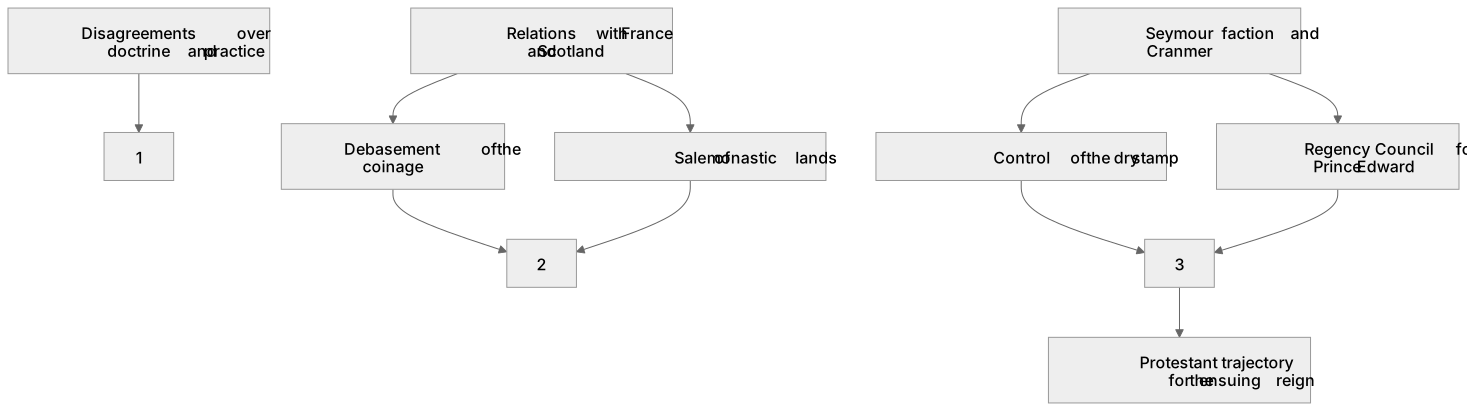
Some boxes have lost their names. Pick the right name for each number.
1Box 1
2Box 2
3Box 3
There is more to this lesson
The full lesson goes on to check your understanding and help you earn the marks. Create a free account to carry on, with your progress saved.
A week of Premium from your first lesson · Then the free plan continues · No card, no charge
Test your understanding of 2D Religious conflict and the Church in England, c1529– c1570 – Change and reaction, 1536–1547: The state of the Church and belief by 1547: disagreements over doctrine and practice; relations with France and Scotland and their impact; the growing influence of the Seymour faction and Cranmer; the importance of the succession
Active recall beats re-reading. Take an instant quiz now to test what you’ve learned and lock it into long-term memory.
A week of Premium from your first lesson · Then the free plan continues · No card, no charge