AQA · A-Level · History
Course version: 7042 · Version from Sept 2017
The First Civil War: the strengths and weaknesses of the political and…
Full specification wording
2E The English Revolution, 1625–1660 – only) War and radicalism, 1642–1646 (A-level only): The First Civil War: the strengths and weaknesses of the political and military leadership of the Parliamentary forces; emergence of the New Model Army; the Solemn League and Covenant; Self Denying Ordinance
Parliament's early war effort suffered from divided political leadership and military commanders, like Essex, who were reluctant to decisively defeat the King.
Checked against the AQA 7042 specification (opens in a new tab) on .
- Point 2 of 4
- 4 key terms
Study notes
From the checked teaching notes for this specification point.
The idea
Parliament's early war effort suffered from divided political leadership and military commanders, like Essex, who were reluctant to decisively defeat the King. However, Parliament demonstrated a crucial ability to adapt. Politically, the 1643 Solemn League and Covenant secured vital Scottish military support, shifting the balance of power. To resolve military stagnation, the 1645 Self-Denying Ordinance forced MPs to resign their military commands, separating political and military leadership. This paved the way for the emergence of the New Model Army, a national, meritocratic force funded by regular taxation. Under the disciplined military leadership of Fairfax and Cromwell, this professional army overcame early weaknesses, culminating in the decisive victory at Naseby.
What earns the marks
- Evaluate the initial weaknesses of Parliamentary leadership, focusing on the reluctance of aristocratic commanders like the Earl of Essex to pursue total victory.
- Analyse the political and military significance of the Solemn League and Covenant in securing the Scottish army, which was crucial at Marston Moor.
- Assess the impact of the Self-Denying Ordinance in removing ineffective aristocratic leaders and separating political factionalism from military command.
- Examine the emergence and structure of the New Model Army, highlighting its meritocratic promotion, regular pay, and strict discipline under Fairfax and Cromwell.
Common mistakes and how to put them right
Confusing the Solemn League and Covenant with a purely religious agreement.
Put it right: Explain that while it had religious terms regarding Presbyterianism, it was fundamentally a military and political alliance with Scotland.
Stating that Oliver Cromwell was the commander-in-chief of the New Model Army from its inception.
Put it right: Specify that Sir Thomas Fairfax was the commander-in-chief, while Cromwell was appointed as his deputy and commander of the cavalry.
Assuming the Self-Denying Ordinance removed all MPs from military command permanently.
Put it right: Note that exceptions were made, most notably for Oliver Cromwell, who retained his military command despite being an MP.
Exam tips
- Trace the evolution of Parliament's military strategy from the defensive, regional armies of 1642 to the offensive, national New Model Army of 1645.
- Link the Self-Denying Ordinance directly to the creation of the New Model Army as a two-step process to reform Parliament's failing war effort.
- Evaluate how Parliament's superior financial administration underpinned the success of their evolving military leadership.
Try the lesson
The start of the 2E The English Revolution, 1625–1660 – only) War and radicalism, 1642–1646 (A-level only): The First Civil War: the strengths and weaknesses of the political and military leadership of the Parliamentary forces; emergence of the New Model Army; the Solemn League and Covenant; Self Denying Ordinance lesson, made from checked teaching notes for this specification point.
Have a go first
What was the primary military consequence of the Solemn League and Covenant signed in 1643?
Listen
Parliament's early war effort suffered from divided political leadership and military commanders, like Essex, who were reluctant to decisively defeat the King. However, Parliament demonstrated a crucial ability to adapt. Politically, the 1643 Solemn League and Covenant secured vital Scottish military support, shifting the balance of power. To resolve military stagnation, the 1645 Self-Denying Ordinance forced MPs to resign their military commands, separating political and military leadership. This paved the way for the emergence of the New Model Army, a national, meritocratic force funded by regular taxation. Under the disciplined military leadership of Fairfax and Cromwell, this professional army overcame early weaknesses, culminating in the decisive victory at Naseby. A strong answer earns marks for these points. Evaluate the initial weaknesses of Parliamentary leadership, focusing on the reluctance of aristocratic commanders like the Earl of Essex to pursue total victory. Analyse the political and military significance of the Solemn League and Covenant in securing the Scottish army, which was crucial at Marston Moor. Assess the impact of the Self-Denying Ordinance in removing ineffective aristocratic leaders and separating political factionalism from military command. Examine the emergence and structure of the New Model Army, highlighting its meritocratic promotion, regular pay, and strict discipline under Fairfax and Cromwell. A common slip: Confusing the Solemn League and Covenant with a purely religious agreement. Instead, Explain that while it had religious terms regarding Presbyterianism, it was fundamentally a military and political alliance with Scotland. Exam tip: Trace the evolution of Parliament's military strategy from the defensive, regional armies of 1642 to the offensive, national New Model Army of 1645.
See it
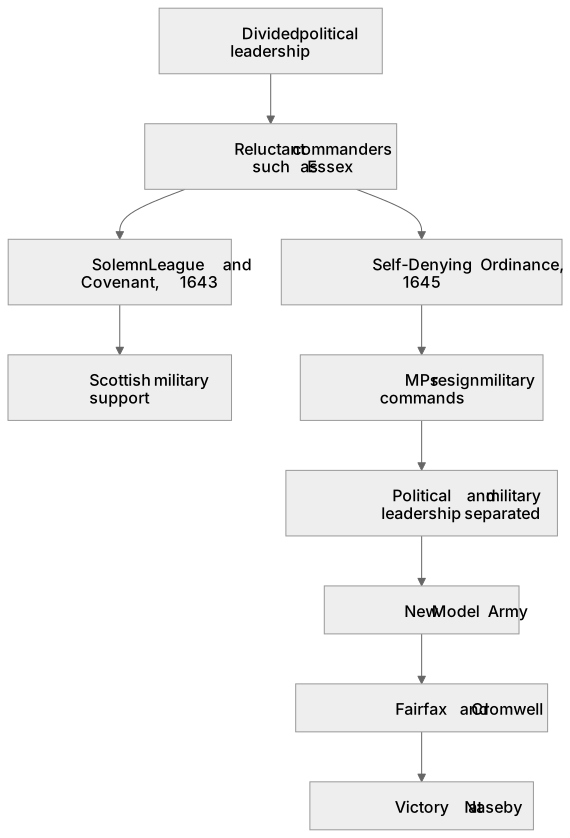
Key words
Say what each word means before you turn the card.
Solemn League and Covenant
Try answering aloud or in your head before turning the card.
Self-Denying Ordinance
Try answering aloud or in your head before turning the card.
New Model Army
Try answering aloud or in your head before turning the card.
Meritocracy
Try answering aloud or in your head before turning the card.
See every definition
- Solemn League and Covenant
- The 1643 agreement that secured vital Scottish military support, shifting the balance of power.
- Self-Denying Ordinance
- The 1645 measure that forced MPs to resign their military commands, separating political and military leadership.
- New Model Army
- A national, meritocratic force funded by regular taxation, with regular pay and strict discipline under Fairfax and Cromwell.
- Meritocracy
- The principle of promotion on merit that characterised the New Model Army.
Label the diagram
Some boxes have lost their names. Pick the right name for each number.
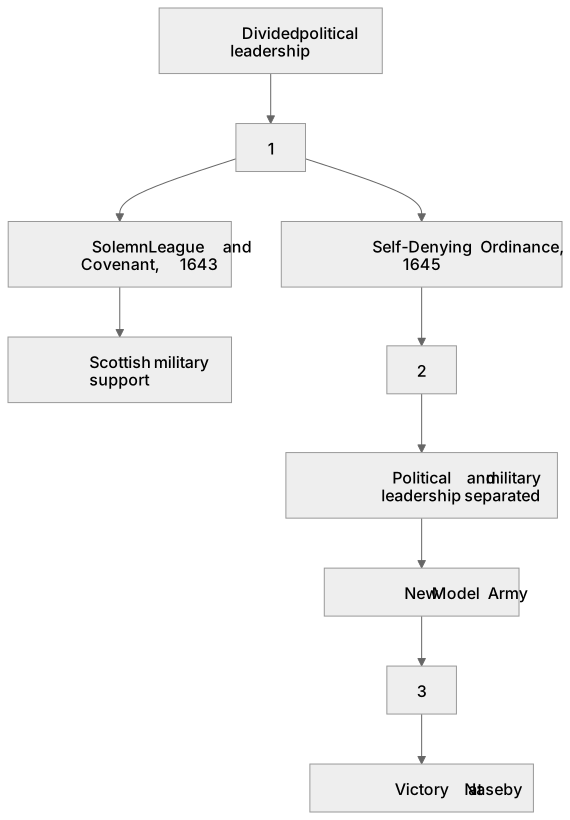
1Box 1
2Box 2
3Box 3
There is more to this lesson
The full lesson goes on to check your understanding and help you earn the marks. Create a free account to carry on, with your progress saved.
A week of Premium from your first lesson · Then the free plan continues · No card, no charge
Test your understanding of 2E The English Revolution, 1625–1660 – only) War and radicalism, 1642–1646 (A-level only): The First Civil War: the strengths and weaknesses of the political and military leadership of the Parliamentary forces; emergence of the New Model Army; the Solemn League and Covenant; Self Denying Ordinance
Active recall beats re-reading. Take an instant quiz now to test what you’ve learned and lock it into long-term memory.
A week of Premium from your first lesson · Then the free plan continues · No card, no charge