AQA · A-Level · History
Course version: 7042 · Version from Sept 2017
The Political Nation 1640: the recall of Parliament; the strengths and…
Full specification wording
2E The English Revolution, 1625–1660 – The crisis of Parliament and the outbreak of the First Civil War, 1640–1642: The Political Nation 1640: the recall of Parliament; the strengths and weaknesses of Charles I; the strengths and divisions of parliamentary opposition
In 1640, the Political Nation faced a crisis forcing the recall of Parliament.
Checked against the AQA 7042 specification (opens in a new tab) on .
- Point 1 of 4
- 4 key terms
Study notes
From the checked teaching notes for this specification point.
The idea
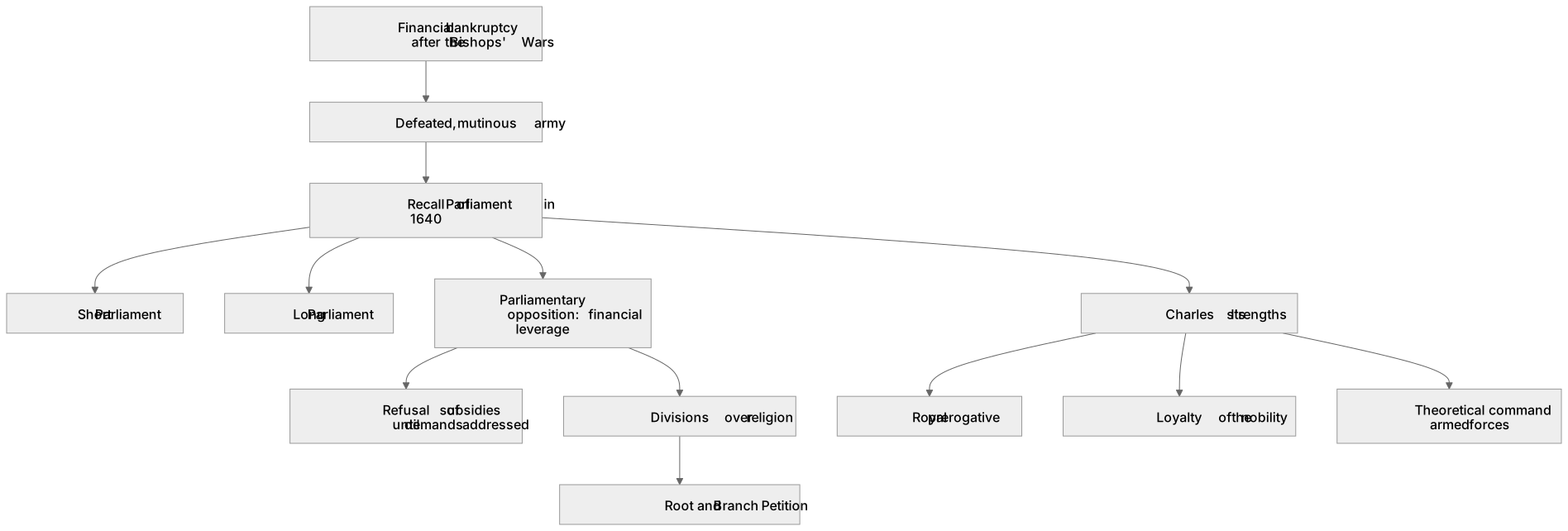
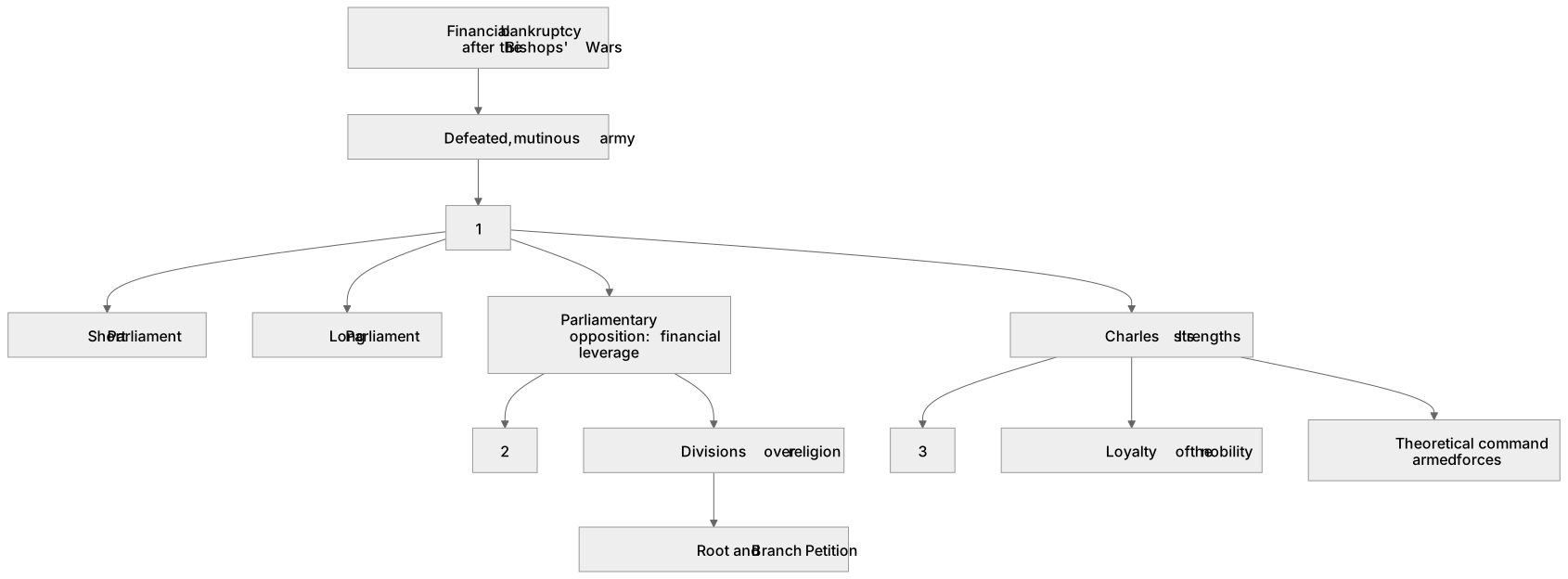
In 1640, the Political Nation faced a crisis forcing the recall of Parliament. Charles I’s main weakness was his financial bankruptcy following the Bishops' Wars and a defeated, mutinous army, compelling him to summon the Short and Long Parliaments. His strengths included his legally inherent royal prerogative, the ingrained loyalty of the nobility, and theoretical command of the armed forces, though in reality, his military position was severely compromised. The parliamentary opposition possessed the strength of financial leverage, refusing subsidies until Charles addressed demands. Yet, divisions rapidly emerged within Parliament over religion, specifically the Root and Branch Petition, fracturing their unity.
What earns the marks
- Evaluate the financial and military pressures, including a defeated and mutinous army, that forced Charles I to recall Parliament in 1640.
- Assess Charles I's strengths, such as his legally inherent royal prerogative and the traditional deference of the Political Nation, while noting his theoretical rather than practical military command.
- Analyse Charles I's weaknesses, particularly his lack of funds, untrustworthy reputation, and the ineffectiveness of his armed forces.
- Examine the strengths of the parliamentary opposition, notably their control over taxation and initial unity against the abuses of Personal Rule.
- Identify the emerging divisions within the parliamentary opposition, especially concerning religious reforms like the Root and Branch Petition.
Common mistakes and how to put them right
Listing practical army control as a strength of Charles I in 1640.
Put it right: Clarify that while he had theoretical prerogative command, his actual army was defeated, unpaid, and mutinous, constituting a major weakness.
Assuming Parliament was completely united against Charles I in 1640.
Put it right: Acknowledge that while initially united against Personal Rule, deep divisions quickly surfaced over religious reform and constitutional limits.
Confusing the Short and Long Parliaments.
Put it right: Distinguish between the Short Parliament (April-May 1640), dissolved quickly over subsidy disputes, and the Long Parliament (convened November 1640).
Exam tips
- When evaluating Charles I's position in 1640, contrast his theoretical prerogative powers with the practical reality of his financial ruin and military defeat.
- Use the Root and Branch Petition as a concrete example to demonstrate the religious divisions fracturing the parliamentary opposition.
- Avoid treating the 'Political Nation' as a single entity; highlight how differing regional and religious loyalties influenced their response to the 1640 crisis.
Try the lesson
The start of the 2E The English Revolution, 1625–1660 – The crisis of Parliament and the outbreak of the First Civil War, 1640–1642: The Political Nation 1640: the recall of Parliament; the strengths and weaknesses of Charles I; the strengths and divisions of parliamentary opposition lesson, made from checked teaching notes for this specification point.
Have a go first
What was the primary reason Charles I was forced to recall Parliament in 1640, ending his Personal Rule?
Listen
In 1640, the Political Nation faced a crisis forcing the recall of Parliament. Charles I’s main weakness was his financial bankruptcy following the Bishops' Wars and a defeated, mutinous army, compelling him to summon the Short and Long Parliaments. His strengths included his legally inherent royal prerogative, the ingrained loyalty of the nobility, and theoretical command of the armed forces, though in reality, his military position was severely compromised. The parliamentary opposition possessed the strength of financial leverage, refusing subsidies until Charles addressed demands. Yet, divisions rapidly emerged within Parliament over religion, specifically the Root and Branch Petition, fracturing their unity. A strong answer earns marks for these points. Evaluate the financial and military pressures, including a defeated and mutinous army, that forced Charles I to recall Parliament in 1640. Assess Charles I's strengths, such as his legally inherent royal prerogative and the traditional deference of the Political Nation, while noting his theoretical rather than practical military command. Analyse Charles I's weaknesses, particularly his lack of funds, untrustworthy reputation, and the ineffectiveness of his armed forces. Examine the strengths of the parliamentary opposition, notably their control over taxation and initial unity against the abuses of Personal Rule. A common slip: Listing practical army control as a strength of Charles I in 1640. Instead, Clarify that while he had theoretical prerogative command, his actual army was defeated, unpaid, and mutinous, constituting a major weakness. Exam tip: When evaluating Charles I's position in 1640, contrast his theoretical prerogative powers with the practical reality of his financial ruin and military defeat.
See it
Key words
Say what each word means before you turn the card.
Royal prerogative versus parliamentary privilege
Try answering aloud or in your head before turning the card.
Religious division within the opposition
Try answering aloud or in your head before turning the card.
Financial and military instability
Try answering aloud or in your head before turning the card.
Recall of Parliament
Try answering aloud or in your head before turning the card.
See every definition
- Royal prerogative versus parliamentary privilege
- Charles I's legally inherent royal prerogative was a strength, but the parliamentary opposition used financial leverage by refusing subsidies until he addressed their demands.
- Religious division within the opposition
- Divisions rapidly emerged within Parliament over religion, specifically the Root and Branch Petition, fracturing the unity of the parliamentary opposition.
- Financial and military instability
- Charles I's financial bankruptcy following the Bishops' Wars and a defeated, mutinous army compelled him to summon the Short and Long Parliaments.
- Recall of Parliament
- In 1640, the Political Nation faced a crisis forcing the recall of Parliament, with Charles I summoning the Short and Long Parliaments.
Label the diagram
Some boxes have lost their names. Pick the right name for each number.
1Box 1
2Box 2
3Box 3
There is more to this lesson
The full lesson goes on to check your understanding and help you earn the marks. Create a free account to carry on, with your progress saved.
A week of Premium from your first lesson · Then the free plan continues · No card, no charge
Test your understanding of 2E The English Revolution, 1625–1660 – The crisis of Parliament and the outbreak of the First Civil War, 1640–1642: The Political Nation 1640: the recall of Parliament; the strengths and weaknesses of Charles I; the strengths and divisions of parliamentary opposition
Active recall beats re-reading. Take an instant quiz now to test what you’ve learned and lock it into long-term memory.
A week of Premium from your first lesson · Then the free plan continues · No card, no charge