AQA · A-Level · History
Course version: 7042 · Version from Sept 2017
The slide into war: the impact of events in Ireland; the failed arrest of…
Full specification wording
2E The English Revolution, 1625–1660 – The crisis of Parliament and the outbreak of the First Civil War, 1640–1642: The slide into war: the impact of events in Ireland; the failed arrest of the Five Members; local grievances; attempts to impose royal authority and the development of a Royalist Party; military preparations for war
The slide into war accelerated in 1641 following the Irish Rebellion.
Checked against the AQA 7042 specification (opens in a new tab) on .
- Point 4 of 4
- 3 key terms
Study notes
From the checked teaching notes for this specification point.
The idea
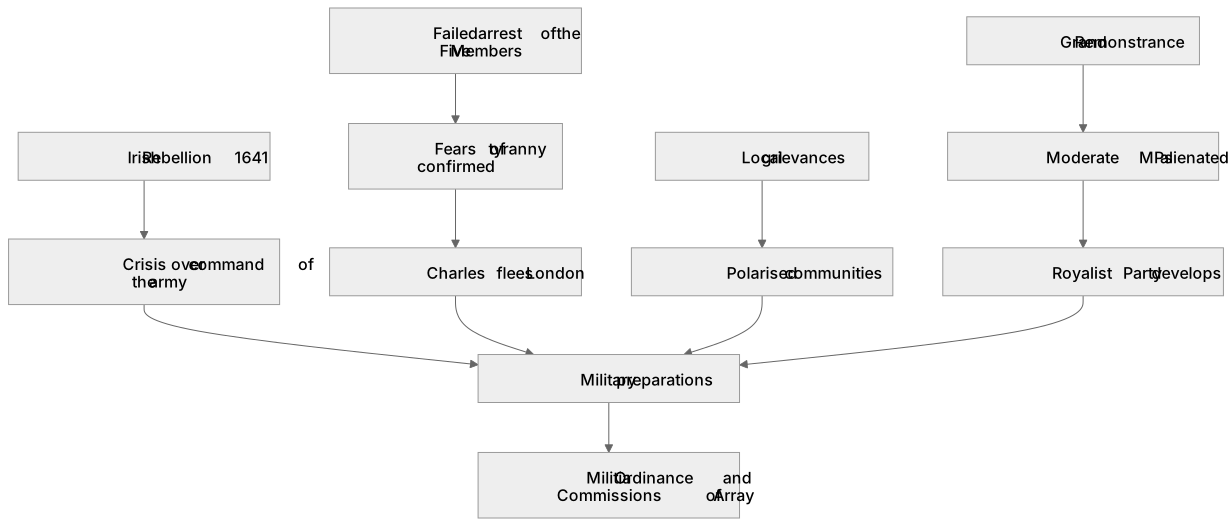
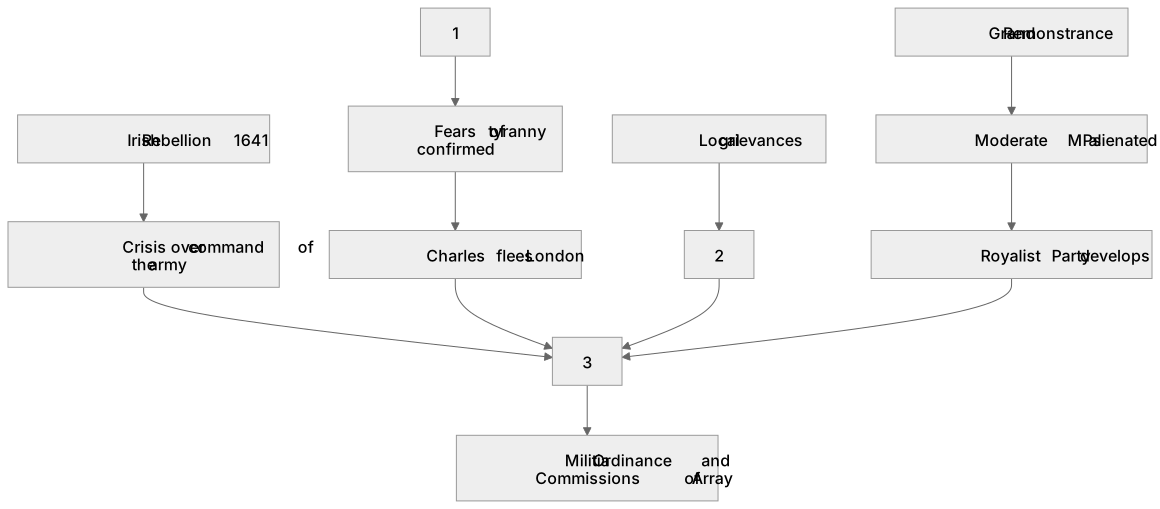
The slide into war accelerated in 1641 following the Irish Rebellion. Reports of Catholic atrocities in Ireland sparked a crisis over whether the King or Parliament should command the army. Charles's attempt to impose royal authority by entering the Commons to arrest the Five Members in January 1642 confirmed fears of tyranny, forcing him to flee London. Concurrently, local grievances over religion and taxation polarised communities. A Royalist Party developed as moderate MPs, alienated by radical demands like the Grand Remonstrance, rallied to the King as the defender of order. Both sides then began military preparations, issuing rival commissions of array and militia ordinances to secure county magazines and raise troops.
What earns the marks
- Assess how the Irish Rebellion of 1641 created a military crisis that forced Parliament to challenge the King's prerogative over the armed forces.
- Explain the significance of the failed arrest of the Five Members in destroying the possibility of a peaceful settlement and forcing Charles to leave London.
- Analyse how local grievances, such as opposition to enclosure or religious radicalism, influenced allegiance in the localities.
- Evaluate the formation of the Royalist Party, focusing on the reaction of constitutional royalists to Pym's radicalism and the Grand Remonstrance.
- Compare the methods used for military preparations, specifically Parliament's Militia Ordinance versus the King's Commissions of Array.
Common mistakes and how to put them right
Assuming the Irish Rebellion was a direct attack on England.
Put it right: Clarify that it was an uprising by Irish Catholics against Protestant settlers in Ireland, but it triggered a political crisis in England over control of the army.
Stating that the country was neatly divided into two distinct sides from the start.
Put it right: Emphasise that many localities were neutral or driven by local grievances, and the formation of a Royalist Party was a gradual reaction to parliamentary radicalism.
Confusing the Militia Ordinance with the Commissions of Array.
Put it right: Specify that Parliament issued the Militia Ordinance without royal assent, while the King issued traditional Commissions of Array to raise troops.
Exam tips
- Link the events in Ireland directly to the Militia Bill to show how external events drove constitutional radicalism in England.
- When discussing the development of the Royalist Party, use the Grand Remonstrance as the key turning point that alienated moderates like Edward Hyde.
- Contrast the national political crisis with local grievances to demonstrate a nuanced understanding of why individuals chose sides in 1642.
Try the lesson
The start of the 2E The English Revolution, 1625–1660 – The crisis of Parliament and the outbreak of the First Civil War, 1640–1642: The slide into war: the impact of events in Ireland; the failed arrest of the Five Members; local grievances; attempts to impose royal authority and the development of a Royalist Party; military preparations for war lesson, made from checked teaching notes for this specification point.
Have a go first
In January 1642, Charles I entered the House of Commons with armed guards to arrest five Members of Parliament. What was the immediate outcome of this action?
Listen
The slide into war accelerated in 1641 following the Irish Rebellion. Reports of Catholic atrocities in Ireland sparked a crisis over whether the King or Parliament should command the army. Charles's attempt to impose royal authority by entering the Commons to arrest the Five Members in January 1642 confirmed fears of tyranny, forcing him to flee London. Concurrently, local grievances over religion and taxation polarised communities. A Royalist Party developed as moderate MPs, alienated by radical demands like the Grand Remonstrance, rallied to the King as the defender of order. Both sides then began military preparations, issuing rival commissions of array and militia ordinances to secure county magazines and raise troops. A strong answer earns marks for these points. Assess how the Irish Rebellion of 1641 created a military crisis that forced Parliament to challenge the King's prerogative over the armed forces. Explain the significance of the failed arrest of the Five Members in destroying the possibility of a peaceful settlement and forcing Charles to leave London. Analyse how local grievances, such as opposition to enclosure or religious radicalism, influenced allegiance in the localities. Evaluate the formation of the Royalist Party, focusing on the reaction of constitutional royalists to Pym's radicalism and the Grand Remonstrance. A common slip: Assuming the Irish Rebellion was a direct attack on England. Instead, Clarify that it was an uprising by Irish Catholics against Protestant settlers in Ireland, but it triggered a political crisis in England over control of the army. Exam tip: Link the events in Ireland directly to the Militia Bill to show how external events drove constitutional radicalism in England.
See it
Key words
Say what each word means before you turn the card.
Control of the Armed Forces
Try answering aloud or in your head before turning the card.
Constitutional Royalism
Try answering aloud or in your head before turning the card.
Provincial Neutralism vs National Conflict
Try answering aloud or in your head before turning the card.
See every definition
- Control of the Armed Forces
- A crisis over whether the King or Parliament should command the army, sparked by reports of Catholic atrocities in Ireland.
- Constitutional Royalism
- The reaction of moderate MPs, alienated by radical demands like the Grand Remonstrance, who rallied to the King as the defender of order.
- Provincial Neutralism vs National Conflict
- Many localities were neutral or driven by local grievances over religion and taxation, and the formation of a Royalist Party was a gradual reaction to parliamentary radicalism.
Label the diagram
Some boxes have lost their names. Pick the right name for each number.
1Box 1
2Box 2
3Box 3
There is more to this lesson
The full lesson goes on to check your understanding and help you earn the marks. Create a free account to carry on, with your progress saved.
A week of Premium from your first lesson · Then the free plan continues · No card, no charge
Test your understanding of 2E The English Revolution, 1625–1660 – The crisis of Parliament and the outbreak of the First Civil War, 1640–1642: The slide into war: the impact of events in Ireland; the failed arrest of the Five Members; local grievances; attempts to impose royal authority and the development of a Royalist Party; military preparations for war
Active recall beats re-reading. Take an instant quiz now to test what you’ve learned and lock it into long-term memory.
A week of Premium from your first lesson · Then the free plan continues · No card, no charge