AQA · A-Level · History
Course version: 7042 · Version from Sept 2017
The problem of Charles I: divisions within the army and Parliament; the…
Full specification wording
2E The English Revolution, 1625–1660 – The disintegration of the Political Nation, 1646–1649 (A-level only): The problem of Charles I: divisions within the army and Parliament; the trial and execution of the King
Following the Second Civil War, Charles I presented an intractable problem: he refused to compromise, believing in his divine right, while his opponents remained deeply divided.
Checked against the AQA 7042 specification (opens in a new tab) on .
- Point 4 of 4
Study notes
From the checked teaching notes for this specification point.
The idea
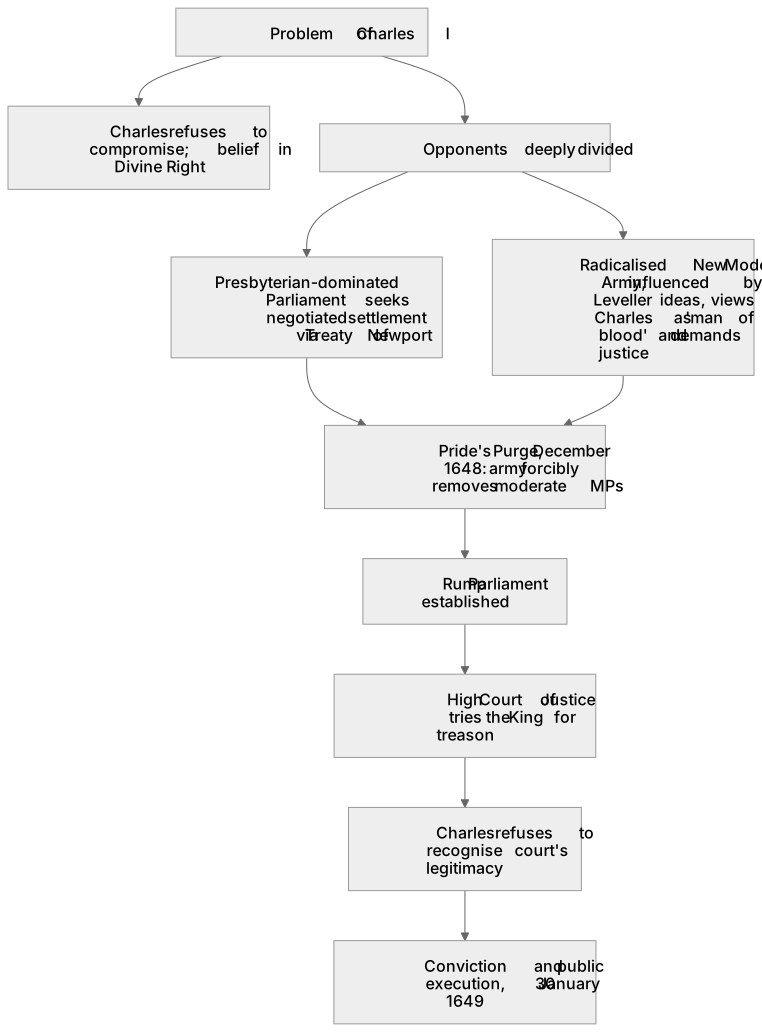
Following the Second Civil War, Charles I presented an intractable problem: he refused to compromise, believing in his divine right, while his opponents remained deeply divided. Parliament, dominated by Presbyterians, sought a negotiated settlement through the Treaty of Newport. Conversely, the radicalised New Model Army, influenced by Leveller ideas and viewing Charles as a 'man of blood', demanded justice. This division culminated in Pride's Purge (December 1648), where the army forcibly removed moderate MPs, creating the Rump Parliament. This purged body established a High Court of Justice to try the King for treason. Charles refused to recognise the court's legitimacy, leading to his conviction and unprecedented public execution on 30 January 1649, fundamentally fracturing the Political Nation.
What earns the marks
- Analyse the 'problem of Charles I', focusing on his intransigence, his belief in Divine Right, and his willingness to exploit divisions among his enemies.
- Examine the ideological and political divisions between the Presbyterian-dominated Parliament seeking a treaty, and the radicalised New Model Army demanding retribution.
- Explain the significance of Pride's Purge in breaking the political deadlock and enabling the army to force through the King's trial via the Rump Parliament.
- Assess the legal and political unprecedented nature of the trial, including Charles's refusal to plead and the ideological justification used for his execution.
Common mistakes and how to put them right
Stating that Parliament as a whole wanted to execute the King.
Put it right: Clarify that the majority of MPs wanted a settlement, and it required a military coup (Pride's Purge) to enable the trial.
Claiming Charles I mounted a vigorous legal defence.
Put it right: Note that Charles refused to recognise the court's authority and therefore refused to enter a plea.
Assuming the army was entirely unified in wanting execution from the start.
Put it right: Explain that the army's stance radicalised over time, particularly after the Second Civil War convinced them Charles was defying God's will.
Exam tips
- Use the phrase 'man of blood' to illustrate the religious and providential mindset of the New Model Army following the Second Civil War.
- Contrast the aims of the Treaty of Newport with the Remonstrance of the Army to clearly demonstrate the division between Parliament and the military.
- When evaluating the trial, discuss the constitutional crisis it created, as trying a divinely appointed monarch for treason against his own people was legally unprecedented.
Try the lesson
The start of the 2E The English Revolution, 1625–1660 – The disintegration of the Political Nation, 1646–1649 (A-level only): The problem of Charles I: divisions within the army and Parliament; the trial and execution of the King lesson, made from checked teaching notes for this specification point.
Have a go first
Following the Second Civil War, what was the primary source of division between the New Model Army and the Presbyterian majority in Parliament?
Listen
Following the Second Civil War, Charles I presented an intractable problem: he refused to compromise, believing in his divine right, while his opponents remained deeply divided. Parliament, dominated by Presbyterians, sought a negotiated settlement through the Treaty of Newport. Conversely, the radicalised New Model Army, influenced by Leveller ideas and viewing Charles as a 'man of blood', demanded justice. This division culminated in Pride's Purge (December 1648), where the army forcibly removed moderate MPs, creating the Rump Parliament. This purged body established a High Court of Justice to try the King for treason. Charles refused to recognise the court's legitimacy, leading to his conviction and unprecedented public execution on 30 January 1649, fundamentally fracturing the Political Nation. A strong answer earns marks for these points. Analyse the 'problem of Charles I', focusing on his intransigence, his belief in Divine Right, and his willingness to exploit divisions among his enemies. Examine the ideological and political divisions between the Presbyterian-dominated Parliament seeking a treaty, and the radicalised New Model Army demanding retribution. Explain the significance of Pride's Purge in breaking the political deadlock and enabling the army to force through the King's trial via the Rump Parliament. Assess the legal and political unprecedented nature of the trial, including Charles's refusal to plead and the ideological justification used for his execution. A common slip: Stating that Parliament as a whole wanted to execute the King. Instead, clarify that the majority of MPs wanted a settlement, and it required a military coup (Pride's Purge) to enable the trial. Exam tip: Use the phrase 'man of blood' to illustrate the religious and providential mindset of the New Model Army following the Second Civil War.
See it
Label the diagram
Some boxes have lost their names. Pick the right name for each number.
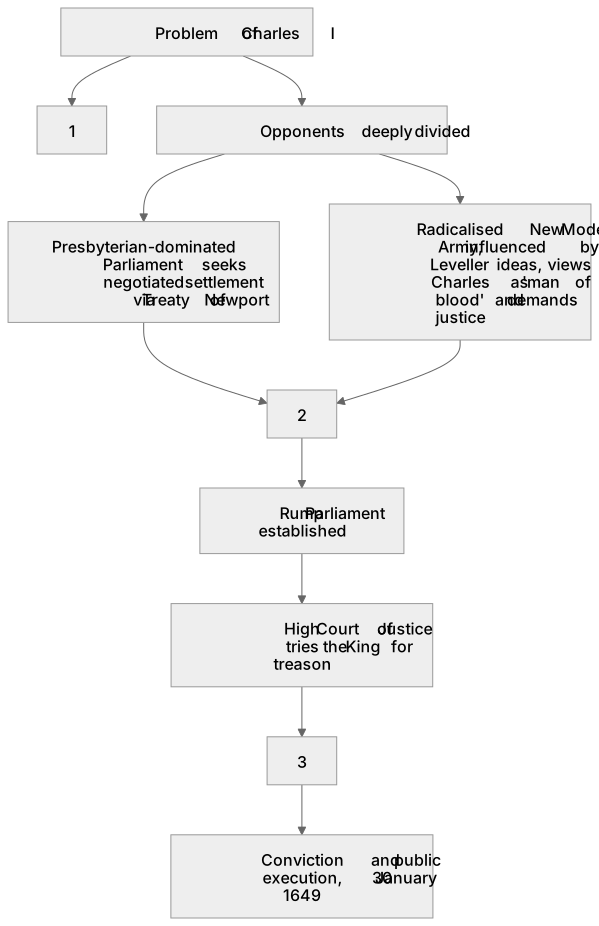
1Box 1
2Box 2
3Box 3
There is more to this lesson
The full lesson goes on to check your understanding and help you earn the marks. Create a free account to carry on, with your progress saved.
A week of Premium from your first lesson · Then the free plan continues · No card, no charge
Test your understanding of 2E The English Revolution, 1625–1660 – The disintegration of the Political Nation, 1646–1649 (A-level only): The problem of Charles I: divisions within the army and Parliament; the trial and execution of the King
Active recall beats re-reading. Take an instant quiz now to test what you’ve learned and lock it into long-term memory.
A week of Premium from your first lesson · Then the free plan continues · No card, no charge