AQA · A-Level · History
Course version: 7042 · Version from Sept 2017
Louis XIV, France and Europe, 1643– 1715 (A-level only) – Challenges in…
Full specification wording
2F The Sun King: Louis XIV, France and Europe, 1643– 1715 (A-level only) – Challenges in Europe, 1685–1697: The new balance of power: the position of France in relation to the European powers by 1697; the impact of years of war on France’s economic and military resources; the prospects of future wars
By 1697, the Peace of Ryswick established a new balance of power, halting French expansion and demonstrating that a united coalition of European powers could successfully contain Louis XIV.
Checked against the AQA 7042 specification (opens in a new tab) on .
- Point 4 of 4
Study notes
From the checked teaching notes for this specification point.
The idea
By 1697, the Peace of Ryswick established a new balance of power, halting French expansion and demonstrating that a united coalition of European powers could successfully contain Louis XIV. France's position relative to rivals like England and the Dutch Republic shifted from absolute dominance to defensive containment. The prolonged conflict severely impacted France's economic and military resources; crippling taxation, famine (such as the crisis of 1693–1694), and massive debt weakened the state, while the army suffered heavy attrition. Despite the peace, the prospects of future wars loomed large, as the unresolved issue of the Spanish succession guaranteed that this new balance of power would soon be tested again by competing dynastic claims.
What earns the marks
- Analyse the shift in the European balance of power by 1697, noting the successful containment of French hegemony by the Grand Alliance.
- Evaluate the relative position of France compared to emerging powers like Williamite England and the Habsburg monarchy.
- Assess the severe impact of the Nine Years War on France's domestic economy, including agricultural crises, demographic decline, and mounting state debt.
- Explain how the unresolved Spanish succession created immediate prospects for future wars, making Ryswick a mere truce.
Common mistakes and how to put them right
Arguing that France was completely defeated and powerless by 1697.
Put it right: Clarify that while contained and financially exhausted, France remained the single most formidable military power in Europe.
Ignoring the domestic economic crisis in France during the 1690s.
Put it right: Explicitly mention the devastating impact of war taxation and the famine of 1693–1694 on French resources.
Treating the Peace of Ryswick as a permanent settlement.
Put it right: Emphasise that contemporaries viewed it as a temporary truce due to the looming crisis over the Spanish succession.
Exam tips
- Link France's military concessions at Ryswick directly to its internal economic exhaustion to build a strong analytical argument.
- Contrast France's position in 1697 with its peak dominance in 1684 (Truce of Ratisbon) to illustrate the shifting balance of power.
- Use the phrase 'armed truce' to describe the period after 1697, highlighting the inevitability of future conflict over Spain.
Try the lesson
The start of the 2F The Sun King: Louis XIV, France and Europe, 1643– 1715 (A-level only) – Challenges in Europe, 1685–1697: The new balance of power: the position of France in relation to the European powers by 1697; the impact of years of war on France’s economic and military resources; the prospects of future wars lesson, made from checked teaching notes for this specification point.
Have a go first
Which of the following best describes the condition of France's domestic economy by the conclusion of the Nine Years War in 1697?
Listen
By 1697, the Peace of Ryswick established a new balance of power, halting French expansion and demonstrating that a united coalition of European powers could successfully contain Louis XIV. France's position relative to rivals like England and the Dutch Republic shifted from absolute dominance to defensive containment. The prolonged conflict severely impacted France's economic and military resources; crippling taxation, famine (such as the crisis of 1693–1694), and massive debt weakened the state, while the army suffered heavy attrition. Despite the peace, the prospects of future wars loomed large, as the unresolved issue of the Spanish succession guaranteed that this new balance of power would soon be tested again by competing dynastic claims. A strong answer earns marks for these points. Analyse the shift in the European balance of power by 1697, noting the successful containment of French hegemony by the Grand Alliance. Evaluate the relative position of France compared to emerging powers like Williamite England and the Habsburg monarchy. Assess the severe impact of the Nine Years War on France's domestic economy, including agricultural crises, demographic decline, and mounting state debt. Explain how the unresolved Spanish succession created immediate prospects for future wars, making Ryswick a mere truce. A common slip: Arguing that France was completely defeated and powerless by 1697. Instead, Clarify that while contained and financially exhausted, France remained the single most formidable military power in Europe. Exam tip: Link France's military concessions at Ryswick directly to its internal economic exhaustion to build a strong analytical argument.
See it
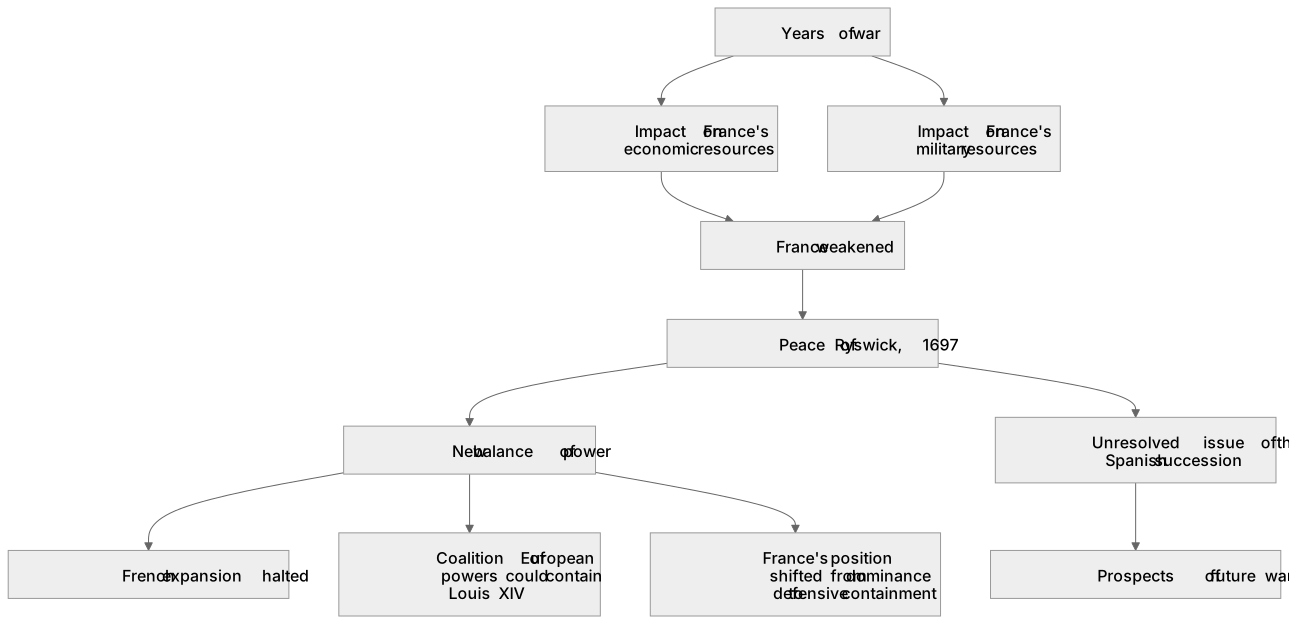
Put the events in order
Put these events in the order they happened, earliest first.
- 1. Truce of Ratisbon marked peak of French dominance
- 2. Peace of Ryswick established a new balance of power
- 3. Famine crisis struck France
Label the diagram
Some boxes have lost their names. Pick the right name for each number.
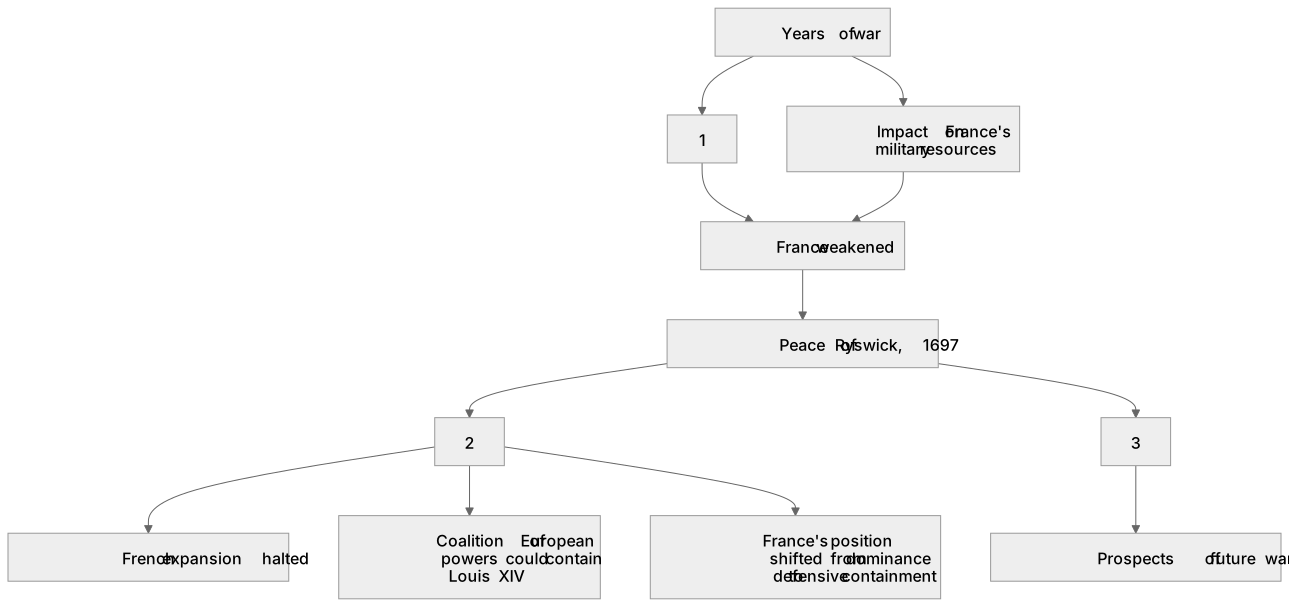
1Box 1
2Box 2
3Box 3
There is more to this lesson
The full lesson goes on to check your understanding and help you earn the marks. Create a free account to carry on, with your progress saved.
A week of Premium from your first lesson · Then the free plan continues · No card, no charge
Test your understanding of 2F The Sun King: Louis XIV, France and Europe, 1643– 1715 (A-level only) – Challenges in Europe, 1685–1697: The new balance of power: the position of France in relation to the European powers by 1697; the impact of years of war on France’s economic and military resources; the prospects of future wars
Active recall beats re-reading. Take an instant quiz now to test what you’ve learned and lock it into long-term memory.
A week of Premium from your first lesson · Then the free plan continues · No card, no charge