AQA · A-Level · History
Course version: 7042 · Version from Sept 2017
Louis XIV, France and Europe, 1643– 1715 (A-level only) – The…
Full specification wording
2F The Sun King: Louis XIV, France and Europe, 1643– 1715 (A-level only) – The establishment of Absolutism at home, 1661–1685: Louis XIV and the Church: disputes with the papacy; persecution of Jansenists; policies towards Huguenots and the Revocation Edict of 1685
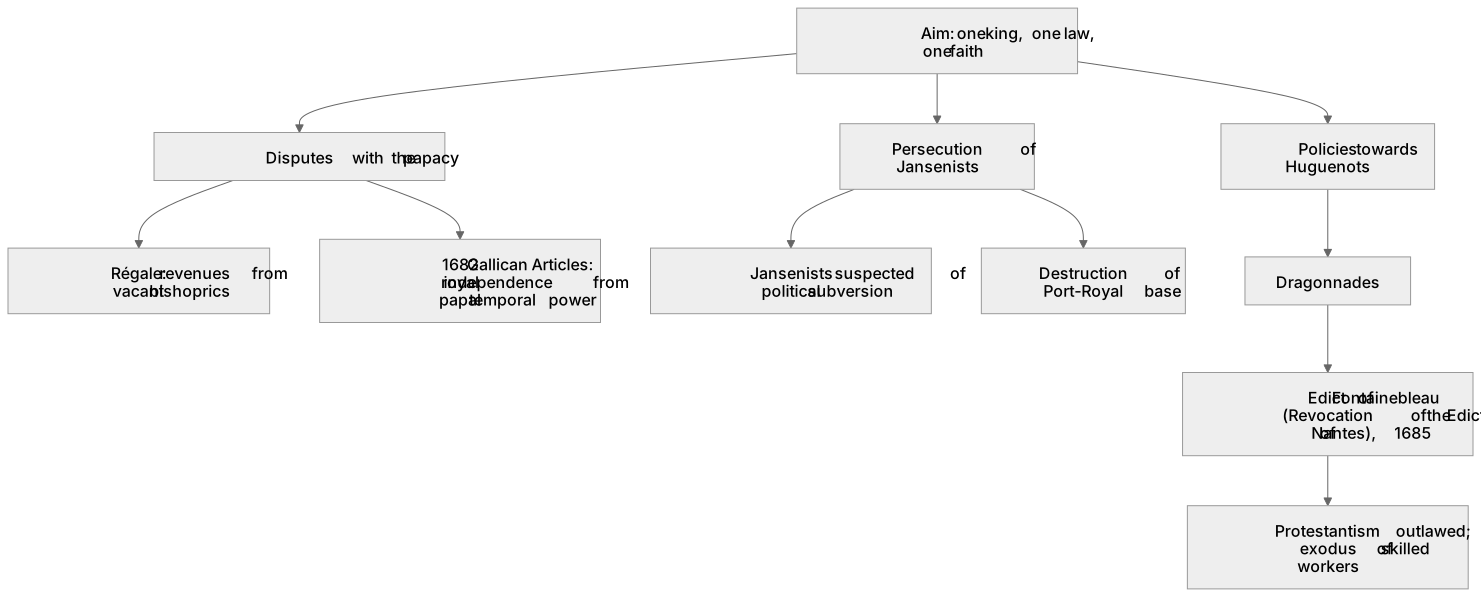
Louis XIV’s religious policies aimed to enforce unity under the principle of 'one king, one law, one faith'.
Checked against the AQA 7042 specification (opens in a new tab) on .
- Point 4 of 4
- 4 key terms
Study notes
From the checked teaching notes for this specification point.
The idea
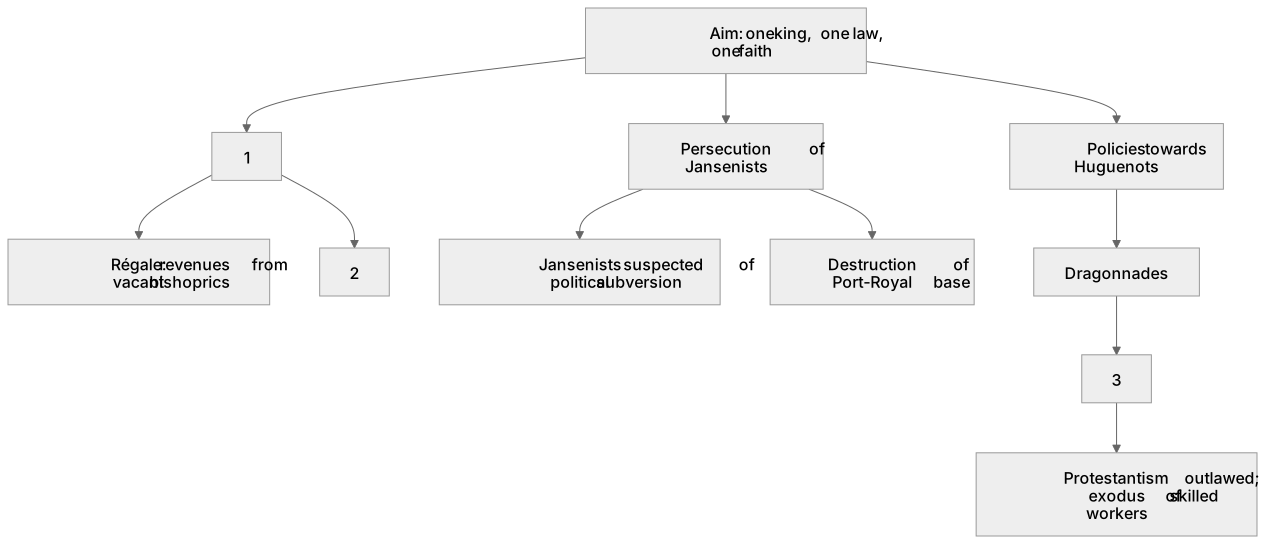
Louis XIV’s religious policies aimed to enforce unity under the principle of 'one king, one law, one faith'. His pursuit of Gallicanism led to severe disputes with the papacy, notably over the régale (collecting revenues from vacant bishoprics) and the 1682 Gallican Articles, which asserted royal independence from papal temporal power. Domestically, Louis persecuted the Jansenists, an austere Catholic movement he suspected of political subversion, eventually destroying their Port-Royal base. His policies towards Protestant Huguenots escalated from the brutal dragonnades to the Edict of Fontainebleau (Revocation of the Edict of Nantes) in 1685. This outlawed Protestantism entirely, triggering a massive demographic and economic exodus of skilled workers.
What earns the marks
- Assess the motivations behind Louis XIV's disputes with the papacy, focusing on the assertion of Gallican liberties and the régale.
- Evaluate the political and religious reasons for the persecution of the Jansenists and the destruction of Port-Royal.
- Analyse the escalation of anti-Huguenot policies, from early restrictions and dragonnades to the Revocation of the Edict of Nantes.
- Examine the domestic and international consequences of the 1685 Edict of Fontainebleau, particularly the economic impact of the Huguenot exodus.
Common mistakes and how to put them right
Confusing Jansenists with Protestants.
Put it right: Jansenists were a Catholic reform movement that Louis viewed as politically subversive, not a separate Protestant denomination.
Assuming the Revocation of the Edict of Nantes was universally condemned in France.
Put it right: It was actually widely praised by the French Catholic majority at the time.
Stating that the papacy supported Louis XIV's anti-Protestant crusade.
Put it right: Pope Innocent XI actually disapproved of the violent methods used and was already alienated by the Gallican Articles.
Exam tips
- Connect Louis XIV's religious policies to his broader goal of absolutism, demonstrating how religious uniformity was seen as essential for political stability.
- Use the 1682 Gallican Articles as a key piece of evidence when discussing the tension between royal authority and papal supremacy.
- Consider the international context, such as the threat of a Protestant coalition, when evaluating the timing and impact of the 1685 Revocation.
Try the lesson
The start of the 2F The Sun King: Louis XIV, France and Europe, 1643– 1715 (A-level only) – The establishment of Absolutism at home, 1661–1685: Louis XIV and the Church: disputes with the papacy; persecution of Jansenists; policies towards Huguenots and the Revocation Edict of 1685 lesson, made from checked teaching notes for this specification point.
Have a go first
Which 1685 decree issued by Louis XIV officially revoked the Edict of Nantes and stripped French Protestants of their religious and civil rights?
Listen
Louis XIV’s religious policies aimed to enforce unity under the principle of 'one king, one law, one faith'. His pursuit of Gallicanism led to severe disputes with the papacy, notably over the régale (collecting revenues from vacant bishoprics) and the 1682 Gallican Articles, which asserted royal independence from papal temporal power. Domestically, Louis persecuted the Jansenists, an austere Catholic movement he suspected of political subversion, eventually destroying their Port-Royal base. His policies towards Protestant Huguenots escalated from the brutal dragonnades to the Edict of Fontainebleau (Revocation of the Edict of Nantes) in 1685. This outlawed Protestantism entirely, triggering a massive demographic and economic exodus of skilled workers. A strong answer earns marks for these points. Assess the motivations behind Louis XIV's disputes with the papacy, focusing on the assertion of Gallican liberties and the régale. Evaluate the political and religious reasons for the persecution of the Jansenists and the destruction of Port-Royal. Analyse the escalation of anti-Huguenot policies, from early restrictions and dragonnades to the Revocation of the Edict of Nantes. Examine the domestic and international consequences of the 1685 Edict of Fontainebleau, particularly the economic impact of the Huguenot exodus. Exam tip: Connect Louis XIV's religious policies to his broader goal of absolutism, demonstrating how religious uniformity was seen as essential for political stability.
See it
Key words
Say what each word means before you turn the card.
Gallicanism
Try answering aloud or in your head before turning the card.
Jansenists
Try answering aloud or in your head before turning the card.
dragonnades
Try answering aloud or in your head before turning the card.
Edict of Fontainebleau
Try answering aloud or in your head before turning the card.
See every definition
- Gallicanism
- Pursuit of royal independence from papal temporal power, asserted in the 1682 Gallican Articles and tied to disputes over the régale.
- Jansenists
- An austere Catholic movement suspected of political subversion, persecuted and eventually destroyed at their Port-Royal base.
- dragonnades
- Brutal measures marking the escalation of policies towards Protestant Huguenots before the Revocation Edict of 1685.
- Edict of Fontainebleau
- The Revocation of the Edict of Nantes in 1685, outlawing Protestantism entirely and triggering a demographic and economic exodus of skilled workers.
Label the diagram
Some boxes have lost their names. Pick the right name for each number.
1Box 1
2Box 2
3Box 3
There is more to this lesson
The full lesson goes on to check your understanding and help you earn the marks. Create a free account to carry on, with your progress saved.
A week of Premium from your first lesson · Then the free plan continues · No card, no charge
Test your understanding of 2F The Sun King: Louis XIV, France and Europe, 1643– 1715 (A-level only) – The establishment of Absolutism at home, 1661–1685: Louis XIV and the Church: disputes with the papacy; persecution of Jansenists; policies towards Huguenots and the Revocation Edict of 1685
Active recall beats re-reading. Take an instant quiz now to test what you’ve learned and lock it into long-term memory.
A week of Premium from your first lesson · Then the free plan continues · No card, no charge