AQA · A-Level · History
Course version: 7042 · Version from Sept 2017
The Thirteen Colonies: social, economic and political characteristics;…
Full specification wording
2G The Birth of the USA, 1760–1801 – Britain and the American Colonies, 1760–1763: The Thirteen Colonies: social, economic and political characteristics; divisions and rivalries within the colonies
By 1760, the Thirteen Colonies had distinct regional traits.
Checked against the AQA 7042 specification (opens in a new tab) on .
- Point 2 of 4
Study notes
From the checked teaching notes for this specification point.
The idea
By 1760, the Thirteen Colonies had distinct regional traits. Economically, New England relied on maritime trade, the Middle colonies grew staple crops, and the South used enslaved labour for tobacco. Socially, the colonies were diverse, featuring rapid population growth, varied immigration, and distinct class structures. Politically, each colony possessed a governor and a representative assembly, fostering a strong tradition of self-government. Crucially, significant internal divisions and rivalries existed. Boundary disputes, economic tensions between coastal elites and backcountry farmers, and religious differences frequently fractured colonial unity, making inter-colonial cooperation exceptionally rare before the revolutionary period.
What earns the marks
- Identify the distinct economic bases of the New England, Middle, and Southern colonies.
- Analyse the social composition of the colonies, including the impact of immigration, population growth, and the institution of slavery.
- Evaluate the political structure of the colonies, focusing on the balance of power between royal governors and colonial assemblies.
- Assess the causes and consequences of internal divisions, such as east-west tensions and inter-colonial boundary disputes.
Common mistakes and how to put them right
Treating the Thirteen Colonies as a unified, homogenous entity in 1760.
Put it right: They were highly diverse, culturally distinct, and often suspicious of one another.
Overstating the democratic nature of colonial politics.
Put it right: While assemblies existed, the franchise was restricted by property qualifications and excluded women, Native Americans, and enslaved people.
Ignoring internal conflicts; students often miss the significance of backcountry versus coastal elite tensions when discussing colonial society.
Exam tips
- Use specific regional examples, such as Virginia for the plantation economy or Massachusetts for maritime trade, to illustrate economic and social characteristics.
- When discussing political characteristics, emphasise the 'power of the purse' held by colonial assemblies as a key source of their autonomy from royal governors.
- Highlight the lack of colonial unity in 1760 to set up a strong contrast with the later unification against British taxation policies.
Try the lesson
The start of the 2G The Birth of the USA, 1760–1801 – Britain and the American Colonies, 1760–1763: The Thirteen Colonies: social, economic and political characteristics; divisions and rivalries within the colonies lesson, made from checked teaching notes for this specification point.
Have a go first
Which economic activity was most characteristic of the Southern colonies in the mid-18th century?
Listen
By 1760, the Thirteen Colonies had distinct regional traits. Economically, New England relied on maritime trade, the Middle colonies grew staple crops, and the South used enslaved labour for tobacco. Socially, the colonies were diverse, featuring rapid population growth, varied immigration, and distinct class structures. Politically, each colony possessed a governor and a representative assembly, fostering a strong tradition of self-government. Crucially, significant internal divisions and rivalries existed. Boundary disputes, economic tensions between coastal elites and backcountry farmers, and religious differences frequently fractured colonial unity, making inter-colonial cooperation exceptionally rare before the revolutionary period. A strong answer earns marks for these points. Identify the distinct economic bases of the New England, Middle, and Southern colonies. Analyse the social composition of the colonies, including the impact of immigration, population growth, and the institution of slavery. Evaluate the political structure of the colonies, focusing on the balance of power between royal governors and colonial assemblies. Assess the causes and consequences of internal divisions, such as east-west tensions and inter-colonial boundary disputes. Exam tip: Use specific regional examples, such as Virginia for the plantation economy or Massachusetts for maritime trade, to illustrate economic and social characteristics.
See it
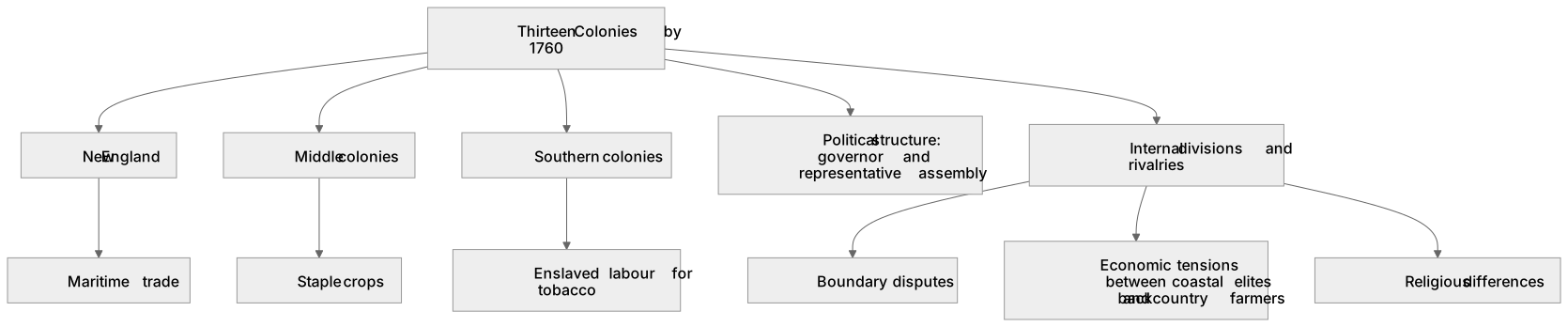
Label the diagram
Some boxes have lost their names. Pick the right name for each number.
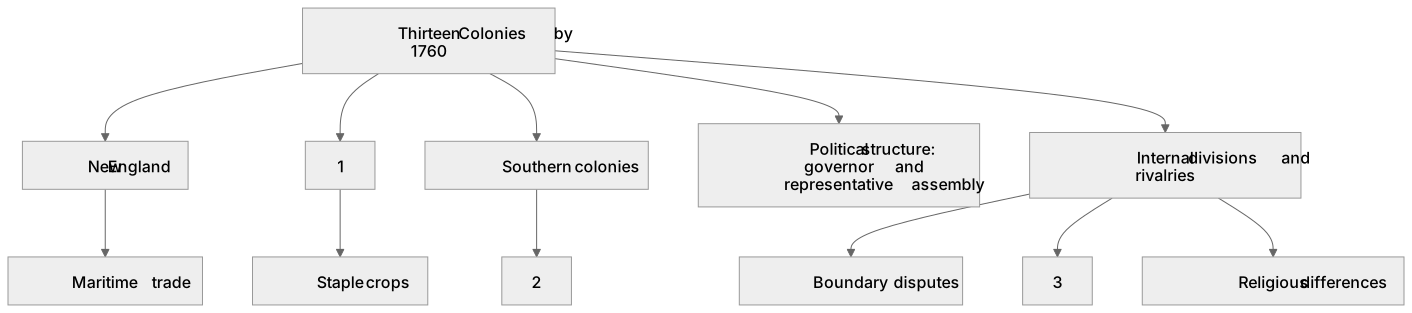
1Box 1
2Box 2
3Box 3
There is more to this lesson
The full lesson goes on to check your understanding and help you earn the marks. Create a free account to carry on, with your progress saved.
A week of Premium from your first lesson · Then the free plan continues · No card, no charge
Test your understanding of 2G The Birth of the USA, 1760–1801 – Britain and the American Colonies, 1760–1763: The Thirteen Colonies: social, economic and political characteristics; divisions and rivalries within the colonies
Active recall beats re-reading. Take an instant quiz now to test what you’ve learned and lock it into long-term memory.
A week of Premium from your first lesson · Then the free plan continues · No card, no charge