AQA · A-Level · History
Course version: 7042 · Version from Sept 2017
The Declaration of Independence: its political origins and its impact on…
Full specification wording
2G The Birth of the USA, 1760–1801 – Ending the Colonial Relationship, 1774–1776: The Declaration of Independence: its political origins and its impact on the revolutionary cause
The 1776 Declaration of Independence was the culmination of complex political origins, rooted in Enlightenment philosophy and a decade of escalating grievances against King George III.
Checked against the AQA 7042 specification (opens in a new tab) on .
- Point 4 of 4
- 4 key terms
Study notes
From the checked teaching notes for this specification point.
The idea
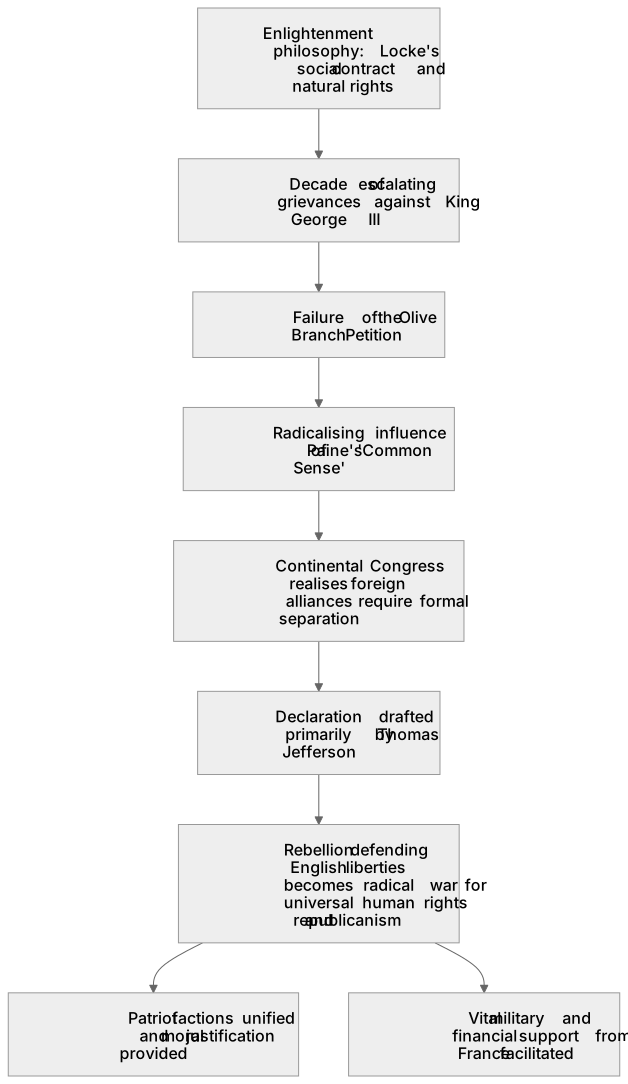
The 1776 Declaration of Independence was the culmination of complex political origins, rooted in Enlightenment philosophy and a decade of escalating grievances against King George III. Politically, it emerged from the failure of the Olive Branch Petition, the radicalising influence of Thomas Paine’s 'Common Sense', and the Continental Congress's realisation that foreign alliances required formal separation. Drafted primarily by Thomas Jefferson, the document profoundly impacted the revolutionary cause. It transformed a conservative rebellion defending traditional English liberties into a radical war for universal human rights and republicanism. This ideological shift unified the Patriot factions, provided a clear moral justification for the conflict, and crucially facilitated vital military and financial support from France.
What earns the marks
- Trace the political origins of the Declaration, including the influence of John Locke's social contract theory and natural rights philosophy.
- Analyse the role of Thomas Paine's 'Common Sense' in shifting public and political opinion towards formal independence in early 1776.
- Evaluate the impact of the Declaration in unifying the colonies and providing a coherent ideological framework for the revolutionary cause.
- Assess how the formal declaration of independence was a necessary diplomatic step to secure essential foreign intervention, particularly from France.
Common mistakes and how to put them right
Claiming the Declaration of Independence started the American Revolution.
Put it right: Armed conflict had already been ongoing for over a year (since April 1775) before independence was declared.
Assuming the Declaration immediately established a new national government.
Put it right: It only severed ties with Britain, leaving the creation of a national framework to the later Articles of Confederation.
Stating that all colonists supported the Declaration.
Put it right: A significant proportion remained Loyalists or neutral, making the revolutionary cause a deeply divisive civil conflict.
Exam tips
- Contrast the colonists' earlier demands for the 'rights of Englishmen' with the Declaration's assertion of universal 'natural rights' to show ideological progression.
- Discuss the strategic necessity of the Declaration, particularly how formal separation was required to negotiate treaties with European powers.
- Use specific grievances listed in the Declaration to demonstrate how it served as a piece of political propaganda to justify the rebellion to a global audience.
Try the lesson
The start of the 2G The Birth of the USA, 1760–1801 – Ending the Colonial Relationship, 1774–1776: The Declaration of Independence: its political origins and its impact on the revolutionary cause lesson, made from checked teaching notes for this specification point.
Have a go first
Which political pamphlet, published in January 1776, played a crucial role in shifting colonial public opinion towards supporting the Declaration of Independence?
Listen
The 1776 Declaration of Independence was the culmination of complex political origins, rooted in Enlightenment philosophy and a decade of escalating grievances against King George III. Politically, it emerged from the failure of the Olive Branch Petition, the radicalising influence of Thomas Paine’s 'Common Sense', and the Continental Congress's realisation that foreign alliances required formal separation. Drafted primarily by Thomas Jefferson, the document profoundly impacted the revolutionary cause. It transformed a conservative rebellion defending traditional English liberties into a radical war for universal human rights and republicanism. This ideological shift unified the Patriot factions, provided a clear moral justification for the conflict, and crucially facilitated vital military and financial support from France. A strong answer earns marks for these points. Trace the political origins of the Declaration, including the influence of John Locke's social contract theory and natural rights philosophy. Analyse the role of Thomas Paine's 'Common Sense' in shifting public and political opinion towards formal independence in early 1776. Evaluate the impact of the Declaration in unifying the colonies and providing a coherent ideological framework for the revolutionary cause. Assess how the formal declaration of independence was a necessary diplomatic step to secure essential foreign intervention, particularly from France. Exam tip: Contrast the colonists' earlier demands for the 'rights of Englishmen' with the Declaration's assertion of universal 'natural rights' to show ideological progression.
See it
Key words
Say what each word means before you turn the card.
Enlightenment philosophy
Try answering aloud or in your head before turning the card.
Political radicalisation
Try answering aloud or in your head before turning the card.
Diplomacy and foreign alliances
Try answering aloud or in your head before turning the card.
Ideological justification for war
Try answering aloud or in your head before turning the card.
See every definition
- Enlightenment philosophy
- A body of thought in which the political origins of the Declaration of Independence were rooted, including John Locke's social contract theory and natural rights philosophy.
- Political radicalisation
- A shift driven by the failure of the Olive Branch Petition and the radicalising influence of Thomas Paine's 'Common Sense', moving opinion towards formal independence.
- Diplomacy and foreign alliances
- A realisation by the Continental Congress that foreign alliances required formal separation, making a formal declaration a necessary diplomatic step to secure foreign intervention.
- Ideological justification for war
- The transformation of a conservative rebellion into a radical war for universal human rights and republicanism, providing a clear moral justification for the conflict.
Label the diagram
Some boxes have lost their names. Pick the right name for each number.
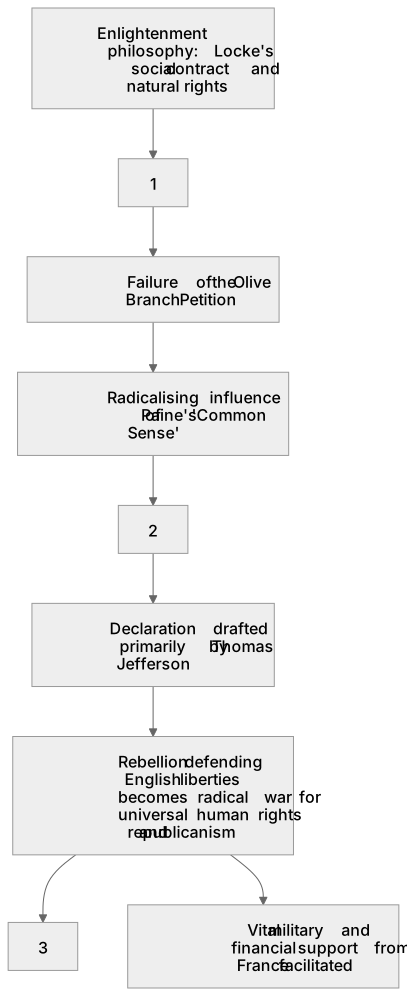
1Box 1
2Box 2
3Box 3
There is more to this lesson
The full lesson goes on to check your understanding and help you earn the marks. Create a free account to carry on, with your progress saved.
A week of Premium from your first lesson · Then the free plan continues · No card, no charge
Test your understanding of 2G The Birth of the USA, 1760–1801 – Ending the Colonial Relationship, 1774–1776: The Declaration of Independence: its political origins and its impact on the revolutionary cause
Active recall beats re-reading. Take an instant quiz now to test what you’ve learned and lock it into long-term memory.
A week of Premium from your first lesson · Then the free plan continues · No card, no charge