AQA · A-Level · History
Course version: 7042 · Version from Sept 2017
The Articles of Confederation: drafting from 1776; ratification by the…
Full specification wording
2G The Birth of the USA, 1760–1801 – Founding the Republic, 1776–1789 (A-level only): The Articles of Confederation: drafting from 1776; ratification by the thirteen states
The drafting of the Articles of Confederation began in 1776, led by John Dickinson, as the Continental Congress recognised the need for a formal national government to direct the Revolutionary War.
Checked against the AQA 7042 specification (opens in a new tab) on .
- Point 1 of 4
- 4 key terms
Study notes
From the checked teaching notes for this specification point.
The idea
The drafting of the Articles of Confederation began in 1776, led by John Dickinson, as the Continental Congress recognised the need for a formal national government to direct the Revolutionary War. The drafting process was fraught with disagreements over representation, taxation, and control of western land claims. Consequently, the final document created a deliberately weak central government, preserving the sovereignty of individual states. Ratification by all thirteen states was a protracted process, delayed primarily by disputes over western land claims. Maryland, lacking such claims, refused to ratify until states like Virginia ceded their western territories to the national government, finally allowing the Articles to take effect in 1781.
What earns the marks
- Identify John Dickinson's role in the initial 1776 drafting of the Articles of Confederation.
- Explain how the fear of a strong central authority, akin to the British Crown, influenced the creation of a weak national government.
- Analyse the reasons for the delay in ratification by the thirteen states, specifically focusing on western land claims.
- Evaluate the significance of Maryland's refusal to ratify until 1781, which forced states like Virginia to cede western lands.
Common mistakes and how to put them right
Claiming the Articles were ratified immediately in 1776.
Put it right: They were drafted in 1776 but not fully ratified by all thirteen states until 1781.
Confusing the Articles of Confederation with the US Constitution.
Put it right: The Articles created a much weaker central government without an executive branch.
Assuming all states eagerly supported the Articles.
Put it right: Ratification was heavily delayed by inter-state disputes over western territories.
Exam tips
- Use the delay in ratification to demonstrate the deep-seated mistrust between states, which foreshadows later constitutional debates.
- When discussing the drafting process, explicitly link the weak central powers to the colonists' recent experiences with British taxation and tyranny.
- Memorise the timeline: drafting began in 1776, Congress approved them in 1777, but full ratification by the thirteen states took until 1781.
Try the lesson
The start of the 2G The Birth of the USA, 1760–1801 – Founding the Republic, 1776–1789 (A-level only): The Articles of Confederation: drafting from 1776; ratification by the thirteen states lesson, made from checked teaching notes for this specification point.
Have a go first
When did the drafting of the Articles of Confederation begin, and what was required for their ratification?
Listen
The drafting of the Articles of Confederation began in 1776, led by John Dickinson, as the Continental Congress recognised the need for a formal national government to direct the Revolutionary War. The drafting process was fraught with disagreements over representation, taxation, and control of western land claims. Consequently, the final document created a deliberately weak central government, preserving the sovereignty of individual states. Ratification by all thirteen states was a protracted process, delayed primarily by disputes over western land claims. Maryland, lacking such claims, refused to ratify until states like Virginia ceded their western territories to the national government, finally allowing the Articles to take effect in 1781. A strong answer earns marks for these points. Identify John Dickinson's role in the initial 1776 drafting of the Articles of Confederation. Explain how the fear of a strong central authority, akin to the British Crown, influenced the creation of a weak national government. Analyse the reasons for the delay in ratification by the thirteen states, specifically focusing on western land claims. Evaluate the significance of Maryland's refusal to ratify until 1781, which forced states like Virginia to cede western lands. Exam tip: Use the delay in ratification to demonstrate the deep-seated mistrust between states, which foreshadows later constitutional debates.
See it
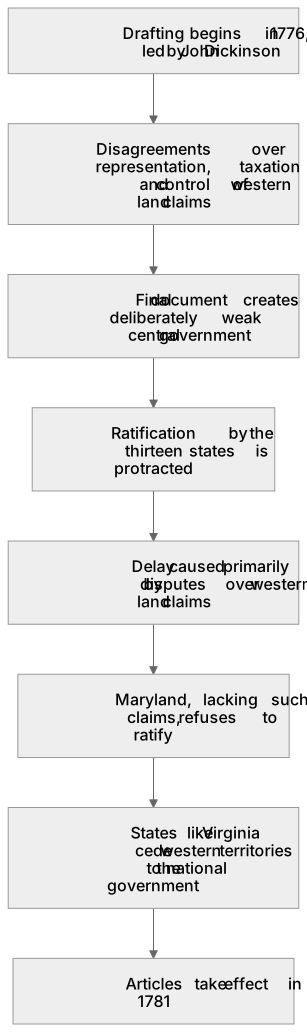
Put it in order
Put these steps in the order they happen.
- 1. Delay caused primarily by disputes over western land claims
- 2. Articles take effect in 1781
- 3. Maryland, lacking such claims, refuses to ratify
- 4. Drafting begins in 1776, led by John Dickinson
- 5. Disagreements over representation, taxation and control of western land claims
- 6. States like Virginia cede western territories to the national government
- 7. Final document creates a deliberately weak central government
- 8. Ratification by the thirteen states is protracted
Key words
Say what each word means before you turn the card.
State sovereignty versus central authority
Try answering aloud or in your head before turning the card.
The impact of the Revolutionary War on governance
Try answering aloud or in your head before turning the card.
Territorial expansion and land disputes
Try answering aloud or in your head before turning the card.
Constitutional development
Try answering aloud or in your head before turning the card.
See every definition
- State sovereignty versus central authority
- The final document created a deliberately weak central government, preserving the sovereignty of individual states.
- The impact of the Revolutionary War on governance
- The Continental Congress recognised the need for a formal national government to direct the Revolutionary War.
- Territorial expansion and land disputes
- Ratification was delayed primarily by disputes over western land claims, and Maryland refused to ratify until states like Virginia ceded their western territories to the national government.
- Constitutional development
- The drafting of the Articles of Confederation began in 1776, and the Articles finally took effect in 1781.
Label the diagram
Some boxes have lost their names. Pick the right name for each number.
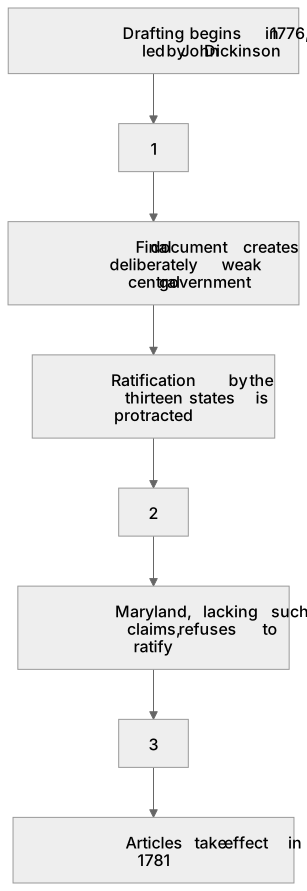
1Box 1
2Box 2
3Box 3
There is more to this lesson
The full lesson goes on to check your understanding and help you earn the marks. Create a free account to carry on, with your progress saved.
A week of Premium from your first lesson · Then the free plan continues · No card, no charge
Test your understanding of 2G The Birth of the USA, 1760–1801 – Founding the Republic, 1776–1789 (A-level only): The Articles of Confederation: drafting from 1776; ratification by the thirteen states
Active recall beats re-reading. Take an instant quiz now to test what you’ve learned and lock it into long-term memory.
A week of Premium from your first lesson · Then the free plan continues · No card, no charge