AQA · A-Level · History
Course version: 7042 · Version from Sept 2017
Absolutism and the structure of the Ancien Régime: Louis XVI as King;…
Full specification wording
2H France in Revolution, 1774–1815 (A-level only) – 1795 The origins of the French Revolution, 1774–1789: Absolutism and the structure of the Ancien Régime: Louis XVI as King; government; social divisions; privileges and burdens; strengths and weaknesses
The Ancien Régime was structured around absolute monarchy, where Louis XVI held supreme authority by divine right, though his power was practically limited by overlapping jurisdictions and parlements.
Checked against the AQA 7042 specification (opens in a new tab) on .
- Point 1 of 4
- 4 key terms
Study notes
From the checked teaching notes for this specification point.
The idea
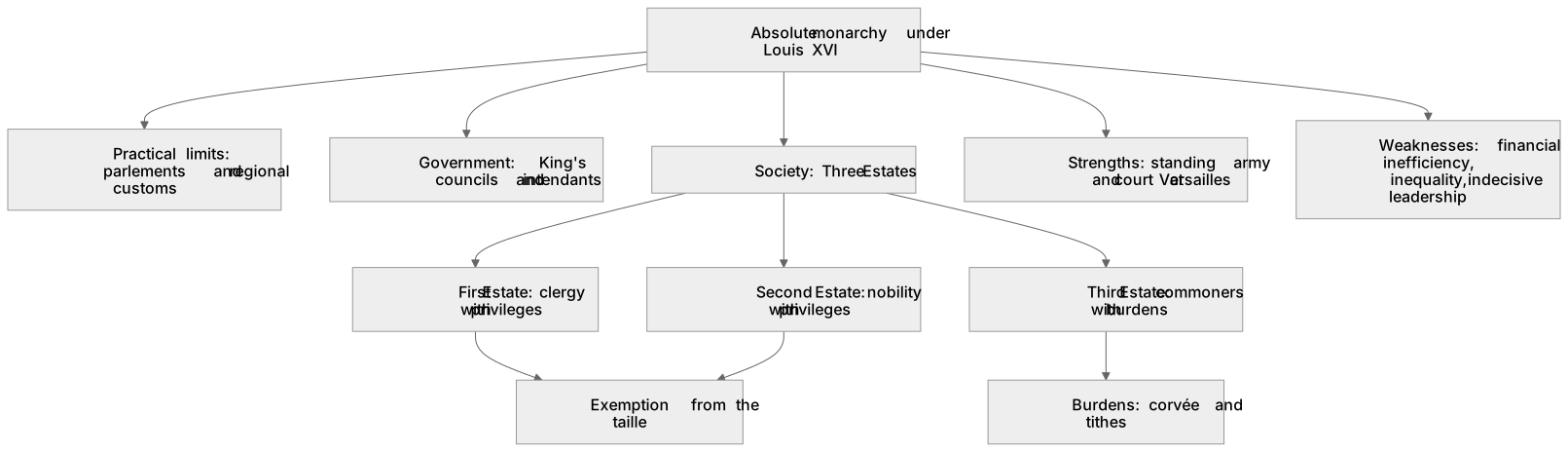
The Ancien Régime was structured around absolute monarchy, where Louis XVI held supreme authority by divine right, though his power was practically limited by overlapping jurisdictions and parlements. Government administration was complex and inefficient, relying on intendants and a chaotic legal system. Society was rigidly divided into three Estates: the First (clergy) and Second (nobility) enjoyed vast privileges, including exemption from the taille, while the Third Estate (commoners) bore heavy tax burdens like the corvée and tithes. While the system's strengths included a powerful standing army and a rich cultural court at Versailles, its fatal weaknesses were systemic financial inefficiency, deep social inequality, and Louis XVI's indecisive leadership during crises.
What earns the marks
- Explain the theoretical nature of absolutism versus the practical limitations imposed by parlements and regional customs.
- Assess Louis XVI's personal characteristics, noting his well-meaning nature but fatal indecisiveness in matters of state.
- Detail the structure of the government, including the roles of the King's councils and the intendants in the provinces.
- Analyse the social divisions of the Three Estates, contrasting the tax exemptions of the privileged orders with the heavy direct and indirect taxation on the Third Estate.
- Evaluate the strengths of the Ancien Régime, such as its cultural dominance and military power, against weaknesses like administrative chaos and financial vulnerability.
Common mistakes and how to put them right
Claiming Louis XVI was a tyrant who ruled with unlimited practical power.
Put it right: Acknowledge that while his power was theoretically absolute, it was heavily restricted by parlements, entrenched noble privileges, and regional laws.
Stating the Third Estate consisted only of poor peasants.
Put it right: Recognise that the Third Estate was highly diverse, encompassing wealthy bourgeoisie, urban workers (sans-culottes), and rural peasantry.
Assuming the First and Second Estates paid absolutely no taxes.
Put it right: Note that while they were exempt from the main direct tax (the taille), they did pay some indirect taxes and occasionally agreed to voluntary contributions (don gratuit).
Exam tips
- Use specific terms like 'taille', 'corvée', and 'lettres de cachet' to demonstrate precise knowledge of Ancien Régime burdens and royal powers.
- When evaluating Louis XVI, balance his personal flaws with the systemic, inherited weaknesses of the government structure he was forced to manage.
- Link the social inequalities directly to the financial weaknesses of the state, showing how the exemption of the wealthiest hindered economic stability.
Try the lesson
The start of the 2H France in Revolution, 1774–1815 (A-level only) – 1795 The origins of the French Revolution, 1774–1789: Absolutism and the structure of the Ancien Régime: Louis XVI as King; government; social divisions; privileges and burdens; strengths and weaknesses lesson, made from checked teaching notes for this specification point.
Have a go first
Which of the following accurately describes a primary financial burden placed on the Third Estate under the Ancien Régime?
Listen
The Ancien Régime was structured around absolute monarchy, where Louis XVI held supreme authority by divine right, though his power was practically limited by overlapping jurisdictions and parlements. Government administration was complex and inefficient, relying on intendants and a chaotic legal system. Society was rigidly divided into three Estates: the First (clergy) and Second (nobility) enjoyed vast privileges, including exemption from the taille, while the Third Estate (commoners) bore heavy tax burdens like the corvée and tithes. While the system's strengths included a powerful standing army and a rich cultural court at Versailles, its fatal weaknesses were systemic financial inefficiency, deep social inequality, and Louis XVI's indecisive leadership during crises. A strong answer earns marks for these points. Explain the theoretical nature of absolutism versus the practical limitations imposed by parlements and regional customs. Assess Louis XVI's personal characteristics, noting his well-meaning nature but fatal indecisiveness in matters of state. Detail the structure of the government, including the roles of the King's councils and the intendants in the provinces. Analyse the social divisions of the Three Estates, contrasting the tax exemptions of the privileged orders with the heavy direct and indirect taxation on the Third Estate. A common slip: Claiming Louis XVI was a tyrant who ruled with unlimited practical power. Instead, Acknowledge that while his power was theoretically absolute, it was heavily restricted by parlements, entrenched noble privileges, and regional laws. Exam tip: Use specific terms like 'taille', 'corvée', and 'lettres de cachet' to demonstrate precise knowledge of Ancien Régime burdens and royal powers.
See it
Key words
Say what each word means before you turn the card.
Social inequality and class division
Try answering aloud or in your head before turning the card.
The nature and limits of absolute power
Try answering aloud or in your head before turning the card.
Administrative and financial inefficiency
Try answering aloud or in your head before turning the card.
The role of the individual in history
Try answering aloud or in your head before turning the card.
See every definition
- Social inequality and class division
- Society was rigidly divided into three Estates, with the First and Second Estates enjoying vast privileges while the Third Estate bore heavy tax burdens.
- The nature and limits of absolute power
- Louis XVI held supreme authority by divine right, though his power was practically limited by overlapping jurisdictions and parlements.
- Administrative and financial inefficiency
- Government administration was complex and inefficient, relying on intendants and a chaotic legal system, with systemic financial inefficiency as a fatal weakness.
- The role of the individual in history
- Louis XVI's indecisive leadership during crises was among the fatal weaknesses of the Ancien Régime.
Label the diagram
Some boxes have lost their names. Pick the right name for each number.
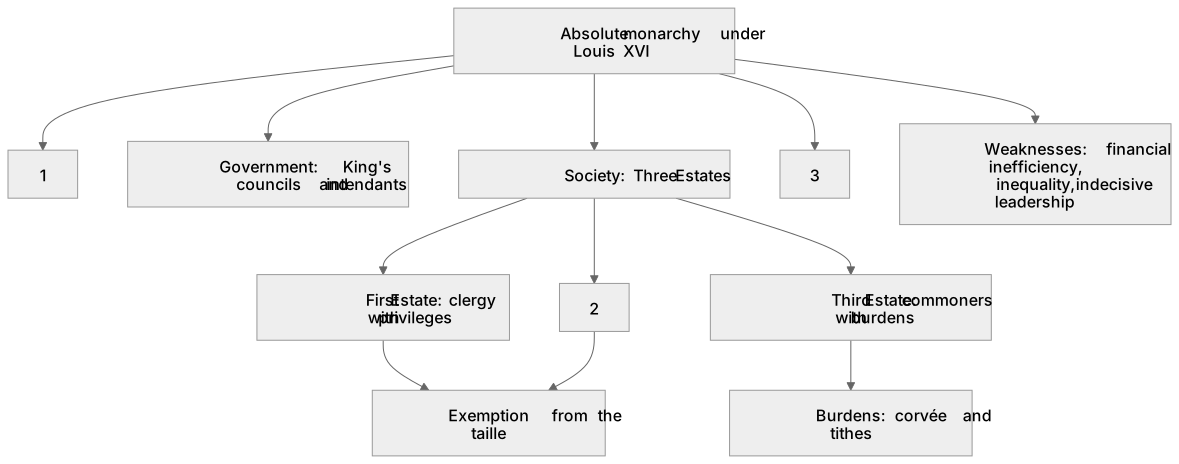
1Box 1
2Box 2
3Box 3
There is more to this lesson
The full lesson goes on to check your understanding and help you earn the marks. Create a free account to carry on, with your progress saved.
A week of Premium from your first lesson · Then the free plan continues · No card, no charge
Test your understanding of 2H France in Revolution, 1774–1815 (A-level only) – 1795 The origins of the French Revolution, 1774–1789: Absolutism and the structure of the Ancien Régime: Louis XVI as King; government; social divisions; privileges and burdens; strengths and weaknesses
Active recall beats re-reading. Take an instant quiz now to test what you’ve learned and lock it into long-term memory.
A week of Premium from your first lesson · Then the free plan continues · No card, no charge