AQA · A-Level · History
Course version: 7042 · Version from Sept 2017
The collapse of the Empire: the first Peace of Paris; the 100 days;…
Full specification wording
2H France in Revolution, 1774–1815 (A-level only) – The impact of Napoleon's rule on Europe, 1799–1815: The collapse of the Empire: the first Peace of Paris; the 100 days; Napoleon's abdication and second Peace of Paris; treatment of France by the Vienna settlement; the condition of France in 1815; Napoleon's reputation and legacy
The collapse of Napoleon's Empire culminated in his 1814 abdication and the lenient First Peace of Paris, restoring the Bourbons.
Checked against the AQA 7042 specification (opens in a new tab) on .
- Point 4 of 4
Study notes
From the checked teaching notes for this specification point.
The idea
The collapse of Napoleon's Empire culminated in his 1814 abdication and the lenient First Peace of Paris, restoring the Bourbons. His dramatic return during the 100 Days ended at Waterloo, forcing a second abdication. Consequently, the Second Peace of Paris was harsher, imposing indemnities and occupation. The Vienna settlement sought to contain France by establishing strong buffer states. By 1815, the condition of France was dire, suffering economic exhaustion and deep political divisions. Despite this, Napoleon's reputation and legacy endured, romanticised as a tragic hero and a modernising force whose legal and administrative reforms permanently shaped European institutions.
What earns the marks
- Contrast the lenient terms of the First Peace of Paris with the punitive measures of the Second Peace of Paris.
- Analyse the political and military significance of the 100 Days and Napoleon's final abdication.
- Evaluate the treatment of France by the Vienna settlement, focusing on the creation of buffer states to prevent future French aggression.
- Assess the economic, social, and political condition of France in 1815 following decades of continuous warfare.
- Examine the dual nature of Napoleon's legacy, balancing his authoritarianism against his enduring administrative and legal reforms.
Common mistakes and how to put them right
Confusing the terms of the First and Second Peace of Paris.
Put it right: Clearly distinguish that the First Peace (1814) was lenient to support the restored Bourbons, while the Second Peace (1815) imposed heavy indemnities and border reductions after the 100 Days.
Assuming the Congress of Vienna sought to completely destroy France.
Put it right: Explain that the Vienna settlement aimed for a balance of power, containing France with buffer states rather than dismantling it entirely.
Viewing Napoleon's legacy solely in terms of military defeat.
Put it right: Acknowledge his lasting civilian legacy, including the Napoleonic Code, administrative centralisation, and the spread of revolutionary ideals across Europe.
Exam tips
- Compare the condition of France in 1815 with its condition in 1799 to effectively evaluate the overall impact of Napoleon's rule.
- Use the events of the 100 Days to explain why the Allies adopted a much harsher stance towards France in the Second Peace of Paris.
- When discussing Napoleon's reputation, reference the 'Napoleonic Legend' that developed during his exile on St Helena.
Try the lesson
The start of the 2H France in Revolution, 1774–1815 (A-level only) – The impact of Napoleon's rule on Europe, 1799–1815: The collapse of the Empire: the first Peace of Paris; the 100 days; Napoleon's abdication and second Peace of Paris; treatment of France by the Vienna settlement; the condition of France in 1815; Napoleon's reputation and legacy lesson, made from checked teaching notes for this specification point.
Have a go first
Which event directly initiated the period known as the '100 days' during the collapse of Napoleon's Empire?
Listen
The collapse of Napoleon's Empire culminated in his 1814 abdication and the lenient First Peace of Paris, restoring the Bourbons. His dramatic return during the 100 Days ended at Waterloo, forcing a second abdication. Consequently, the Second Peace of Paris was harsher, imposing indemnities and occupation. The Vienna settlement sought to contain France by establishing strong buffer states. By 1815, the condition of France was dire, suffering economic exhaustion and deep political divisions. Despite this, Napoleon's reputation and legacy endured, romanticised as a tragic hero and a modernising force whose legal and administrative reforms permanently shaped European institutions. A strong answer earns marks for these points. Contrast the lenient terms of the First Peace of Paris with the punitive measures of the Second Peace of Paris. Analyse the political and military significance of the 100 Days and Napoleon's final abdication. Evaluate the treatment of France by the Vienna settlement, focusing on the creation of buffer states to prevent future French aggression. Assess the economic, social, and political condition of France in 1815 following decades of continuous warfare. A common slip: Confusing the terms of the First and Second Peace of Paris. Instead, Clearly distinguish that the First Peace (1814) was lenient to support the restored Bourbons, while the Second Peace (1815) imposed heavy indemnities and border reductions after the 100 Days. Exam tip: Compare the condition of France in 1815 with its condition in 1799 to effectively evaluate the overall impact of Napoleon's rule.
See it
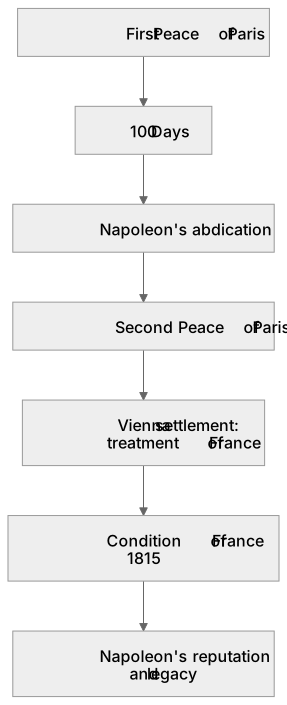
Put it in order
Put these steps in the order they happen.
- 1. Napoleon's reputation and legacy
- 2. Condition of France in 1815
- 3. Napoleon's abdication
- 4. Vienna settlement: treatment of France
- 5. First Peace of Paris
- 6. 100 Days
- 7. Second Peace of Paris
Label the diagram
Some boxes have lost their names. Pick the right name for each number.
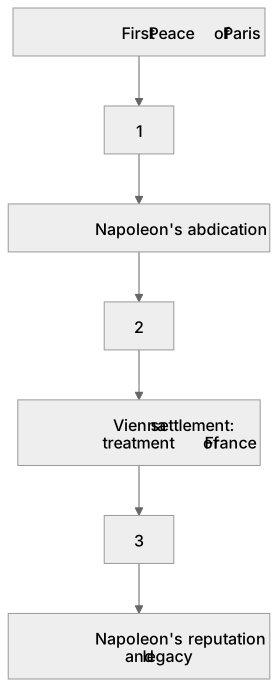
1Box 1
2Box 2
3Box 3
There is more to this lesson
The full lesson goes on to check your understanding and help you earn the marks. Create a free account to carry on, with your progress saved.
A week of Premium from your first lesson · Then the free plan continues · No card, no charge
Test your understanding of 2H France in Revolution, 1774–1815 (A-level only) – The impact of Napoleon's rule on Europe, 1799–1815: The collapse of the Empire: the first Peace of Paris; the 100 days; Napoleon's abdication and second Peace of Paris; treatment of France by the Vienna settlement; the condition of France in 1815; Napoleon's reputation and legacy
Active recall beats re-reading. Take an instant quiz now to test what you’ve learned and lock it into long-term memory.
A week of Premium from your first lesson · Then the free plan continues · No card, no charge