AQA · A-Level · History
Course version: 7042 · Version from Sept 2017
A Nation Divided, c1845–1877 – Early Reconstruction, 1865–1867 (A-level…
Full specification wording
2J America: A Nation Divided, c1845–1877 – Early Reconstruction, 1865–1867 (A-level only): Planning for the future after the war: the impact of the Emancipation Proclamation; Lincoln’s aims; the approach to preparing for post-war reconstruction
Planning for the post-war future began well before the Civil War ended, fundamentally shaped by the 1863 Emancipation Proclamation.
Checked against the AQA 7042 specification (opens in a new tab) on .
- Point 1 of 4
- 3 key terms
Study notes
From the checked teaching notes for this specification point.
The idea
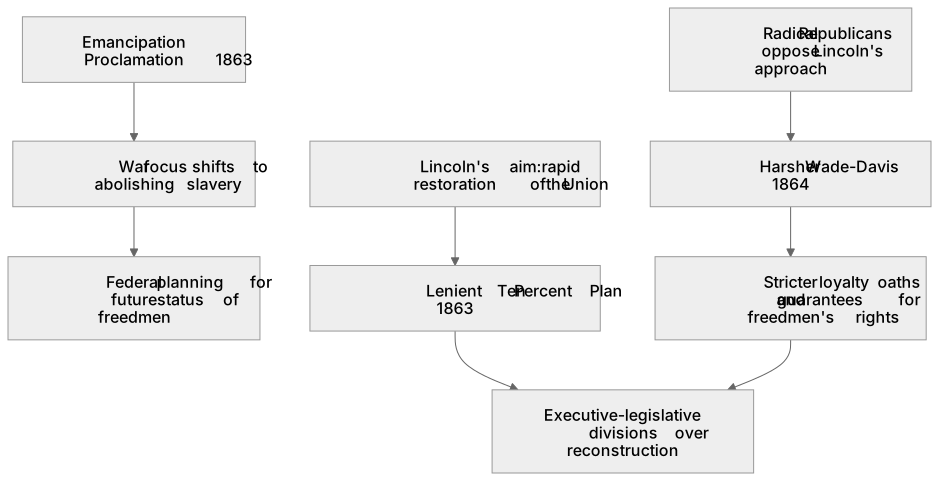
Planning for the post-war future began well before the Civil War ended, fundamentally shaped by the 1863 Emancipation Proclamation. This executive order shifted the war's focus from merely preserving the Union to abolishing slavery, forcing the federal government to consider the future status of four million freedmen. Lincoln’s primary aim was the rapid restoration of the Union, demonstrated by his lenient 1863 Ten Percent Plan, which required only a fraction of voters to swear loyalty. However, his approach to preparing for reconstruction faced fierce opposition from Radical Republicans, who passed the harsher Wade-Davis Bill in 1864, demanding stricter loyalty oaths and stronger guarantees for freedmen's rights, highlighting early executive-legislative divisions.
What earns the marks
- Explain how the Emancipation Proclamation transformed the war's objectives and necessitated federal planning for the integration of freedmen.
- Analyse Lincoln's Ten Percent Plan (1863) as evidence of his lenient aims to quickly restore Southern states to the Union without punitive measures.
- Evaluate the Radical Republicans' opposition to Lincoln's approach, specifically their demand for harsher terms and civil rights protections.
- Assess the significance of the Wade-Davis Bill (1864) and Lincoln's pocket veto in demonstrating the ideological split over post-war reconstruction planning.
Common mistakes and how to put them right
Assuming the Emancipation Proclamation freed all enslaved people immediately.
Put it right: It only applied to states in active rebellion, not the loyal border states.
Claiming Lincoln and Congress were united in their reconstruction plans.
Put it right: They were deeply divided, as clearly shown by the Wade-Davis Bill veto.
Stating that Lincoln's primary aim in 1864 was punishing the South.
Put it right: His actual goal was rapid reconciliation and the swift restoration of the Union.
Exam tips
- Contrast Lincoln's Ten Percent Plan with the Wade-Davis Bill to illustrate the tension between the executive and legislative branches regarding reconstruction.
- Use the Emancipation Proclamation as a turning point that made the abolition of slavery an unavoidable condition of post-war reconstruction planning.
- When discussing Lincoln's aims, reference his Second Inaugural Address ('with malice toward none') to support arguments about his lenient approach.
Try the lesson
The start of the 2J America: A Nation Divided, c1845–1877 – Early Reconstruction, 1865–1867 (A-level only): Planning for the future after the war: the impact of the Emancipation Proclamation; Lincoln’s aims; the approach to preparing for post-war reconstruction lesson, made from checked teaching notes for this specification point.
Have a go first
What was Abraham Lincoln's primary aim when formulating his initial plans for post-war Reconstruction?
Listen
Planning for the post-war future began well before the Civil War ended, fundamentally shaped by the 1863 Emancipation Proclamation. This executive order shifted the war's focus from merely preserving the Union to abolishing slavery, forcing the federal government to consider the future status of four million freedmen. Lincoln’s primary aim was the rapid restoration of the Union, demonstrated by his lenient 1863 Ten Percent Plan, which required only a fraction of voters to swear loyalty. However, his approach to preparing for reconstruction faced fierce opposition from Radical Republicans, who passed the harsher Wade-Davis Bill in 1864, demanding stricter loyalty oaths and stronger guarantees for freedmen's rights, highlighting early executive-legislative divisions. A strong answer earns marks for these points. Explain how the Emancipation Proclamation transformed the war's objectives and necessitated federal planning for the integration of freedmen. Analyse Lincoln's Ten Percent Plan (1863) as evidence of his lenient aims to quickly restore Southern states to the Union without punitive measures. Evaluate the Radical Republicans' opposition to Lincoln's approach, specifically their demand for harsher terms and civil rights protections. Assess the significance of the Wade-Davis Bill (1864) and Lincoln's pocket veto in demonstrating the ideological split over post-war reconstruction planning. Exam tip: Contrast Lincoln's Ten Percent Plan with the Wade-Davis Bill to illustrate the tension between the executive and legislative branches regarding reconstruction.
See it
Key words
Say what each word means before you turn the card.
Presidential versus Congressional power
Try answering aloud or in your head before turning the card.
Civil Rights and emancipation
Try answering aloud or in your head before turning the card.
Reconciliation versus Retribution
Try answering aloud or in your head before turning the card.
See every definition
- Presidential versus Congressional power
- The early executive-legislative divisions over reconstruction planning, shown by Lincoln's lenient approach facing fierce opposition from Radical Republicans in Congress.
- Civil Rights and emancipation
- The 1863 Emancipation Proclamation shifted the war's focus to abolishing slavery and forced the federal government to consider the future status of freedmen.
- Reconciliation versus Retribution
- Lincoln's primary aim was the rapid restoration of the Union through lenient measures, rather than punitive measures against the South.
Label the diagram
Some boxes have lost their names. Pick the right name for each number.
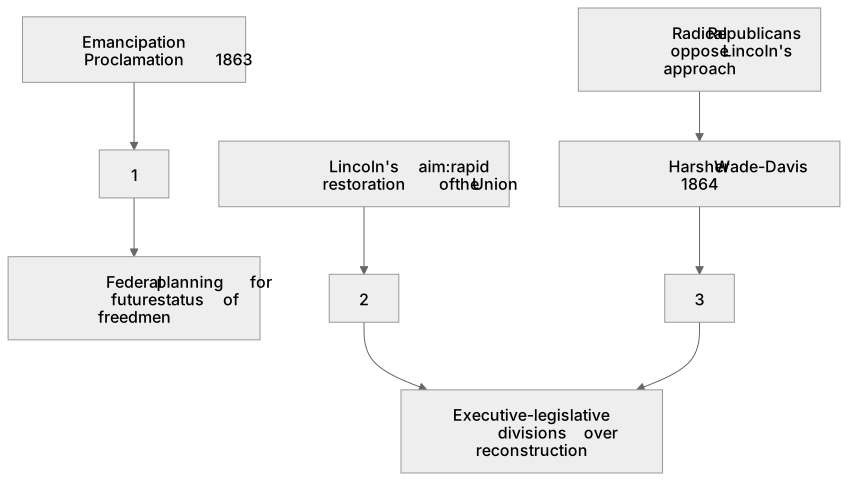
1Box 1
2Box 2
3Box 3
There is more to this lesson
The full lesson goes on to check your understanding and help you earn the marks. Create a free account to carry on, with your progress saved.
A week of Premium from your first lesson · Then the free plan continues · No card, no charge
Test your understanding of 2J America: A Nation Divided, c1845–1877 – Early Reconstruction, 1865–1867 (A-level only): Planning for the future after the war: the impact of the Emancipation Proclamation; Lincoln’s aims; the approach to preparing for post-war reconstruction
Active recall beats re-reading. Take an instant quiz now to test what you’ve learned and lock it into long-term memory.
A week of Premium from your first lesson · Then the free plan continues · No card, no charge