AQA · A-Level · History
Course version: 7042 · Version from Sept 2017
A Nation Divided, c1845–1877 – Early Reconstruction, 1865–1867 (A-level…
Full specification wording
2J America: A Nation Divided, c1845–1877 – Early Reconstruction, 1865–1867 (A-level only): The Fourteenth Amendment: Thaddeus Stevens; Radical republicans; the struggle to pass the amendment; the Reconstruction Acts
The Fourteenth Amendment (1868) enshrined birthright citizenship and equal protection under the law, fundamentally altering the US Constitution.
Checked against the AQA 7042 specification (opens in a new tab) on .
- Point 3 of 4
Study notes
From the checked teaching notes for this specification point.
The idea
The Fourteenth Amendment (1868) enshrined birthright citizenship and equal protection under the law, fundamentally altering the US Constitution. Radical Republicans, led in the House by the uncompromising Thaddeus Stevens, championed this legislation to dismantle the Black Codes and secure civil rights for freedmen. The struggle to pass the amendment was fierce, facing intense opposition from President Johnson and Southern states. Consequently, Congress passed the Reconstruction Acts (1867) over Johnson's veto, dividing the South into five military districts and making ratification of the Fourteenth Amendment a strict precondition for former Confederate states to be readmitted to the Union.
What earns the marks
- Explain the core provisions of the Fourteenth Amendment, specifically birthright citizenship and equal protection under the law.
- Analyse the role of Thaddeus Stevens and the Radical Republicans in driving the civil rights agenda against executive opposition.
- Evaluate the political struggle to pass the amendment, including Johnson's 'Swing Around the Circle' campaign against it.
- Assess the impact of the Reconstruction Acts of 1867, noting the imposition of military rule and the requirement of amendment ratification for state readmission.
Common mistakes and how to put them right
Confusing the Thirteenth, Fourteenth, and Fifteenth Amendments.
Put it right: The Fourteenth guarantees citizenship and equal protection, not the abolition of slavery or voting rights.
Assuming the Fourteenth Amendment was easily passed.
Put it right: It required the Reconstruction Acts to force Southern ratification.
Underestimating Thaddeus Stevens' influence.
Put it right: He was not just a participant but the primary architect of Radical Reconstruction in the House of Representatives.
Exam tips
- Use the Reconstruction Acts to demonstrate how Radical Republicans bypassed presidential obstruction to enforce their agenda.
- Link Thaddeus Stevens' ideological commitment to racial equality with the pragmatic political need to secure Republican dominance in the South.
- When discussing the struggle to pass the amendment, explicitly mention the two-thirds majority required to override presidential vetoes.
Try the lesson
The start of the 2J America: A Nation Divided, c1845–1877 – Early Reconstruction, 1865–1867 (A-level only): The Fourteenth Amendment: Thaddeus Stevens; Radical republicans; the struggle to pass the amendment; the Reconstruction Acts lesson, made from checked teaching notes for this specification point.
Have a go first
Which political faction, led by figures such as Thaddeus Stevens, was the primary driving force behind the drafting and passage of the Fourteenth Amendment?
Listen
The Fourteenth Amendment (1868) enshrined birthright citizenship and equal protection under the law, fundamentally altering the US Constitution. Radical Republicans, led in the House by the uncompromising Thaddeus Stevens, championed this legislation to dismantle the Black Codes and secure civil rights for freedmen. The struggle to pass the amendment was fierce, facing intense opposition from President Johnson and Southern states. Consequently, Congress passed the Reconstruction Acts (1867) over Johnson's veto, dividing the South into five military districts and making ratification of the Fourteenth Amendment a strict precondition for former Confederate states to be readmitted to the Union. A strong answer earns marks for these points. Explain the core provisions of the Fourteenth Amendment, specifically birthright citizenship and equal protection under the law. Analyse the role of Thaddeus Stevens and the Radical Republicans in driving the civil rights agenda against executive opposition. Evaluate the political struggle to pass the amendment, including Johnson's 'Swing Around the Circle' campaign against it. Assess the impact of the Reconstruction Acts of 1867, noting the imposition of military rule and the requirement of amendment ratification for state readmission. Exam tip: Use the Reconstruction Acts to demonstrate how Radical Republicans bypassed presidential obstruction to enforce their agenda.
See it
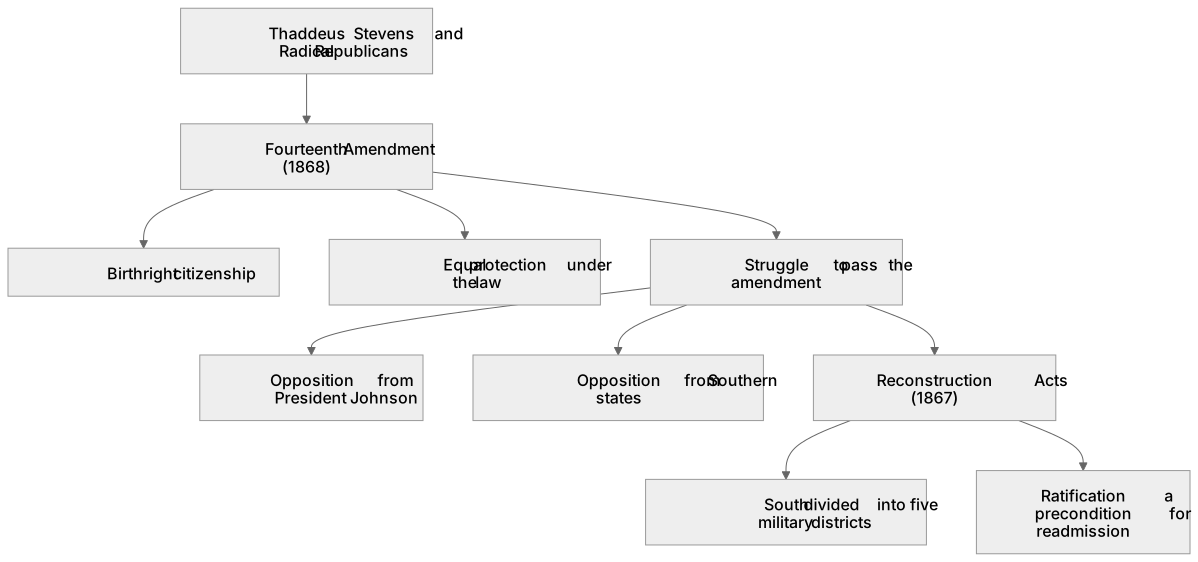
Label the diagram
Some boxes have lost their names. Pick the right name for each number.
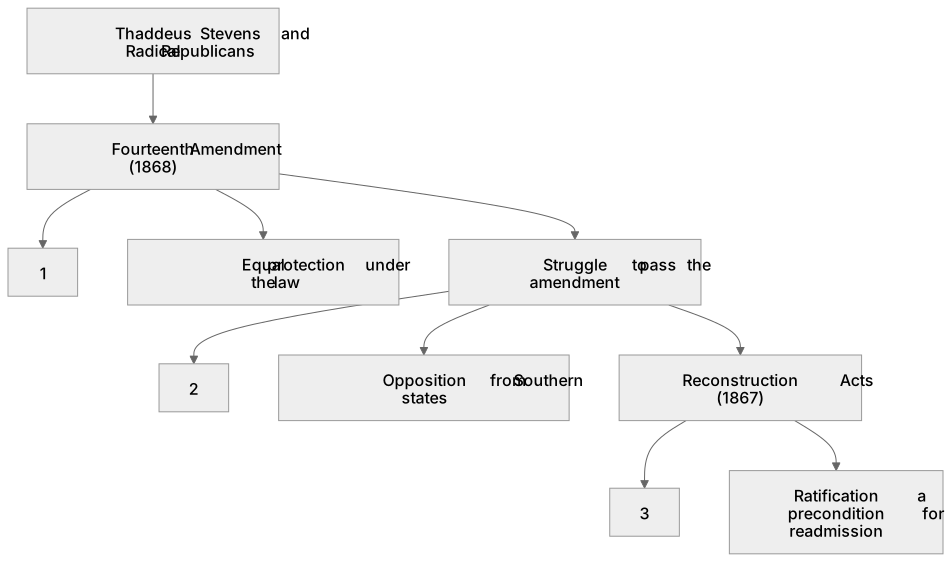
1Box 1
2Box 2
3Box 3
There is more to this lesson
The full lesson goes on to check your understanding and help you earn the marks. Create a free account to carry on, with your progress saved.
A week of Premium from your first lesson · Then the free plan continues · No card, no charge
Test your understanding of 2J America: A Nation Divided, c1845–1877 – Early Reconstruction, 1865–1867 (A-level only): The Fourteenth Amendment: Thaddeus Stevens; Radical republicans; the struggle to pass the amendment; the Reconstruction Acts
Active recall beats re-reading. Take an instant quiz now to test what you’ve learned and lock it into long-term memory.
A week of Premium from your first lesson · Then the free plan continues · No card, no charge