AQA · A-Level · History
Course version: 7042 · Version from Sept 2017
A Nation Divided, c1845–1877 – North and South in c1845: The American…
Full specification wording
2J America: A Nation Divided, c1845–1877 – North and South in c1845: The American Republic: the federal government and its relationships with the states; the role of the president; the US constitution and the Supreme Court
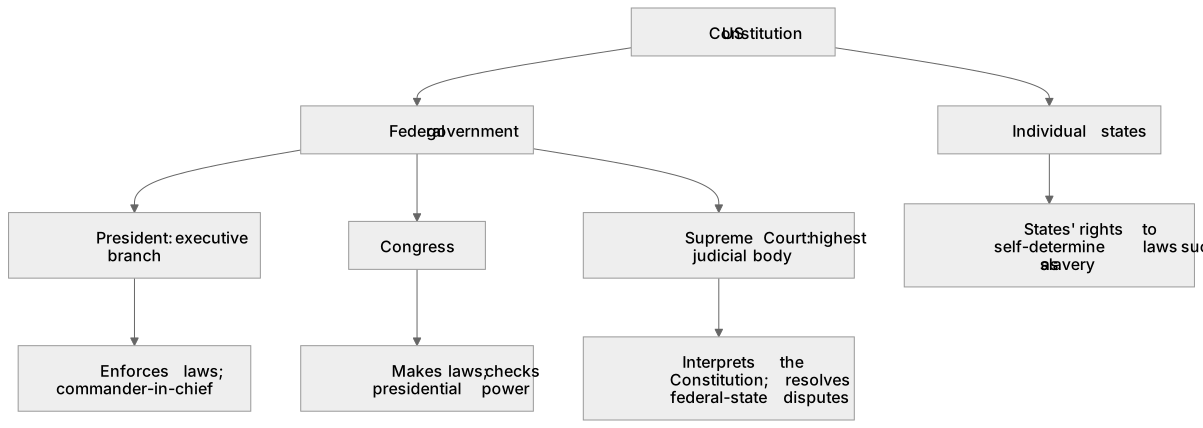
The 1787 US Constitution established a federal republic, dividing power between the national government and individual states.
Checked against the AQA 7042 specification (opens in a new tab) on .
- Point 1 of 4
- 3 key terms
Study notes
From the checked teaching notes for this specification point.
The idea
The 1787 US Constitution established a federal republic, dividing power between the national government and individual states. This relationship was frequently tense, particularly regarding states' rights to self-determine laws such as slavery. The federal government features three branches to ensure checks and balances. The President leads the executive branch, acting as commander-in-chief and enforcing laws, though Congress checks this power. The Constitution serves as the supreme law, outlining these powers and protecting liberties. The Supreme Court, the highest judicial body, interprets the Constitution and resolves disputes between states and the federal government, shaping national policy through landmark rulings.
What earns the marks
- Explain the division of power between federal and state governments (federalism) as outlined in the Tenth Amendment.
- Analyse the role of the President as the head of the executive branch, including their veto power and role as commander-in-chief.
- Evaluate the US Constitution as a framework designed to prevent tyranny through a system of checks and balances.
- Assess the Supreme Court's function in judicial review and its authority to interpret the Constitution in federal-state disputes.
Common mistakes and how to put them right
Assuming the federal government had absolute power over states in 1845.
Put it right: States retained significant autonomy, leading to intense states' rights debates.
Confusing the roles of the three branches.
Put it right: The President enforces laws, Congress makes them, and the Supreme Court interprets them.
Believing the Constitution explicitly resolved the issue of slavery.
Put it right: The Constitution compromised on slavery, leaving it as a source of future conflict.
Exam tips
- Use the concept of 'checks and balances' to explain why Presidents could not easily impose their will on the nation.
- Reference the Tenth Amendment when discussing Southern arguments for states' rights and the protection of slavery.
- Link the structure of the Supreme Court to its ability to make binding decisions on constitutional crises during this period.
Try the lesson
The start of the 2J America: A Nation Divided, c1845–1877 – North and South in c1845: The American Republic: the federal government and its relationships with the states; the role of the president; the US constitution and the Supreme Court lesson, made from checked teaching notes for this specification point.
Have a go first
By 1845, which institution exercised the power of judicial review to interpret the US Constitution and resolve disputes between the federal government and the states?
Listen
The 1787 US Constitution established a federal republic, dividing power between the national government and individual states. This relationship was frequently tense, particularly regarding states' rights to self-determine laws such as slavery. The federal government features three branches to ensure checks and balances. The President leads the executive branch, acting as commander-in-chief and enforcing laws, though Congress checks this power. The Constitution serves as the supreme law, outlining these powers and protecting liberties. The Supreme Court, the highest judicial body, interprets the Constitution and resolves disputes between states and the federal government, shaping national policy through landmark rulings. A strong answer earns marks for these points. Explain the division of power between federal and state governments (federalism) as outlined in the Tenth Amendment. Analyse the role of the President as the head of the executive branch, including their veto power and role as commander-in-chief. Evaluate the US Constitution as a framework designed to prevent tyranny through a system of checks and balances. Assess the Supreme Court's function in judicial review and its authority to interpret the Constitution in federal-state disputes. A common slip: Assuming the federal government had absolute power over states in 1845. Instead, states retained significant autonomy, leading to intense states' rights debates. Exam tip: Use the concept of 'checks and balances' to explain why Presidents could not easily impose their will on the nation.
See it
Key words
Say what each word means before you turn the card.
Federalism
Try answering aloud or in your head before turning the card.
Checks and balances
Try answering aloud or in your head before turning the card.
Constitutional interpretation
Try answering aloud or in your head before turning the card.
See every definition
- Federalism
- The division of power between the national government and individual states, as outlined in the Tenth Amendment.
- Checks and balances
- A system of three branches designed to prevent tyranny by checking each other's power.
- Constitutional interpretation
- The Supreme Court's authority to interpret the Constitution and resolve disputes between states and the federal government.
Label the diagram
Some boxes have lost their names. Pick the right name for each number.
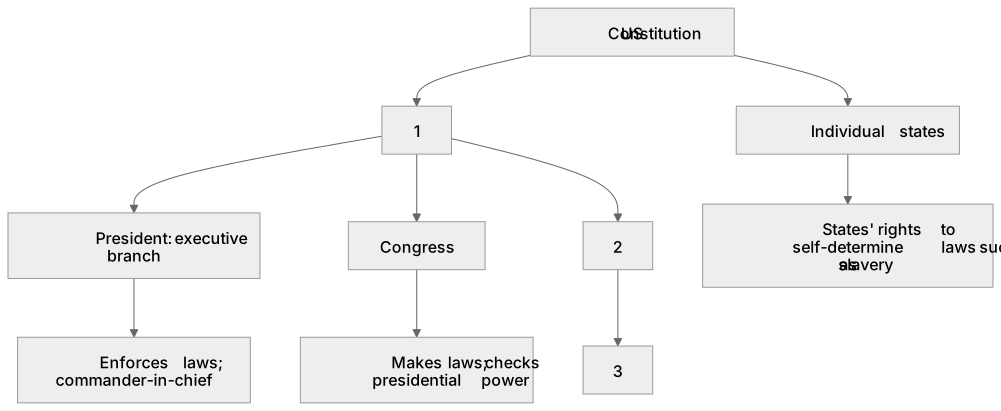
1Box 1
2Box 2
3Box 3
There is more to this lesson
The full lesson goes on to check your understanding and help you earn the marks. Create a free account to carry on, with your progress saved.
A week of Premium from your first lesson · Then the free plan continues · No card, no charge
Test your understanding of 2J America: A Nation Divided, c1845–1877 – North and South in c1845: The American Republic: the federal government and its relationships with the states; the role of the president; the US constitution and the Supreme Court
Active recall beats re-reading. Take an instant quiz now to test what you’ve learned and lock it into long-term memory.
A week of Premium from your first lesson · Then the free plan continues · No card, no charge