AQA · A-Level · History
Course version: 7042 · Version from Sept 2017
A Nation Divided, c1845–1877 – North and South in c1845: The Southern…
Full specification wording
2J America: A Nation Divided, c1845–1877 – North and South in c1845: The Southern states: social, economic and political characteristics
In c1845, the Southern states were defined by an agrarian economy heavily reliant on enslaved labour and cash crops, particularly 'King Cotton', which accounted for over half of all US exports.
Checked against the AQA 7042 specification (opens in a new tab) on .
- Point 3 of 4
Study notes
From the checked teaching notes for this specification point.
The idea
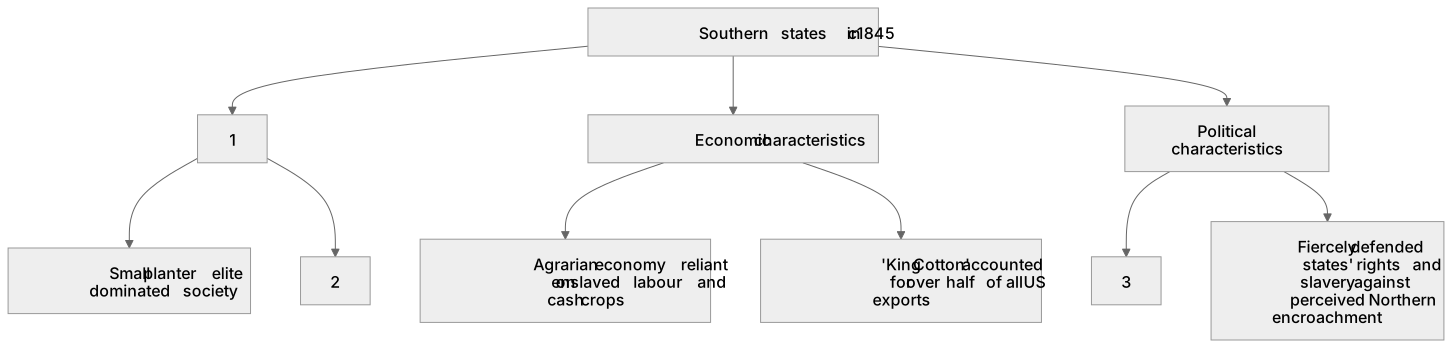
In c1845, the Southern states were defined by an agrarian economy heavily reliant on enslaved labour and cash crops, particularly 'King Cotton', which accounted for over half of all US exports. Socially, the region was highly stratified; a small planter elite dominated society, while the majority were non-slaveholding yeoman farmers, poor whites, and enslaved African Americans. Politically, this planter aristocracy wielded disproportionate power, fiercely defending states' rights and the institution of slavery against perceived Northern encroachment. Unlike the rapidly industrialising North, the South invested its capital in land and enslaved people, resulting in fewer urban centres, limited infrastructure, and a distinct cultural identity rooted in paternalism and honour.
What earns the marks
- Identify the dominance of cotton production and its reliance on enslaved labour as the foundation of the Southern economy.
- Explain the social hierarchy, noting that while a small planter elite held power, most white Southerners were non-slaveholding yeoman farmers.
- Analyse the political ideology of states' rights and how it was used to protect Southern interests and the institution of slavery.
- Contrast the South's agrarian, rural society with the North's industrialisation to highlight the growing sectional divide.
Common mistakes and how to put them right
Assuming all white Southerners owned enslaved people.
Put it right: In reality, only about a quarter of white families were slaveholders.
Treating the Southern economy as weak.
Put it right by noting that cotton made the South incredibly wealthy, though it lacked industrial diversity.
Ignoring the political influence of the planter class.
Put it right: Ensure you emphasise that a small elite controlled state legislatures and national representation.
Exam tips
- Use the term 'King Cotton' to illustrate the economic confidence and international importance of the Southern agricultural system.
- When discussing political characteristics, explicitly link the defence of slavery to the constitutional argument for states' rights.
- Avoid generalisations by distinguishing between the Deep South, which was heavily reliant on cotton, and the Upper South, which had more diverse agriculture.
Try the lesson
The start of the 2J America: A Nation Divided, c1845–1877 – North and South in c1845: The Southern states: social, economic and political characteristics lesson, made from checked teaching notes for this specification point.
Have a go first
Which of the following best describes the primary economic characteristic of the Southern states in 1845?
Listen
In c1845, the Southern states were defined by an agrarian economy heavily reliant on enslaved labour and cash crops, particularly 'King Cotton', which accounted for over half of all US exports. Socially, the region was highly stratified; a small planter elite dominated society, while the majority were non-slaveholding yeoman farmers, poor whites, and enslaved African Americans. Politically, this planter aristocracy wielded disproportionate power, fiercely defending states' rights and the institution of slavery against perceived Northern encroachment. Unlike the rapidly industrialising North, the South invested its capital in land and enslaved people, resulting in fewer urban centres, limited infrastructure, and a distinct cultural identity rooted in paternalism and honour. A strong answer earns marks for these points. Identify the dominance of cotton production and its reliance on enslaved labour as the foundation of the Southern economy. Explain the social hierarchy, noting that while a small planter elite held power, most white Southerners were non-slaveholding yeoman farmers. Analyse the political ideology of states' rights and how it was used to protect Southern interests and the institution of slavery. Contrast the South's agrarian, rural society with the North's industrialisation to highlight the growing sectional divide. A common slip: Treating the Southern economy as weak. Instead, noting that cotton made the South incredibly wealthy, though it lacked industrial diversity. Exam tip: Use the term 'King Cotton' to illustrate the economic confidence and international importance of the Southern agricultural system.
See it

Label the diagram
Some boxes have lost their names. Pick the right name for each number.
1Box 1
2Box 2
3Box 3
There is more to this lesson
The full lesson goes on to check your understanding and help you earn the marks. Create a free account to carry on, with your progress saved.
A week of Premium from your first lesson · Then the free plan continues · No card, no charge
Test your understanding of 2J America: A Nation Divided, c1845–1877 – North and South in c1845: The Southern states: social, economic and political characteristics
Active recall beats re-reading. Take an instant quiz now to test what you’ve learned and lock it into long-term memory.
A week of Premium from your first lesson · Then the free plan continues · No card, no charge