AQA · A-Level · History
Course version: 7042 · Version from Sept 2017
The collapse of collective security: the reasons for and consequences of…
Full specification wording
2K International Relations and Global Conflict, c1890–1941 (A-level only) – Attempts at maintaining the peace, 1923–1935: The collapse of collective security: the reasons for and consequences of the failure of League of Nations in the Manchurian and Abyssinian Crises
The collapse of collective security was starkly demonstrated by the League of Nations' failure to resolve the Manchurian (1931) and Abyssinian (1935) Crises.
Checked against the AQA 7042 specification (opens in a new tab) on .
- Point 4 of 4
Study notes
From the checked teaching notes for this specification point.
The idea
The collapse of collective security was starkly demonstrated by the League of Nations' failure to resolve the Manchurian (1931) and Abyssinian (1935) Crises. Reasons for failure included the absence of major powers like the USA, the slow bureaucratic processes of the League (such as the Lytton Report), and the self-interest of Britain and France, who prioritised their own empires and the Stresa Front over collective action. The consequences were catastrophic: the League was exposed as powerless against aggressive expansionism, economic sanctions were proven ineffective (as seen with the Hoare-Laval Pact), and revisionist powers were emboldened. Ultimately, these failures destroyed the credibility of the League and paved the way for further aggression.
What earns the marks
- Analyse the structural and membership weaknesses of the League that hindered decisive action in Manchuria, such as the absence of the USA and the requirement for unanimous decisions.
- Explain how British and French self-interest, particularly the desire to maintain Italy as an ally against Germany, undermined the response to the Abyssinian Crisis.
- Evaluate the failure of economic sanctions in Abyssinia, noting the exclusion of vital resources like oil and the continued use of the Suez Canal by Italian forces.
- Assess the long-term consequences of these crises, specifically how they emboldened Hitler and Mussolini, leading to the Rome-Berlin Axis and the definitive collapse of collective security.
Common mistakes and how to put them right
Confusing the timelines and details of the two crises.
Put it right: Clearly separate the Manchurian Crisis (1931, Lytton Report, Japan) from the Abyssinian Crisis (1935, Hoare-Laval Pact, Italy).
Stating the League did absolutely nothing.
Put it right: Specify that the League did act through moral condemnation and limited sanctions, but these actions were fundamentally ineffective.
Blaming the failure solely on the League's structure.
Put it right: Balance structural weaknesses with the lack of political will from leading members, particularly Britain and France.
Exam tips
- Use the Hoare-Laval Pact as a prime example of how the self-interest of major powers directly contradicted and undermined the principles of collective security.
- Compare the reasons for failure in both crises to build a strong analytical argument about the inherent flaws of the League of Nations.
- Explicitly link the failure in Abyssinia to the subsequent aggressive actions of Germany, such as the remilitarisation of the Rhineland.
Try the lesson
The start of the 2K International Relations and Global Conflict, c1890–1941 (A-level only) – Attempts at maintaining the peace, 1923–1935: The collapse of collective security: the reasons for and consequences of the failure of League of Nations in the Manchurian and Abyssinian Crises lesson, made from checked teaching notes for this specification point.
Have a go first
Which of the following was a significant reason for the League of Nations' failure to resolve the Manchurian Crisis (1931–1933)?
Listen
The collapse of collective security was starkly demonstrated by the League of Nations' failure to resolve the Manchurian (1931) and Abyssinian (1935) Crises. Reasons for failure included the absence of major powers like the USA, the slow bureaucratic processes of the League (such as the Lytton Report), and the self-interest of Britain and France, who prioritised their own empires and the Stresa Front over collective action. The consequences were catastrophic: the League was exposed as powerless against aggressive expansionism, economic sanctions were proven ineffective (as seen with the Hoare-Laval Pact), and revisionist powers were emboldened. Ultimately, these failures destroyed the credibility of the League and paved the way for further aggression. A strong answer earns marks for these points. Analyse the structural and membership weaknesses of the League that hindered decisive action in Manchuria, such as the absence of the USA and the requirement for unanimous decisions. Explain how British and French self-interest, particularly the desire to maintain Italy as an ally against Germany, undermined the response to the Abyssinian Crisis. Evaluate the failure of economic sanctions in Abyssinia, noting the exclusion of vital resources like oil and the continued use of the Suez Canal by Italian forces. Assess the long-term consequences of these crises, specifically how they emboldened Hitler and Mussolini, leading to the Rome-Berlin Axis and the definitive collapse of collective security. A common slip: Confusing the timelines and details of the two crises. Instead, clearly separate the Manchurian Crisis (1931, Lytton Report, Japan) from the Abyssinian Crisis (1935, Hoare-Laval Pact, Italy). Exam tip: Use the Hoare-Laval Pact as a prime example of how the self-interest of major powers directly contradicted and undermined the principles of collective security.
See it
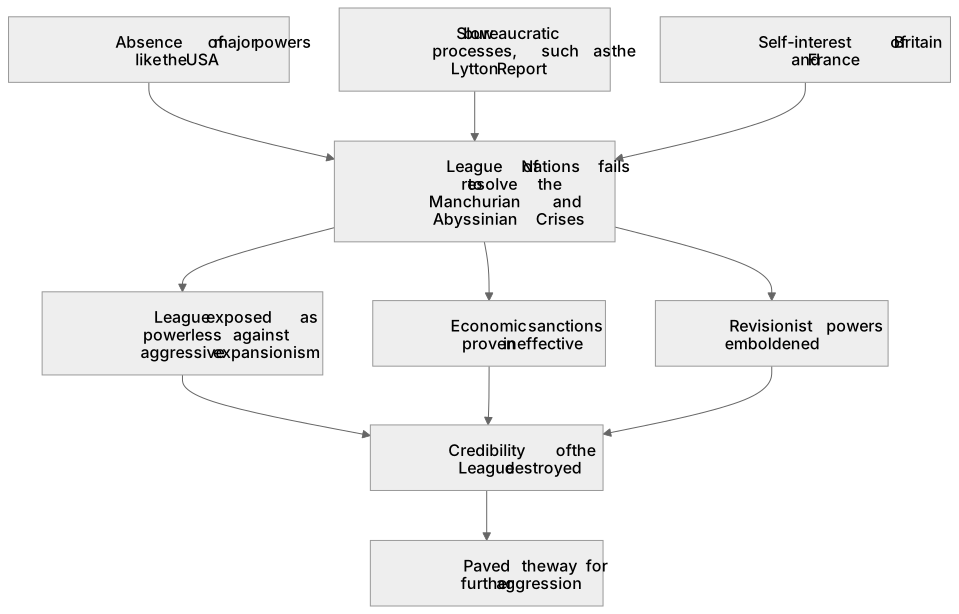
Label the diagram
Some boxes have lost their names. Pick the right name for each number.
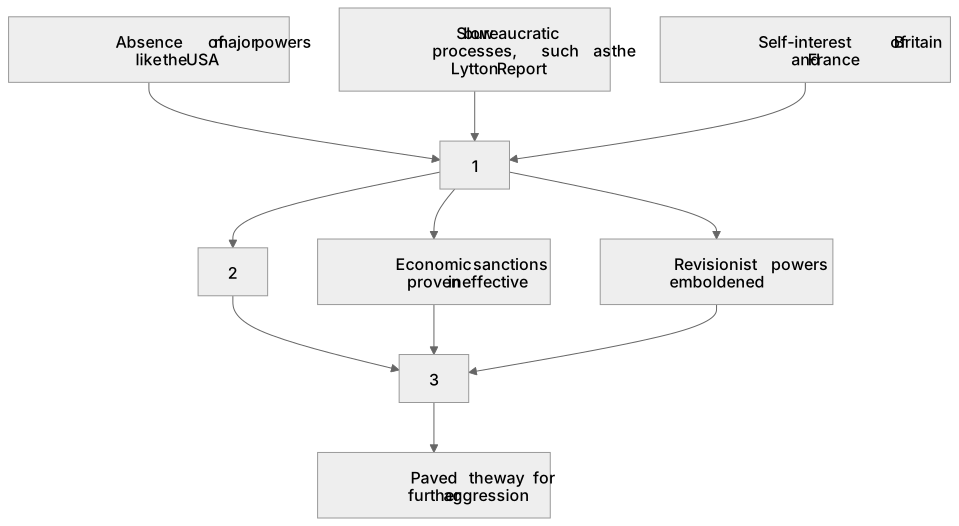
1Box 1
2Box 2
3Box 3
There is more to this lesson
The full lesson goes on to check your understanding and help you earn the marks. Create a free account to carry on, with your progress saved.
A week of Premium from your first lesson · Then the free plan continues · No card, no charge
Test your understanding of 2K International Relations and Global Conflict, c1890–1941 (A-level only) – Attempts at maintaining the peace, 1923–1935: The collapse of collective security: the reasons for and consequences of the failure of League of Nations in the Manchurian and Abyssinian Crises
Active recall beats re-reading. Take an instant quiz now to test what you’ve learned and lock it into long-term memory.
A week of Premium from your first lesson · Then the free plan continues · No card, no charge