AQA · A-Level · History
Course version: 7042 · Version from Sept 2017
The collapse of the autocratic empires: Russia, Germany, Austria-Hungary…
Full specification wording
2K International Relations and Global Conflict, c1890–1941 (A-level only) – Second World War, 1917–1941 The end of the First World War and the peace settlement, 1917–1923: The collapse of the autocratic empires: Russia, Germany, Austria-Hungary and the Ottoman Empire; nationalist ambitions and the impact on international relations and peace-making
The end of the First World War triggered the collapse of four major autocratic empires, fundamentally altering global geopolitics.
Checked against the AQA 7042 specification (opens in a new tab) on .
- Point 1 of 4
- 4 key terms
Study notes
From the checked teaching notes for this specification point.
The idea
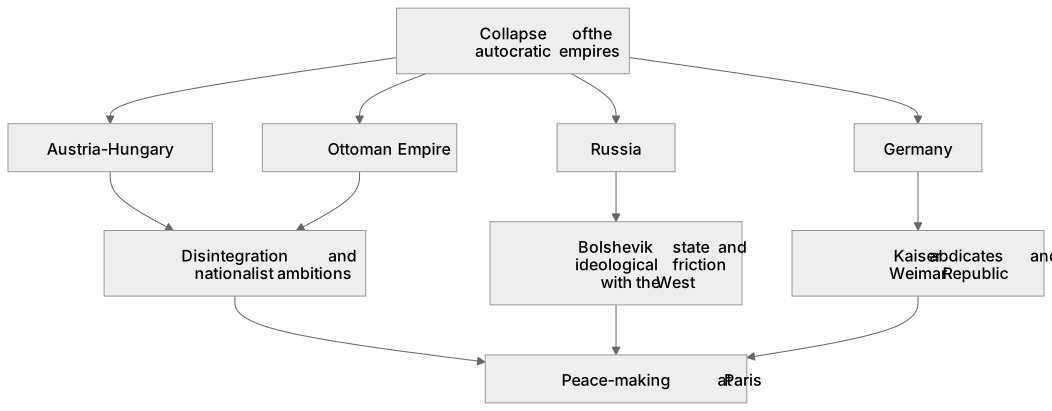
The end of the First World War triggered the collapse of four major autocratic empires, fundamentally altering global geopolitics. In Russia, the 1917 revolutions replaced Tsarist autocracy with a Bolshevik state, creating ideological friction with the West. Germany's Kaiser abdicated in 1918, leading to the fragile Weimar Republic. The multi-ethnic Austro-Hungarian and Ottoman empires disintegrated entirely, unleashing suppressed nationalist ambitions. Groups like the Czechs, South Slavs, and Arabs demanded self-determination, creating a chaotic vacuum. This collapse profoundly impacted international relations and peace-making, as diplomats at Paris struggled to redraw borders, balance competing nationalist claims, and contain Bolshevism.
What earns the marks
- Identify the specific causes and nature of the collapse for each empire, such as the Bolshevik revolution in Russia and military defeat in Germany.
- Explain how the disintegration of Austria-Hungary and the Ottoman Empire created power vacuums filled by competing nationalist movements.
- Analyse the impact of nationalist ambitions on the peace-making process, specifically the challenge of applying Wilson's principle of self-determination.
- Evaluate how the collapse of these empires altered international relations, such as the ideological isolation of Soviet Russia and the instability of new Eastern European states.
Common mistakes and how to put them right
Treating the collapse of all four empires as identical.
Put it right: Distinguish between the ideological revolution in Russia, the regime change in Germany, and the complete territorial disintegration of Austria-Hungary and the Ottoman Empire.
Assuming nationalist ambitions were easily resolved by the peace treaties.
Put it right: Recognise that overlapping ethnic populations made clean borders impossible, leading to ongoing minority conflicts.
Ignoring the Ottoman Empire's collapse in European diplomacy.
Put it right: Include the Middle Eastern mandates and the Greco-Turkish conflicts as direct consequences of Ottoman disintegration.
Exam tips
- When discussing the peace treaties, explicitly link the terms back to the geopolitical vacuum left by the collapsed empires.
- Use specific examples of nationalist ambitions, such as the creation of Yugoslavia or Czechoslovakia, to illustrate the challenges faced by the peacemakers.
- Contrast the ideological threat posed by the collapsed Russian Empire with the territorial challenges posed by the Austro-Hungarian collapse.
Try the lesson
The start of the 2K International Relations and Global Conflict, c1890–1941 (A-level only) – Second World War, 1917–1941 The end of the First World War and the peace settlement, 1917–1923: The collapse of the autocratic empires: Russia, Germany, Austria-Hungary and the Ottoman Empire; nationalist ambitions and the impact on international relations and peace-making lesson, made from checked teaching notes for this specification point.
Have a go first
Which four autocratic empires collapsed as a direct result of the First World War, fundamentally altering international relations and peace-making?
Listen
The end of the First World War triggered the collapse of four major autocratic empires, fundamentally altering global geopolitics. In Russia, the 1917 revolutions replaced Tsarist autocracy with a Bolshevik state, creating ideological friction with the West. Germany's Kaiser abdicated in 1918, leading to the fragile Weimar Republic. The multi-ethnic Austro-Hungarian and Ottoman empires disintegrated entirely, unleashing suppressed nationalist ambitions. Groups like the Czechs, South Slavs, and Arabs demanded self-determination, creating a chaotic vacuum. This collapse profoundly impacted international relations and peace-making, as diplomats at Paris struggled to redraw borders, balance competing nationalist claims, and contain Bolshevism. A strong answer earns marks for these points. Identify the specific causes and nature of the collapse for each empire, such as the Bolshevik revolution in Russia and military defeat in Germany. Explain how the disintegration of Austria-Hungary and the Ottoman Empire created power vacuums filled by competing nationalist movements. Analyse the impact of nationalist ambitions on the peace-making process, specifically the challenge of applying Wilson's principle of self-determination. Evaluate how the collapse of these empires altered international relations, such as the ideological isolation of Soviet Russia and the instability of new Eastern European states. A common slip: Treating the collapse of all four empires as identical. Instead, distinguish between the ideological revolution in Russia, the regime change in Germany, and the complete territorial disintegration of Austria-Hungary and the Ottoman Empire. Exam tip: When discussing the peace treaties, explicitly link the terms back to the geopolitical vacuum left by the collapsed empires.
See it
Key words
Say what each word means before you turn the card.
Imperial collapse and regime change
Try answering aloud or in your head before turning the card.
Nationalism and self-determination
Try answering aloud or in your head before turning the card.
Ideological conflict
Try answering aloud or in your head before turning the card.
Geopolitical instability and border disputes
Try answering aloud or in your head before turning the card.
See every definition
- Imperial collapse and regime change
- The collapse of four major autocratic empires, with Russia replaced by a Bolshevik state and Germany's Kaiser abdicating in 1918 to leave the fragile Weimar Republic.
- Nationalism and self-determination
- Suppressed nationalist ambitions unleashed by the disintegration of the multi-ethnic Austro-Hungarian and Ottoman empires, with groups demanding self-determination and creating a chaotic vacuum.
- Ideological conflict
- Ideological friction with the West created when the 1917 revolutions replaced Tsarist autocracy in Russia with a Bolshevik state.
- Geopolitical instability and border disputes
- A chaotic vacuum in which diplomats at Paris struggled to redraw borders, balance competing nationalist claims and contain Bolshevism.
Label the diagram
Some boxes have lost their names. Pick the right name for each number.
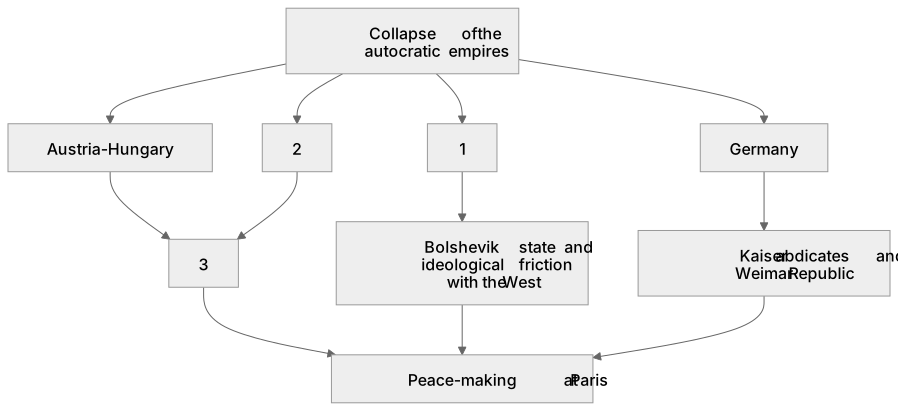
1Box 1
2Box 2
3Box 3
There is more to this lesson
The full lesson goes on to check your understanding and help you earn the marks. Create a free account to carry on, with your progress saved.
A week of Premium from your first lesson · Then the free plan continues · No card, no charge
Test your understanding of 2K International Relations and Global Conflict, c1890–1941 (A-level only) – Second World War, 1917–1941 The end of the First World War and the peace settlement, 1917–1923: The collapse of the autocratic empires: Russia, Germany, Austria-Hungary and the Ottoman Empire; nationalist ambitions and the impact on international relations and peace-making
Active recall beats re-reading. Take an instant quiz now to test what you’ve learned and lock it into long-term memory.
A week of Premium from your first lesson · Then the free plan continues · No card, no charge