AQA · A-Level · History
Course version: 7042 · Version from Sept 2017
The Fascist movement: the ideology of Fascist revolution; the different…
Full specification wording
2L Italy and Fascism, c1900–1945 – Mussolini and the establishment of Fascist Italy, 1922–1926: The Fascist movement: the ideology of Fascist revolution; the different political factions within the Fascist Party; Fascist propaganda; Mussolini as leader
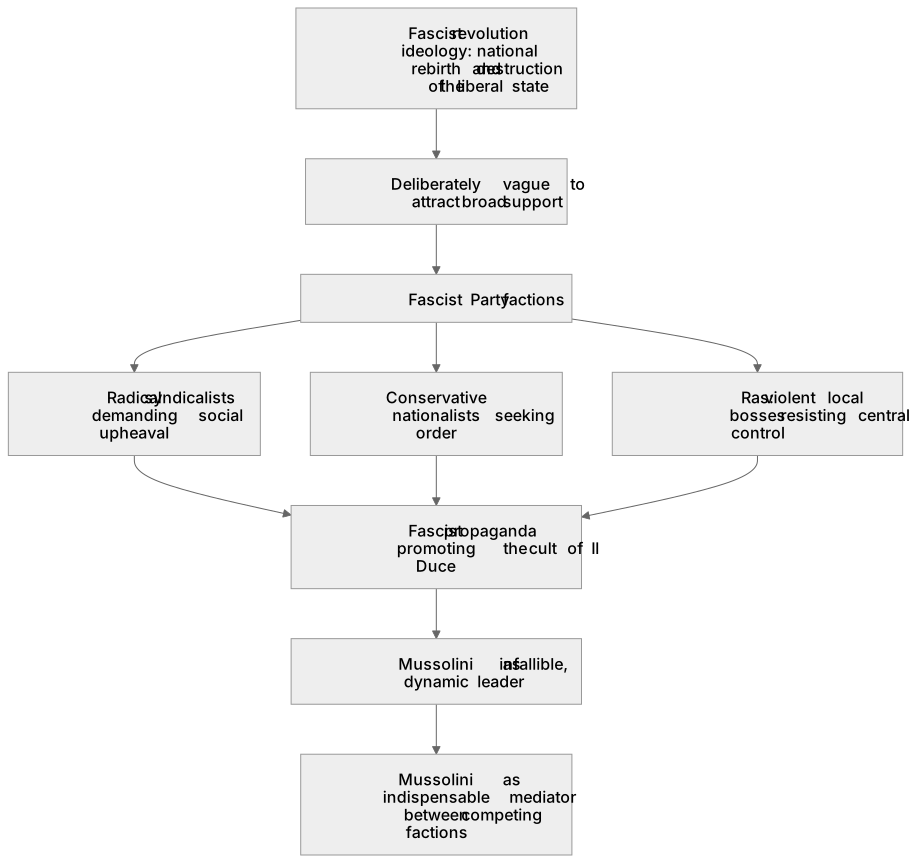
The Fascist movement promoted an ideology of 'Fascist revolution' promising national rebirth and the destruction of the liberal state, yet remained deliberately vague to attract broad support.
Checked against the AQA 7042 specification (opens in a new tab) on .
- Point 2 of 4
- 4 key terms
Study notes
From the checked teaching notes for this specification point.
The idea
The Fascist movement promoted an ideology of 'Fascist revolution' promising national rebirth and the destruction of the liberal state, yet remained deliberately vague to attract broad support. The Fascist Party was deeply divided into factions, including radical syndicalists demanding social upheaval, conservative nationalists seeking order, and violent local bosses (the Ras) resisting central control. To unify these disparate groups, Fascist propaganda heavily promoted the cult of Il Duce, presenting Mussolini as an infallible, dynamic leader. Mussolini’s leadership was the crucial linchpin; he acted as the indispensable mediator between competing factions, using his personal charisma and relentless propaganda to consolidate his authority.
What earns the marks
- Analyse the core tenets and inherent contradictions within the ideology of the Fascist revolution.
- Identify and differentiate between the competing factions within the PNF, such as the radical syndicalists, the conservative right, and the provincial Ras.
- Evaluate the methods and effectiveness of early Fascist propaganda in creating the cult of Il Duce.
- Assess Mussolini's role as the central unifying figure who balanced factional rivalries to maintain control over the movement.
Common mistakes and how to put them right
Treating the Fascist Party as a completely unified and ideologically coherent organisation.
Put it right: Highlight the deep factional divisions, particularly between the radical Ras and the conservative elements.
Confusing the rhetoric of the 'Fascist revolution' with actual radical social change.
Put it right: Explain that the 'revolution' was largely a propaganda construct to mask compromises with the traditional elites.
Underestimating the importance of Mussolini's personal leadership.
Put it right: Emphasise that Mussolini's role as mediator and the focus of the personality cult were essential to holding the fractured movement together.
Exam tips
- Use the term 'Ras' when discussing local Fascist leaders like Farinacci or Balbo to demonstrate specific knowledge of party factions.
- Analyse how the ambiguity of Fascist ideology was actually a tactical strength that allowed Mussolini to appeal to diverse social groups.
- When evaluating Mussolini's leadership, discuss how he deliberately played different factions against each other to secure his own indispensable position.
Try the lesson
The start of the 2L Italy and Fascism, c1900–1945 – Mussolini and the establishment of Fascist Italy, 1922–1926: The Fascist movement: the ideology of Fascist revolution; the different political factions within the Fascist Party; Fascist propaganda; Mussolini as leader lesson, made from checked teaching notes for this specification point.
Have a go first
What was the primary purpose of the 'cult of Il Duce' in Fascist propaganda during the establishment of Mussolini's regime?
Listen
The Fascist movement promoted an ideology of 'Fascist revolution' promising national rebirth and the destruction of the liberal state, yet remained deliberately vague to attract broad support. The Fascist Party was deeply divided into factions, including radical syndicalists demanding social upheaval, conservative nationalists seeking order, and violent local bosses (the Ras) resisting central control. To unify these disparate groups, Fascist propaganda heavily promoted the cult of Il Duce, presenting Mussolini as an infallible, dynamic leader. Mussolini’s leadership was the crucial linchpin; he acted as the indispensable mediator between competing factions, using his personal charisma and relentless propaganda to consolidate his authority. A strong answer earns marks for these points. Analyse the core tenets and inherent contradictions within the ideology of the Fascist revolution. Identify and differentiate between the competing factions within the PNF, such as the radical syndicalists, the conservative right, and the provincial Ras. Evaluate the methods and effectiveness of early Fascist propaganda in creating the cult of Il Duce. Assess Mussolini's role as the central unifying figure who balanced factional rivalries to maintain control over the movement. A common slip: Treating the Fascist Party as a completely unified and ideologically coherent organisation. Instead, Highlight the deep factional divisions, particularly between the radical Ras and the conservative elements. Exam tip: Use the term 'Ras' when discussing local Fascist leaders like Farinacci or Balbo to demonstrate specific knowledge of party factions.
See it
Key words
Say what each word means before you turn the card.
Fascist revolution
Try answering aloud or in your head before turning the card.
Factions
Try answering aloud or in your head before turning the card.
Cult of Il Duce
Try answering aloud or in your head before turning the card.
Ras
Try answering aloud or in your head before turning the card.
See every definition
- Fascist revolution
- An ideology promising national rebirth and the destruction of the liberal state, yet deliberately vague to attract broad support.
- Factions
- Deep divisions within the Fascist Party, including radical syndicalists demanding social upheaval, conservative nationalists seeking order, and violent local bosses resisting central control.
- Cult of Il Duce
- Fascist propaganda presenting Mussolini as an infallible, dynamic leader to unify disparate groups.
- Ras
- Violent local bosses within the Fascist Party who resisted central control.
Label the diagram
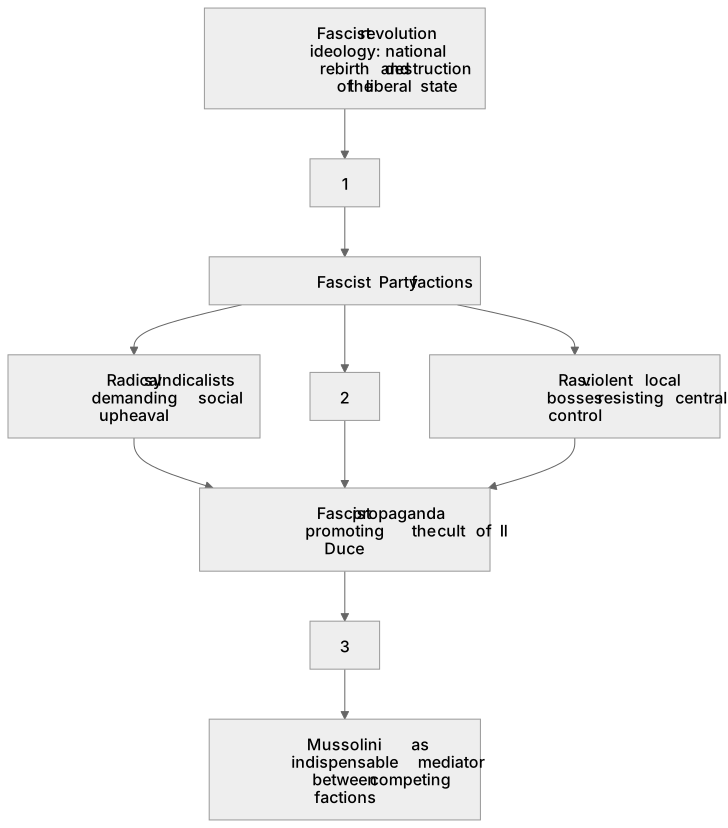
Some boxes have lost their names. Pick the right name for each number.
1Box 1
2Box 2
3Box 3
There is more to this lesson
The full lesson goes on to check your understanding and help you earn the marks. Create a free account to carry on, with your progress saved.
A week of Premium from your first lesson · Then the free plan continues · No card, no charge
Test your understanding of 2L Italy and Fascism, c1900–1945 – Mussolini and the establishment of Fascist Italy, 1922–1926: The Fascist movement: the ideology of Fascist revolution; the different political factions within the Fascist Party; Fascist propaganda; Mussolini as leader
Active recall beats re-reading. Take an instant quiz now to test what you’ve learned and lock it into long-term memory.
A week of Premium from your first lesson · Then the free plan continues · No card, no charge