AQA · A-Level · History
Course version: 7042 · Version from Sept 2017
Britain in Transition, 1906–1957 – only) The 'Hungry Thirties', 1929–1939…
Full specification wording
2M Wars and Welfare: Britain in Transition, 1906–1957 – only) The 'Hungry Thirties', 1929–1939 (A-level only): Challenges to stability: the abdication crisis; radical political groups: the BUF; Communism
In the 1930s, British political stability faced significant challenges from constitutional crises and radical political groups.
Checked against the AQA 7042 specification (opens in a new tab) on .
- Point 4 of 4
- 4 key terms
Study notes
From the checked teaching notes for this specification point.
The idea
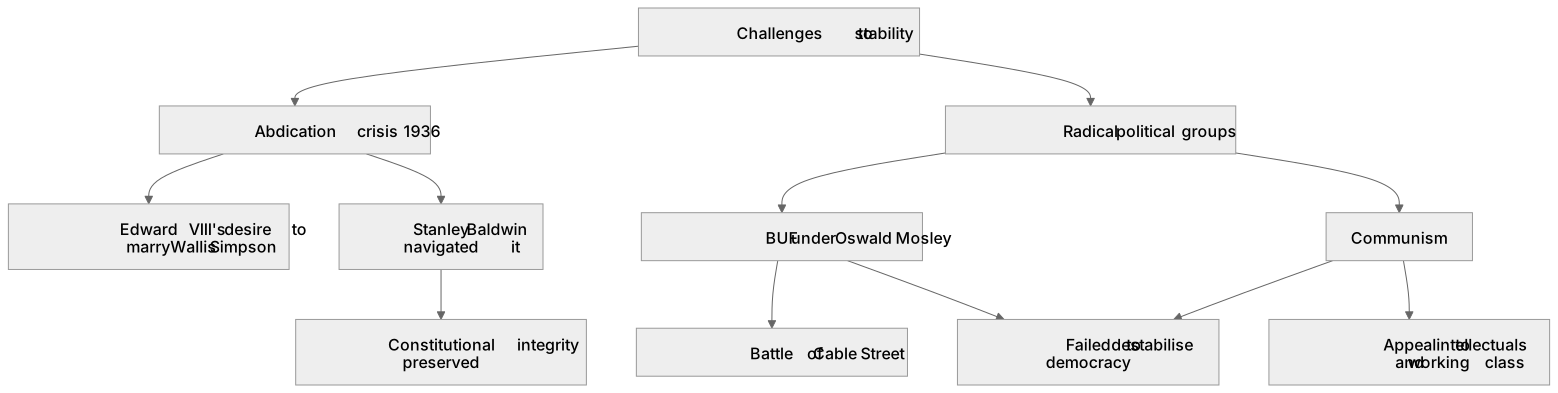
In the 1930s, British political stability faced significant challenges from constitutional crises and radical political groups. The 1936 abdication crisis, triggered by Edward VIII's desire to marry Wallis Simpson, tested the monarchy and the establishment, though Prime Minister Stanley Baldwin successfully navigated it to preserve constitutional integrity. Concurrently, economic hardship fuelled political extremism. Oswald Mosley's British Union of Fascists (BUF) attracted support through anti-Semitism and nationalism, culminating in clashes like the Battle of Cable Street. Similarly, Communism gained traction among intellectuals and the working class. However, both radical movements ultimately failed to destabilise the democratic system.
What earns the marks
- Analyse the constitutional threat posed by the 1936 abdication crisis and how Stanley Baldwin's government managed the situation to maintain stability.
- Evaluate the appeal and ultimate failure of the British Union of Fascists (BUF) under Oswald Mosley.
- Assess the influence of Communism in 1930s Britain, including its appeal to the working class and left-wing intellectuals.
- Compare the methods and impact of radical political groups, such as the BUF and the Communist Party of Great Britain, on domestic stability.
- Examine the significance of events like the Battle of Cable Street in demonstrating public resistance to radical political groups.
Common mistakes and how to put them right
Exaggerating the threat of the BUF and Communism.
Put it right: Emphasise that despite their noise, neither radical group achieved significant electoral success or genuinely threatened the state.
Viewing the abdication crisis solely as a romantic scandal.
Put it right: Analyse it as a severe constitutional crisis that tested the relationship between the monarch, the Church, and Parliament.
Confusing the supporters of the BUF and Communism.
Put it right: Distinguish between the BUF's appeal to some middle-class and disillusioned working-class individuals versus Communism's appeal to specific industrial workers and intellectuals.
Exam tips
- Use the Public Order Act 1936 as concrete evidence of how the government successfully neutralised the threat of radical political groups like the BUF.
- When discussing the abdication crisis, focus on Baldwin's political manoeuvring and the role of the Dominions in forcing Edward VIII's decision.
- Contrast the perceived threat of Communism and the BUF with the enduring electoral dominance of the moderate National Government.
Try the lesson
The start of the 2M Wars and Welfare: Britain in Transition, 1906–1957 – only) The 'Hungry Thirties', 1929–1939 (A-level only): Challenges to stability: the abdication crisis; radical political groups: the BUF; Communism lesson, made from checked teaching notes for this specification point.
Have a go first
What was the primary constitutional issue that led to the abdication of King Edward VIII in 1936?
Listen
In the 1930s, British political stability faced significant challenges from constitutional crises and radical political groups. The 1936 abdication crisis, triggered by Edward VIII's desire to marry Wallis Simpson, tested the monarchy and the establishment, though Prime Minister Stanley Baldwin successfully navigated it to preserve constitutional integrity. Concurrently, economic hardship fuelled political extremism. Oswald Mosley's British Union of Fascists (BUF) attracted support through anti-Semitism and nationalism, culminating in clashes like the Battle of Cable Street. Similarly, Communism gained traction among intellectuals and the working class. However, both radical movements ultimately failed to destabilise the democratic system. A strong answer earns marks for these points. Analyse the constitutional threat posed by the 1936 abdication crisis and how Stanley Baldwin's government managed the situation to maintain stability. Evaluate the appeal and ultimate failure of the British Union of Fascists (BUF) under Oswald Mosley. Assess the influence of Communism in 1930s Britain, including its appeal to the working class and left-wing intellectuals. Compare the methods and impact of radical political groups, such as the BUF and the Communist Party of Great Britain, on domestic stability. A common slip: Exaggerating the threat of the BUF and Communism. Instead, emphasise that despite their noise, neither radical group achieved significant electoral success or genuinely threatened the state. Exam tip: Use the Public Order Act 1936 as concrete evidence of how the government successfully neutralised the threat of radical political groups like the BUF.
See it
Key words
Say what each word means before you turn the card.
Constitutional stability
Try answering aloud or in your head before turning the card.
Political extremism
Try answering aloud or in your head before turning the card.
Government crisis management
Try answering aloud or in your head before turning the card.
Public order and radicalism
Try answering aloud or in your head before turning the card.
See every definition
- Constitutional stability
- British political stability faced significant challenges in the 1930s from constitutional crises and radical political groups, though the democratic system ultimately held.
- Political extremism
- Economic hardship fuelled radical political groups such as Oswald Mosley's British Union of Fascists and Communism, though both ultimately failed to destabilise the democratic system.
- Government crisis management
- Prime Minister Stanley Baldwin successfully navigated the 1936 abdication crisis to preserve constitutional integrity.
- Public order and radicalism
- Radical groups culminated in clashes like the Battle of Cable Street, which demonstrated public resistance to radical political groups.
Label the diagram
Some boxes have lost their names. Pick the right name for each number.
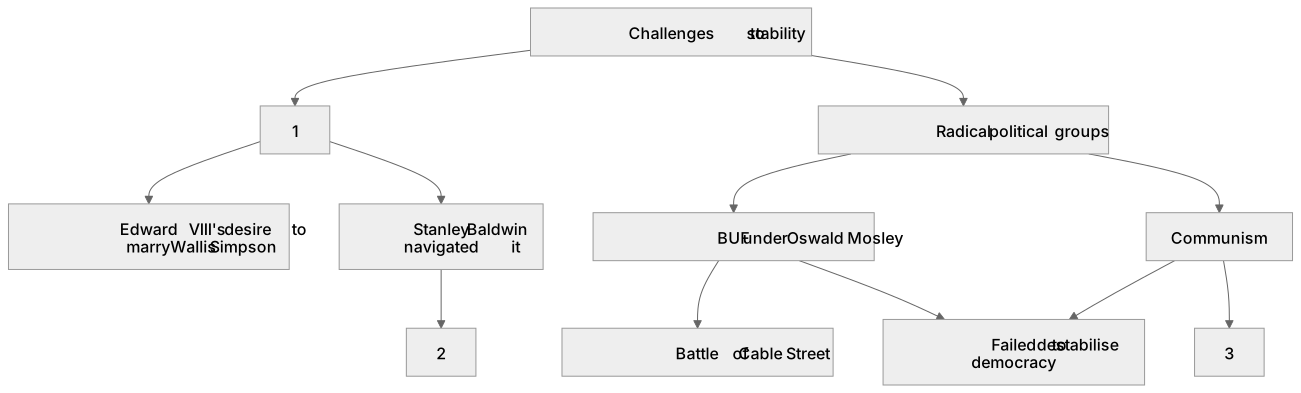
1Box 1
2Box 2
3Box 3
There is more to this lesson
The full lesson goes on to check your understanding and help you earn the marks. Create a free account to carry on, with your progress saved.
A week of Premium from your first lesson · Then the free plan continues · No card, no charge
Test your understanding of 2M Wars and Welfare: Britain in Transition, 1906–1957 – only) The 'Hungry Thirties', 1929–1939 (A-level only): Challenges to stability: the abdication crisis; radical political groups: the BUF; Communism
Active recall beats re-reading. Take an instant quiz now to test what you’ve learned and lock it into long-term memory.
A week of Premium from your first lesson · Then the free plan continues · No card, no charge