AQA · A-Level · History
Course version: 7042 · Version from Sept 2017
Britain in Transition, 1906–1957 – The search for stability, 1922–1929:…
Full specification wording
2M Wars and Welfare: Britain in Transition, 1906–1957 – The search for stability, 1922–1929: The 1929 election: the franchise extension and 'flapper vote'; the new Labour government; MacDonald and Snowden and their aims; the state of Britain by 1929
The 1929 election produced the second, new Labour government.
Checked against the AQA 7042 specification (opens in a new tab) on .
- Point 4 of 4
- 4 key terms
Study notes
From the checked teaching notes for this specification point.
The idea
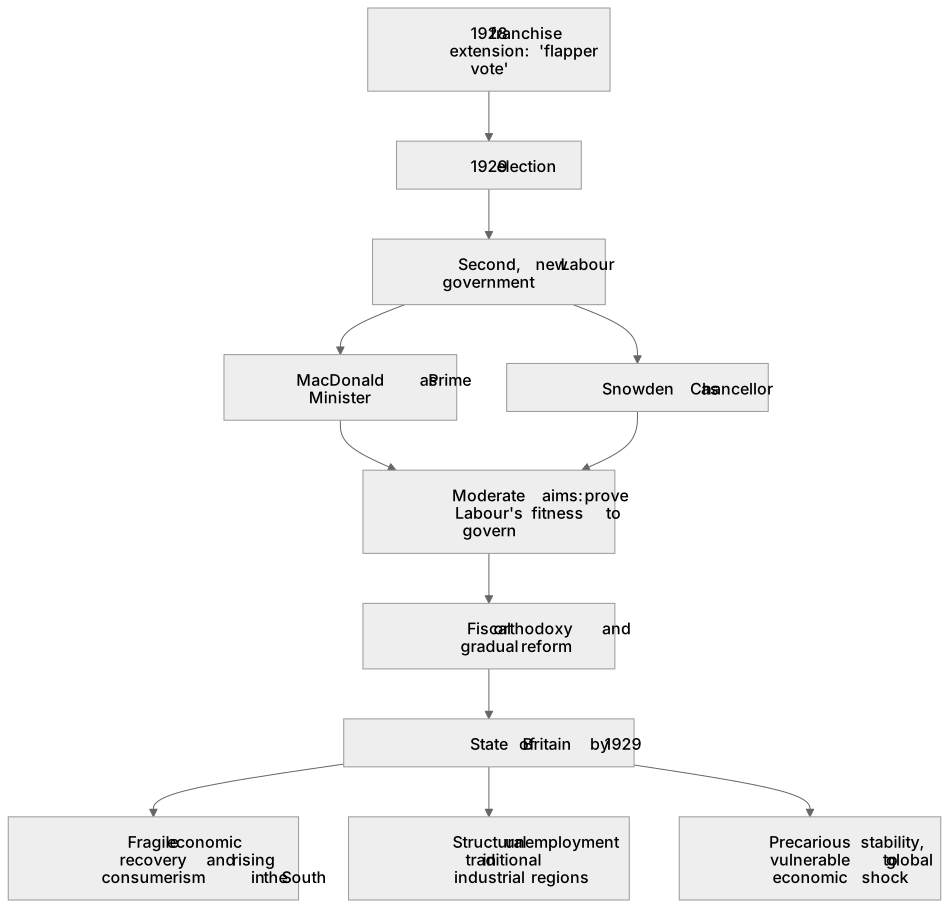
The 1929 election produced the second, new Labour government. A key factor was the 1928 franchise extension, which equalised voting rights and introduced the 'flapper vote', enfranchising millions of young women. Ramsay MacDonald returned as Prime Minister with Philip Snowden as Chancellor. Their aims were strictly moderate; they sought to prove Labour's fitness to govern through fiscal orthodoxy and gradual reform, avoiding radical socialism. By 1929, the state of Britain was complex. Despite fragile economic recovery and rising consumerism in the South, structural unemployment blighted traditional industrial regions. This precarious stability left Britain highly vulnerable to the impending global economic shock.
What earns the marks
- Analyse the impact of the 1928 Representation of the People Act (the 'flapper vote') on the 1929 election outcome and party campaigning strategies.
- Evaluate the moderate political aims of MacDonald and Snowden, focusing on their commitment to balanced budgets and the gold standard to establish Labour's credibility.
- Assess the achievements and limitations of the new Labour government's domestic legislation, such as the 1930 Housing Act, within the constraints of a minority government.
- Describe the state of Britain by 1929 by contrasting the growth of new consumer industries with the persistent structural decline in coal, textiles, and shipbuilding.
Common mistakes and how to put them right
Confusing the 1918 and 1928 franchise extensions.
Put it right: Ensure you specify that 1928 equalised the voting age at 21 for both men and women, creating the 'flapper vote'.
Assuming MacDonald and Snowden pursued radical socialist policies.
Put it right by emphasising their strict adherence to orthodox, conservative economic principles.
Stating that Labour won a majority in the 1929 election.
Put it right: They were the largest single party but still operated as a minority government dependent on Liberal support.
Exam tips
- Use Snowden's rigid belief in free trade and balanced budgets to explain why the Labour government struggled to combat rising unemployment after 1929.
- When evaluating the state of Britain by 1929, explicitly link economic conditions to the political challenges awaiting the incoming Labour administration.
- Discuss how the Conservative slogan 'Safety First' failed to capture the electorate's mood in 1929, contrasting it with Labour's appeal to the newly expanded franchise.
Try the lesson
The start of the 2M Wars and Welfare: Britain in Transition, 1906–1957 – The search for stability, 1922–1929: The 1929 election: the franchise extension and 'flapper vote'; the new Labour government; MacDonald and Snowden and their aims; the state of Britain by 1929 lesson, made from checked teaching notes for this specification point.
Have a go first
What was the primary effect of the Representation of the People (Equal Franchise) Act 1928 on the 1929 general election?
Listen
The 1929 election produced the second, new Labour government. A key factor was the 1928 franchise extension, which equalised voting rights and introduced the 'flapper vote', enfranchising millions of young women. Ramsay MacDonald returned as Prime Minister with Philip Snowden as Chancellor. Their aims were strictly moderate; they sought to prove Labour's fitness to govern through fiscal orthodoxy and gradual reform, avoiding radical socialism. By 1929, the state of Britain was complex. Despite fragile economic recovery and rising consumerism in the South, structural unemployment blighted traditional industrial regions. This precarious stability left Britain highly vulnerable to the impending global economic shock. A strong answer earns marks for these points. Analyse the impact of the 1928 Representation of the People Act (the 'flapper vote') on the 1929 election outcome and party campaigning strategies. Evaluate the moderate political aims of MacDonald and Snowden, focusing on their commitment to balanced budgets and the gold standard to establish Labour's credibility. Assess the achievements and limitations of the new Labour government's domestic legislation, such as the 1930 Housing Act, within the constraints of a minority government. Describe the state of Britain by 1929 by contrasting the growth of new consumer industries with the persistent structural decline in coal, textiles, and shipbuilding. A common slip: Assuming MacDonald and Snowden pursued radical socialist policies. Instead, emphasising their strict adherence to orthodox, conservative economic principles. Exam tip: Use Snowden's rigid belief in free trade and balanced budgets to explain why the Labour government struggled to combat rising unemployment after 1929.
See it
Key words
Say what each word means before you turn the card.
Electoral reform and democracy
Try answering aloud or in your head before turning the card.
Political moderation vs. radicalism
Try answering aloud or in your head before turning the card.
Economic orthodoxy
Try answering aloud or in your head before turning the card.
Minority government dynamics
Try answering aloud or in your head before turning the card.
See every definition
- Electoral reform and democracy
- The 1928 franchise extension equalised voting rights and introduced the 'flapper vote', enfranchising millions of young women.
- Political moderation vs. radicalism
- MacDonald and Snowden's aims were strictly moderate, seeking to prove Labour's fitness to govern through fiscal orthodoxy and gradual reform while avoiding radical socialism.
- Economic orthodoxy
- A commitment to fiscal orthodoxy and balanced budgets, used by MacDonald and Snowden to establish Labour's credibility.
- Minority government dynamics
- Labour were the largest single party but still operated as a minority government dependent on Liberal support.
Label the diagram
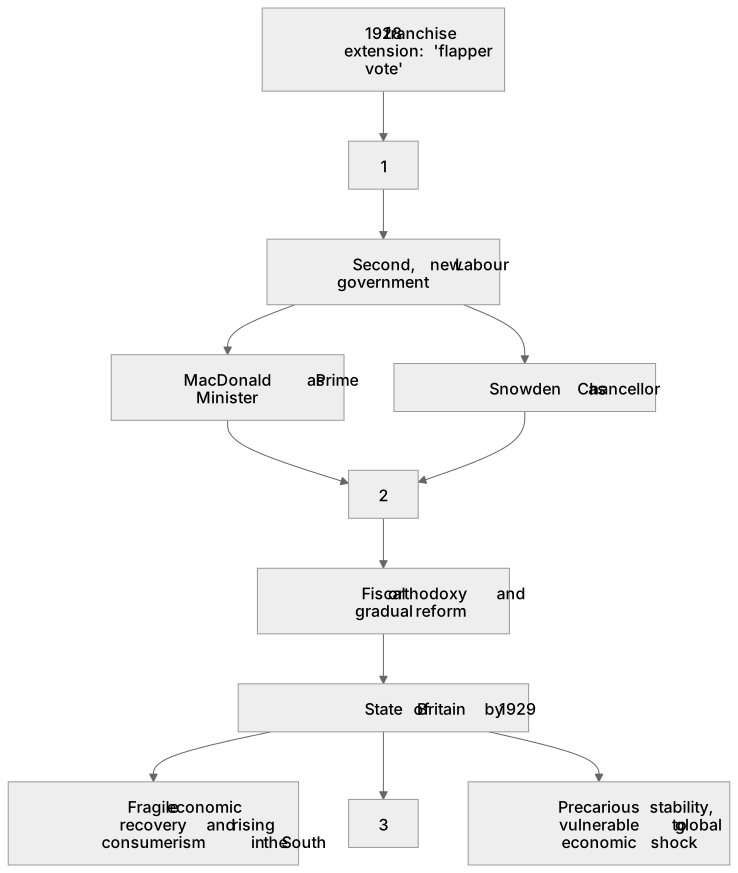
Some boxes have lost their names. Pick the right name for each number.
1Box 1
2Box 2
3Box 3
There is more to this lesson
The full lesson goes on to check your understanding and help you earn the marks. Create a free account to carry on, with your progress saved.
A week of Premium from your first lesson · Then the free plan continues · No card, no charge
Test your understanding of 2M Wars and Welfare: Britain in Transition, 1906–1957 – The search for stability, 1922–1929: The 1929 election: the franchise extension and 'flapper vote'; the new Labour government; MacDonald and Snowden and their aims; the state of Britain by 1929
Active recall beats re-reading. Take an instant quiz now to test what you’ve learned and lock it into long-term memory.
A week of Premium from your first lesson · Then the free plan continues · No card, no charge