AQA · A-Level · History
Course version: 7042 · Version from Sept 2017
Russia, 1917–1953 – Dissent and Revolution, 1917: The February/March…
Full specification wording
2N Revolution and dictatorship: Russia, 1917–1953 – Dissent and Revolution, 1917: The February/March revolution of 1917: causes and course of revolution; issues of leadership and the Tsar's abdication; the establishment of Provisional Government and the Petrograd Soviet; the workings of the Dual authority
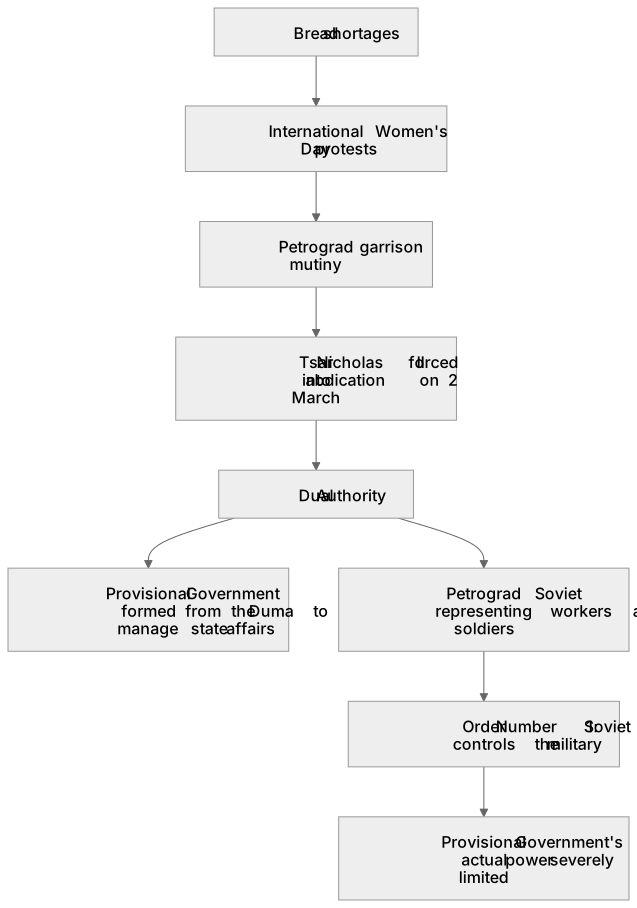
The February 1917 revolution was sparked by bread shortages and International Women's Day protests, rapidly escalating as the Petrograd garrison mutinied.
Checked against the AQA 7042 specification (opens in a new tab) on .
- Point 2 of 4
- 3 key terms
Study notes
From the checked teaching notes for this specification point.
The idea
The February 1917 revolution was sparked by bread shortages and International Women's Day protests, rapidly escalating as the Petrograd garrison mutinied. The course of the revolution was largely spontaneous, highlighting severe issues of leadership as revolutionary parties were caught off guard. Lacking military support, Tsar Nicholas II was forced into abdication on 2 March. Power fell to a precarious Dual Authority: the Provisional Government, formed from the Duma to manage state affairs, and the Petrograd Soviet, representing workers and soldiers. The workings of this Dual Authority were inherently unstable, as the Soviet controlled the military through Order Number 1, severely limiting the Provisional Government's actual power.
What earns the marks
- Trace the course of the revolution from the initial bread riots and women's protests to the crucial mutiny of the Petrograd garrison.
- Analyse the spontaneous nature of the uprising and the absence of clear leadership from established revolutionary parties.
- Explain the political and military pressures that led directly to the Tsar's abdication on 2 March 1917.
- Evaluate the structural weaknesses of the Dual Authority, contrasting the formal power of the Provisional Government with the practical power of the Petrograd Soviet.
Common mistakes and how to put them right
Confusing the February and October revolutions.
Put it right: Ensure the February revolution is described as a largely spontaneous, mass uprising rather than a planned Bolshevik coup.
Stating the Provisional Government was elected by the people.
Put it right: Clarify that it was a self-appointed body formed from the remnants of the Fourth Duma, lacking true democratic legitimacy.
Claiming the Petrograd Soviet wanted to govern immediately.
Put it right: Explain that the Soviet initially supported the Provisional Government due to orthodox Marxist beliefs about the necessity of a bourgeois democratic phase.
Exam tips
- Emphasise the significance of the military mutiny; without the soldiers joining the crowds, the protests might have been suppressed by force.
- Use Soviet Order Number 1 as a concrete example to demonstrate how the Petrograd Soviet held the real military power in the Dual Authority.
- Discuss the 'issues of leadership' by noting the absence of key revolutionary figures like Lenin and Trotsky during the February events.
Try the lesson
The start of the 2N Revolution and dictatorship: Russia, 1917–1953 – Dissent and Revolution, 1917: The February/March revolution of 1917: causes and course of revolution; issues of leadership and the Tsar's abdication; the establishment of Provisional Government and the Petrograd Soviet; the workings of the Dual authority lesson, made from checked teaching notes for this specification point.
Have a go first
Following the abdication of Tsar Nicholas II in March 1917, which two bodies emerged to form the system known as 'Dual Authority'?
Listen
The February 1917 revolution was sparked by bread shortages and International Women's Day protests, rapidly escalating as the Petrograd garrison mutinied. The course of the revolution was largely spontaneous, highlighting severe issues of leadership as revolutionary parties were caught off guard. Lacking military support, Tsar Nicholas II was forced into abdication on 2 March. Power fell to a precarious Dual Authority: the Provisional Government, formed from the Duma to manage state affairs, and the Petrograd Soviet, representing workers and soldiers. The workings of this Dual Authority were inherently unstable, as the Soviet controlled the military through Order Number 1, severely limiting the Provisional Government's actual power. A strong answer earns marks for these points. Trace the course of the revolution from the initial bread riots and women's protests to the crucial mutiny of the Petrograd garrison. Analyse the spontaneous nature of the uprising and the absence of clear leadership from established revolutionary parties. Explain the political and military pressures that led directly to the Tsar's abdication on 2 March 1917. Evaluate the structural weaknesses of the Dual Authority, contrasting the formal power of the Provisional Government with the practical power of the Petrograd Soviet. A common slip: Confusing the February and October revolutions. Instead, ensure the February revolution is described as a largely spontaneous, mass uprising rather than a planned Bolshevik coup. Exam tip: Emphasise the significance of the military mutiny; without the soldiers joining the crowds, the protests might have been suppressed by force.
See it
Key words
Say what each word means before you turn the card.
Spontaneous Revolution
Try answering aloud or in your head before turning the card.
Dual Power
Try answering aloud or in your head before turning the card.
Military Mutiny
Try answering aloud or in your head before turning the card.
See every definition
- Spontaneous Revolution
- A mass uprising that was largely spontaneous, with revolutionary parties caught off guard and no clear leadership from established revolutionary parties.
- Dual Power
- A precarious Dual Authority in which the Provisional Government managed state affairs while the Petrograd Soviet represented workers and soldiers.
- Military Mutiny
- The mutiny of the Petrograd garrison, which escalated the protests after bread shortages and International Women's Day protests.
Label the diagram
Some boxes have lost their names. Pick the right name for each number.
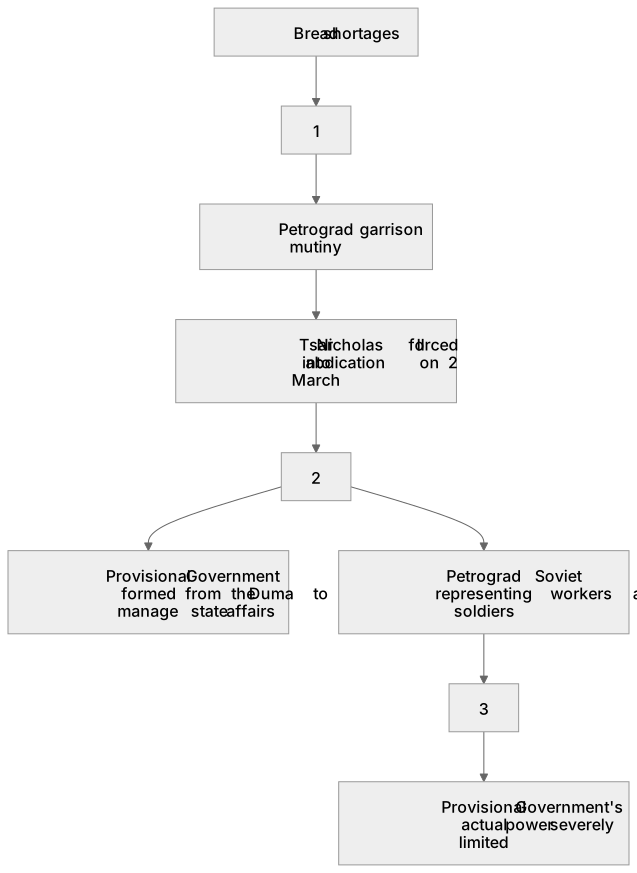
1Box 1
2Box 2
3Box 3
There is more to this lesson
The full lesson goes on to check your understanding and help you earn the marks. Create a free account to carry on, with your progress saved.
A week of Premium from your first lesson · Then the free plan continues · No card, no charge
Test your understanding of 2N Revolution and dictatorship: Russia, 1917–1953 – Dissent and Revolution, 1917: The February/March revolution of 1917: causes and course of revolution; issues of leadership and the Tsar's abdication; the establishment of Provisional Government and the Petrograd Soviet; the workings of the Dual authority
Active recall beats re-reading. Take an instant quiz now to test what you’ve learned and lock it into long-term memory.
A week of Premium from your first lesson · Then the free plan continues · No card, no charge