AQA · A-Level · History
Course version: 7042 · Version from Sept 2017
Russia, 1917–1953 – Stalinism, politics and control, 1929–1941 (A-level…
Full specification wording
2N Revolution and dictatorship: Russia, 1917–1953 – Stalinism, politics and control, 1929–1941 (A-level only): The Yezhovshchina: mass terror and repression at central and local levels; treatment of national minorities; the gulags; the end of the purges; the death of Trotsky; responsibility for and impact of the Terror and purges
The Yezhovshchina (1937–1938) marked the peak of mass terror, extending repression from central political elites to local levels and ordinary citizens.
Checked against the AQA 7042 specification (opens in a new tab) on .
- Point 2 of 4
- 4 key terms
Study notes
From the checked teaching notes for this specification point.
The idea
The Yezhovshchina (1937–1938) marked the peak of mass terror, extending repression from central political elites to local levels and ordinary citizens. The NKVD systematically targeted national minorities to prevent border espionage, while millions were condemned to the brutal forced labour of the gulags. The purges officially ended when Stalin blamed Yezhov for excesses, though targeted assassinations continued, notably the death of Trotsky in Mexico in 1940. Debates over responsibility centre on whether Stalin masterminded the Terror or if local officials drove its momentum. The impact was devastating, decimating the military and intelligentsia, instilling widespread societal fear, and leaving a severely weakened administrative structure on the eve of war.
What earns the marks
- Analyse the expansion of terror during the Yezhovshchina to include ordinary citizens and local party officials.
- Evaluate the specific targeting and harsh treatment of national minorities during the mass operations.
- Assess the economic and punitive roles of the gulag system within the Soviet state.
- Examine the historiographical debate regarding responsibility for the Terror, contrasting Stalin's central direction with local radicalism.
- Evaluate the long-term impact of the purges on Soviet society, the military, and the economy.
Common mistakes and how to put them right
Attributing the entirety of the Terror solely to Stalin's paranoia.
Put it right: This ignores the role of local officials who used the purges to settle scores or meet quotas.
Assuming the purges ended completely in 1938.
Put it right: While mass operations ceased, targeted repression and assassinations, like Trotsky's, continued.
Overlooking the treatment of national minorities; students often focus only on political rivals and ignore the ethnic dimension of the mass operations.
Exam tips
- Use the term 'Yezhovshchina' to specifically denote the period of mass terror from 1937 to 1938, distinguishing it from earlier political purges.
- When discussing the impact of the Terror, explicitly mention the decimation of the Red Army officer corps and its implications for the impending war.
- Address the debate on responsibility by acknowledging both the top-down directives (NKVD Order 00447) and bottom-up pressures.
Try the lesson
The start of the 2N Revolution and dictatorship: Russia, 1917–1953 – Stalinism, politics and control, 1929–1941 (A-level only): The Yezhovshchina: mass terror and repression at central and local levels; treatment of national minorities; the gulags; the end of the purges; the death of Trotsky; responsibility for and impact of the Terror and purges lesson, made from checked teaching notes for this specification point.
Have a go first
How did the Soviet state apparatus finally eliminate Leon Trotsky in August 1940?
Listen
The Yezhovshchina (1937–1938) marked the peak of mass terror, extending repression from central political elites to local levels and ordinary citizens. The NKVD systematically targeted national minorities to prevent border espionage, while millions were condemned to the brutal forced labour of the gulags. The purges officially ended when Stalin blamed Yezhov for excesses, though targeted assassinations continued, notably the death of Trotsky in Mexico in 1940. Debates over responsibility centre on whether Stalin masterminded the Terror or if local officials drove its momentum. The impact was devastating, decimating the military and intelligentsia, instilling widespread societal fear, and leaving a severely weakened administrative structure on the eve of war. A strong answer earns marks for these points. Analyse the expansion of terror during the Yezhovshchina to include ordinary citizens and local party officials. Evaluate the specific targeting and harsh treatment of national minorities during the mass operations. Assess the economic and punitive roles of the gulag system within the Soviet state. Examine the historiographical debate regarding responsibility for the Terror, contrasting Stalin's central direction with local radicalism. Exam tip: Use the term 'Yezhovshchina' to specifically denote the period of mass terror from 1937 to 1938, distinguishing it from earlier political purges.
See it

Put the events in order
Put these events in the order they happened, earliest first.
- 1. Yezhovshchina begins as peak of mass terror and repression
- 2. Death of Trotsky in Mexico
- 3. Purges officially end when Stalin blames Yezhov for excesses
Key words
Say what each word means before you turn the card.
Yezhovshchina
Try answering aloud or in your head before turning the card.
Gulags
Try answering aloud or in your head before turning the card.
Historiographical debates on responsibility
Try answering aloud or in your head before turning the card.
The persecution of ethnic minorities
Try answering aloud or in your head before turning the card.
See every definition
- Yezhovshchina
- The period of mass terror and repression at central and local levels, marking the peak of mass terror.
- Gulags
- The system of brutal forced labour to which millions were condemned.
- Historiographical debates on responsibility
- Debates centring on whether Stalin masterminded the Terror or if local officials drove its momentum.
- The persecution of ethnic minorities
- The systematic targeting of national minorities by the NKVD to prevent border espionage.
Label the diagram
Some boxes have lost their names. Pick the right name for each number.
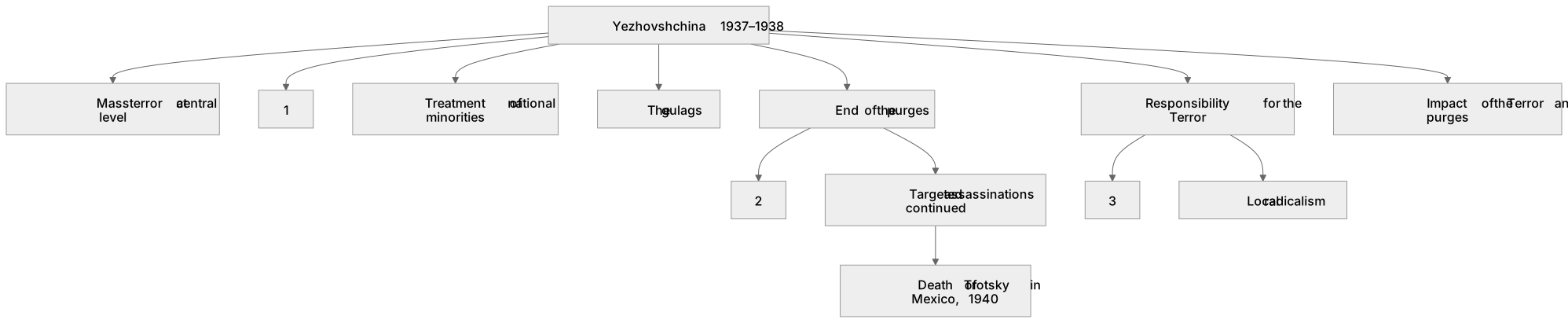
1Box 1
2Box 2
3Box 3
There is more to this lesson
The full lesson goes on to check your understanding and help you earn the marks. Create a free account to carry on, with your progress saved.
A week of Premium from your first lesson · Then the free plan continues · No card, no charge
Test your understanding of 2N Revolution and dictatorship: Russia, 1917–1953 – Stalinism, politics and control, 1929–1941 (A-level only): The Yezhovshchina: mass terror and repression at central and local levels; treatment of national minorities; the gulags; the end of the purges; the death of Trotsky; responsibility for and impact of the Terror and purges
Active recall beats re-reading. Take an instant quiz now to test what you’ve learned and lock it into long-term memory.
A week of Premium from your first lesson · Then the free plan continues · No card, no charge