AQA · A-Level · History
Course version: 7042 · Version from Sept 2017
Russia, 1917–1953 – The Great Patriotic War and Stalin’s Dictatorship,…
Full specification wording
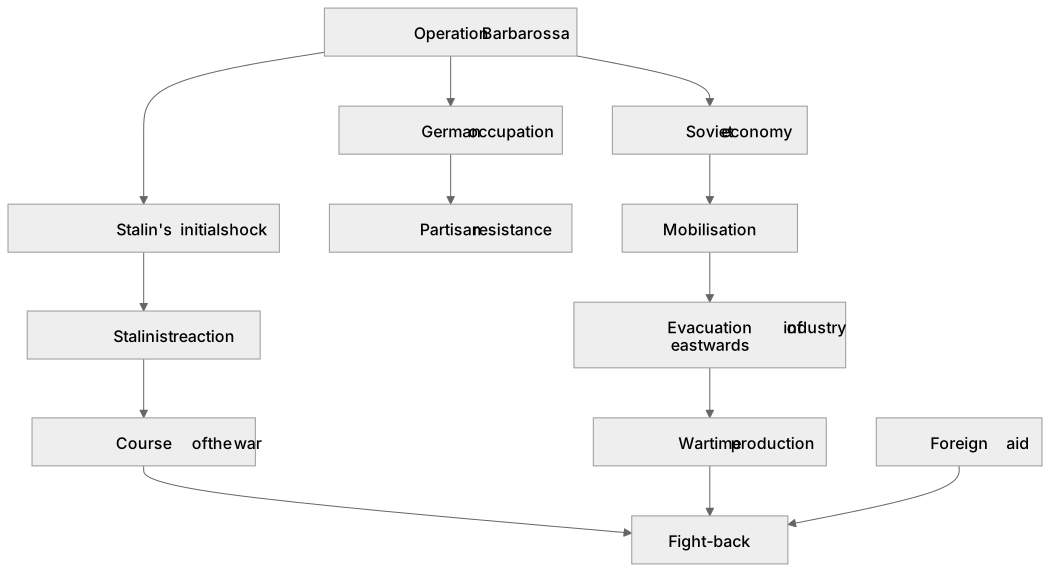
2N Revolution and dictatorship: Russia, 1917–1953 – The Great Patriotic War and Stalin’s Dictatorship, 1941–1953 (A-level only): The impact of the war on the Soviet Union: Operation Barbarossa and the Stalinist reaction; the course of the war; the USSR under occupation and the fight-back; the Soviet economy; mobilisation and evacuation of industry; foreign aid
Operation Barbarossa (June 1941) initially devastated the USSR, prompting Stalin’s initial shock and subsequent ruthless reaction, including Order 227 ('Not one step back').
Checked against the AQA 7042 specification (opens in a new tab) on .
- Point 1 of 4
- 4 key terms
Study notes
From the checked teaching notes for this specification point.
The idea
Operation Barbarossa (June 1941) initially devastated the USSR, prompting Stalin’s initial shock and subsequent ruthless reaction, including Order 227 ('Not one step back'). The course of the war shifted from catastrophic retreats to the pivotal fight-back at Stalingrad and Kursk. Under brutal German occupation, Soviet citizens faced atrocities, sparking fierce partisan resistance. To survive, the Soviet economy underwent massive mobilisation; over 1,500 industrial plants were evacuated eastwards beyond the Urals to sustain production. While the command economy facilitated this rapid relocation, foreign aid, notably the US Lend-Lease programme, provided crucial logistical support, supplying trucks, radios, and food that kept the Red Army mobile during the counter-offensives.
What earns the marks
- Assess Stalin's initial paralysis versus his later effective delegation to Stavka and commanders like Zhukov.
- Evaluate the scale and success of the industrial evacuation to the Urals and Siberia in maintaining wartime production.
- Analyse the impact of German occupation policies in alienating the Soviet populace and fuelling the partisan fight-back.
- Weigh the relative importance of the Soviet command economy against the contribution of Allied Lend-Lease aid.
Common mistakes and how to put them right
Claiming foreign aid was the sole reason for Soviet victory.
Put it right: Acknowledge that while Lend-Lease provided vital logistical support, the bulk of weaponry and manpower was domestically sourced.
Stating Stalin was a flawless military commander from the start.
Put it right: Note Stalin's initial breakdown in June 1941 and his early disastrous interference before he learned to trust his generals.
Ignoring the civilian experience under occupation.
Put it right: Detail the extreme brutality of German occupation, which was crucial in mobilising the population for a desperate fight-back.
Exam tips
- Use specific statistics, such as the relocation of over 1,500 factories, to demonstrate the scale of economic mobilisation.
- Contrast the initial disasters of 1941 with the strategic turning points of 1942-1943 to show the evolution of the course of the war.
- When evaluating foreign aid, specify the types of goods provided, such as transport and communications equipment, rather than just weapons.
Try the lesson
The start of the 2N Revolution and dictatorship: Russia, 1917–1953 – The Great Patriotic War and Stalin’s Dictatorship, 1941–1953 (A-level only): The impact of the war on the Soviet Union: Operation Barbarossa and the Stalinist reaction; the course of the war; the USSR under occupation and the fight-back; the Soviet economy; mobilisation and evacuation of industry; foreign aid lesson, made from checked teaching notes for this specification point.
Have a go first
During the early stages of Operation Barbarossa in 1941, what was the primary Soviet strategy regarding its industrial base in the western regions?
Listen
Operation Barbarossa (June 1941) initially devastated the USSR, prompting Stalin’s initial shock and subsequent ruthless reaction, including Order 227 ('Not one step back'). The course of the war shifted from catastrophic retreats to the pivotal fight-back at Stalingrad and Kursk. Under brutal German occupation, Soviet citizens faced atrocities, sparking fierce partisan resistance. To survive, the Soviet economy underwent massive mobilisation; over 1,500 industrial plants were evacuated eastwards beyond the Urals to sustain production. While the command economy facilitated this rapid relocation, foreign aid, notably the US Lend-Lease programme, provided crucial logistical support, supplying trucks, radios, and food that kept the Red Army mobile during the counter-offensives. A strong answer earns marks for these points. Assess Stalin's initial paralysis versus his later effective delegation to Stavka and commanders like Zhukov. Evaluate the scale and success of the industrial evacuation to the Urals and Siberia in maintaining wartime production. Analyse the impact of German occupation policies in alienating the Soviet populace and fuelling the partisan fight-back. Weigh the relative importance of the Soviet command economy against the contribution of Allied Lend-Lease aid. A common slip: Claiming foreign aid was the sole reason for Soviet victory. Instead, Acknowledge that while Lend-Lease provided vital logistical support, the bulk of weaponry and manpower was domestically sourced. Exam tip: Use specific statistics, such as the relocation of over 1,500 factories, to demonstrate the scale of economic mobilisation.
See it
Key words
Say what each word means before you turn the card.
Operation Barbarossa
Try answering aloud or in your head before turning the card.
Mobilisation
Try answering aloud or in your head before turning the card.
Foreign aid
Try answering aloud or in your head before turning the card.
Partisan resistance
Try answering aloud or in your head before turning the card.
See every definition
- Operation Barbarossa
- The June 1941 attack that initially devastated the USSR and prompted Stalin's initial shock and subsequent ruthless reaction.
- Mobilisation
- The massive wartime transformation of the Soviet economy, including the evacuation of over 1,500 industrial plants eastwards beyond the Urals to sustain production.
- Foreign aid
- Support notably from the US Lend-Lease programme, supplying trucks, radios and food that kept the Red Army mobile during the counter-offensives.
- Partisan resistance
- The fierce fight-back sparked among Soviet citizens by the atrocities they faced under brutal German occupation.
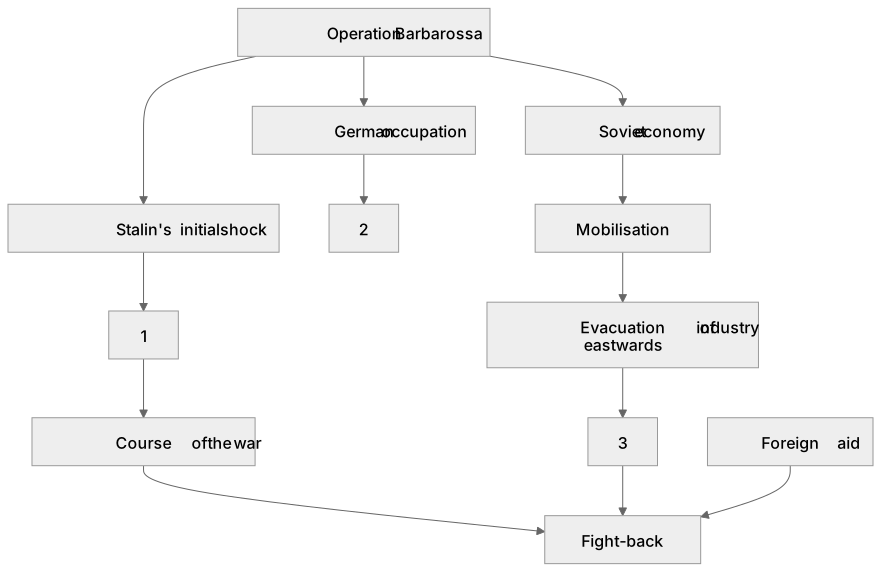
Label the diagram
Some boxes have lost their names. Pick the right name for each number.
1Box 1
2Box 2
3Box 3
There is more to this lesson
The full lesson goes on to check your understanding and help you earn the marks. Create a free account to carry on, with your progress saved.
A week of Premium from your first lesson · Then the free plan continues · No card, no charge
Test your understanding of 2N Revolution and dictatorship: Russia, 1917–1953 – The Great Patriotic War and Stalin’s Dictatorship, 1941–1953 (A-level only): The impact of the war on the Soviet Union: Operation Barbarossa and the Stalinist reaction; the course of the war; the USSR under occupation and the fight-back; the Soviet economy; mobilisation and evacuation of industry; foreign aid
Active recall beats re-reading. Take an instant quiz now to test what you’ve learned and lock it into long-term memory.
A week of Premium from your first lesson · Then the free plan continues · No card, no charge