AQA · A-Level · History
Course version: 7042 · Version from Sept 2017
Germany, 1918–1945 – The Nazi Dictatorship, 1933–1939 (A-level only):…
Full specification wording
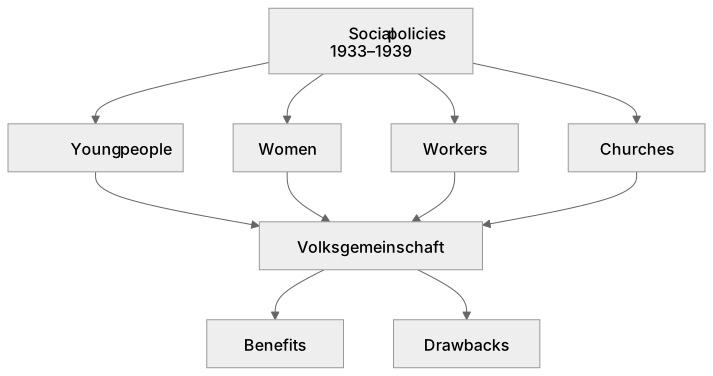
2O Democracy and Nazism: Germany, 1918–1945 – The Nazi Dictatorship, 1933–1939 (A-level only): Social policies: young people; women; workers; the churches; the degree of Volksgemeinschaft; benefits and drawbacks of Nazi rule
During the Nazi Dictatorship (1933–1939), social policies aimed to forge a Volksgemeinschaft (people's community) by subordinating individuals to the state.
Checked against the AQA 7042 specification (opens in a new tab) on .
- Point 4 of 4
- 2 key terms
Study notes
From the checked teaching notes for this specification point.
The idea
During the Nazi Dictatorship (1933–1939), social policies aimed to forge a Volksgemeinschaft (people's community) by subordinating individuals to the state. Youth were indoctrinated via the Hitler Youth and a Nazified curriculum. Women were pushed into maternal roles, though labour shortages later forced them into factories. Workers lost trade unions but gained benefits via Strength Through Joy (KdF), offsetting the drawback of frozen wages. The Churches faced suppression despite the 1933 Concordat, as Nazism demanded total loyalty. The degree of Volksgemeinschaft achieved was limited; while some enjoyed benefits like employment, drawbacks included pervasive terror, loss of freedom, and the brutal exclusion of minorities.
What earns the marks
- Assess the effectiveness of the Hitler Youth and education system in indoctrinating young people during the 1933–1939 dictatorship.
- Evaluate the contradictory nature of policies towards women, contrasting ideological goals with economic realities.
- Analyse the impact of the DAF and KdF on workers' living standards and morale.
- Examine the regime's failure to fully coordinate the Catholic and Protestant churches.
- Weigh the perceived benefits of the Volksgemeinschaft against the severe drawbacks of Nazi rule, such as repression and exclusion.
Common mistakes and how to put them right
Stating that all women were successfully removed from the workplace.
Put it right: Note that female employment actually rose between 1933 and 1939 due to rearmament labour shortages.
Claiming the Churches were completely destroyed.
Put it right: Explain that while heavily persecuted, the Churches remained the only major institutions not fully coordinated by the regime.
Assuming the Volksgemeinschaft was fully realised.
Put it right: Argue that class divisions persisted and the community was largely held together by propaganda and terror rather than genuine unity.
Confusing the 1928–1933 collapse of democracy with the 1933–1939 dictatorship period.
Put it right: Ensure social policies are analysed within the context of the established Nazi regime (1933–1939).
Exam tips
- Use the concept of Volksgemeinschaft as a framework to evaluate the success or failure of specific social policies between 1933 and 1939.
- Contrast the propaganda image of a classless, unified society with the reality of persistent social divisions and terror.
- Highlight the tension between ideological goals (e.g., women at home) and practical necessities (e.g., the need for female factory workers).
Try the lesson
The start of the 2O Democracy and Nazism: Germany, 1918–1945 – The Nazi Dictatorship, 1933–1939 (A-level only): Social policies: young people; women; workers; the churches; the degree of Volksgemeinschaft; benefits and drawbacks of Nazi rule lesson, made from checked teaching notes for this specification point.
Have a go first
Which of the following was a key feature of Nazi social policy towards women in the 1930s?
Listen
During the Nazi Dictatorship (1933–1939), social policies aimed to forge a Volksgemeinschaft (people's community) by subordinating individuals to the state. Youth were indoctrinated via the Hitler Youth and a Nazified curriculum. Women were pushed into maternal roles, though labour shortages later forced them into factories. Workers lost trade unions but gained benefits via Strength Through Joy (KdF), offsetting the drawback of frozen wages. The Churches faced suppression despite the 1933 Concordat, as Nazism demanded total loyalty. The degree of Volksgemeinschaft achieved was limited; while some enjoyed benefits like employment, drawbacks included pervasive terror, loss of freedom, and the brutal exclusion of minorities. A strong answer earns marks for these points. Assess the effectiveness of the Hitler Youth and education system in indoctrinating young people during the 1933–1939 dictatorship. Evaluate the contradictory nature of policies towards women, contrasting ideological goals with economic realities. Analyse the impact of the DAF and KdF on workers' living standards and morale. Examine the regime's failure to fully coordinate the Catholic and Protestant churches. A common slip: Stating that all women were successfully removed from the workplace. Instead, note that female employment actually rose between 1933 and 1939 due to rearmament labour shortages. Exam tip: Use the concept of Volksgemeinschaft as a framework to evaluate the success or failure of specific social policies between 1933 and 1939.
See it
Key words
Say what each word means before you turn the card.
Volksgemeinschaft
Try answering aloud or in your head before turning the card.
Indoctrination
Try answering aloud or in your head before turning the card.
See every definition
- Volksgemeinschaft
- A people's community that social policies aimed to forge by subordinating individuals to the state.
- Indoctrination
- The process through which young people were targeted via the Hitler Youth and a Nazified curriculum.
Label the diagram
Some boxes have lost their names. Pick the right name for each number.
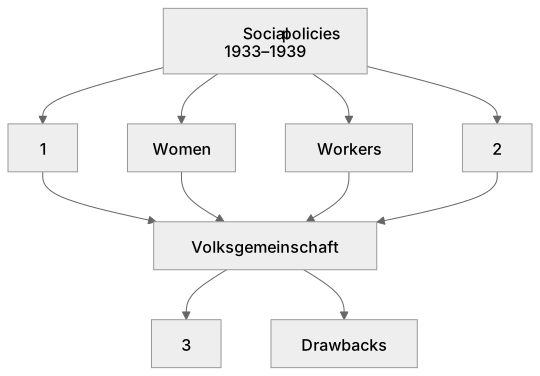
1Box 1
2Box 2
3Box 3
There is more to this lesson
The full lesson goes on to check your understanding and help you earn the marks. Create a free account to carry on, with your progress saved.
A week of Premium from your first lesson · Then the free plan continues · No card, no charge
Test your understanding of 2O Democracy and Nazism: Germany, 1918–1945 – The Nazi Dictatorship, 1933–1939 (A-level only): Social policies: young people; women; workers; the churches; the degree of Volksgemeinschaft; benefits and drawbacks of Nazi rule
Active recall beats re-reading. Take an instant quiz now to test what you’ve learned and lock it into long-term memory.
A week of Premium from your first lesson · Then the free plan continues · No card, no charge