AQA · A-Level · History
Course version: 7042 · Version from Sept 2017
The end of the Japanese war: the breakdown of Nationalist/Communist…
Full specification wording
2P The Transformation of China, 1936–1997 – 1962 The Origins of the Civil War, 1936–1946: The end of the Japanese war: the breakdown of Nationalist/Communist cooperation and outbreak of Civil War; the relative political and military strengths of the two sides
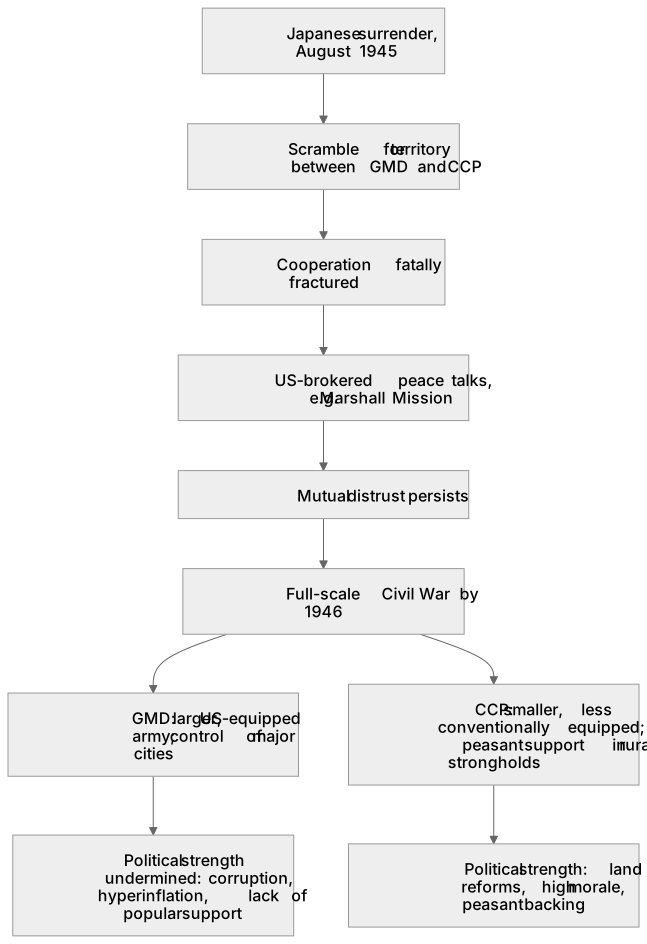
The abrupt end of the Japanese war in August 1945 triggered an immediate scramble for territory between the GMD and CCP, fatally fracturing their fragile cooperation.
Checked against the AQA 7042 specification (opens in a new tab) on .
- Point 4 of 4
- 4 key terms
Study notes
From the checked teaching notes for this specification point.
The idea
The abrupt end of the Japanese war in August 1945 triggered an immediate scramble for territory between the GMD and CCP, fatally fracturing their fragile cooperation. Despite US-brokered peace talks, such as the Marshall Mission, mutual distrust led to the outbreak of full-scale Civil War by 1946. Initially, the GMD possessed significant military superiority, boasting a larger, US-equipped army and control of major cities. However, their political strength was severely undermined by corruption, hyperinflation, and a lack of popular support. In contrast, the CCP's People's Liberation Army, though initially smaller and less conventionally equipped, held immense political strength derived from successful land reforms, high morale, and deep-rooted peasant support in rural strongholds.
What earns the marks
- Analyse how the sudden Japanese surrender in 1945 created a power vacuum that accelerated the breakdown of GMD-CCP cooperation.
- Evaluate the failure of diplomatic interventions, such as the Marshall Mission, in preventing the outbreak of the Chinese Civil War.
- Compare the initial military strengths, noting the GMD's numerical advantage, US funding, and air superiority versus the CCP's guerrilla experience and captured Japanese weapons in Manchuria.
- Assess the relative political strengths, contrasting the GMD's loss of legitimacy due to corruption and economic mismanagement with the CCP's strong ideological discipline and peasant backing.
Common mistakes and how to put them right
Arguing that the CCP had military superiority at the outbreak of the Civil War in 1946.
Put it right: Specify that the GMD had a significantly larger and better-equipped army initially; the CCP's advantages were primarily political and tactical.
Ignoring the role of the United States in the immediate post-war period.
Put it right: Discuss the US airlift of GMD troops to accept Japanese surrenders and the failed mediation efforts of General George Marshall.
Treating the breakdown of cooperation as a sudden event in 1946.
Put it right: Trace the breakdown back to the underlying tensions and skirmishes that persisted throughout the Sino-Japanese War, which simply escalated upon Japan's surrender.
Exam tips
- Create a comparative table of GMD and CCP strengths in 1945 to quickly recall evidence for essays on the outbreak of the Civil War.
- Distinguish clearly between military strength (troops, equipment, territory) and political strength (popular support, morale, economic stability) when evaluating the two sides.
- Use the race to control Manchuria as a key case study to illustrate the immediate breakdown of cooperation following the Japanese surrender.
Try the lesson
The start of the 2P The Transformation of China, 1936–1997 – 1962 The Origins of the Civil War, 1936–1946: The end of the Japanese war: the breakdown of Nationalist/Communist cooperation and outbreak of Civil War; the relative political and military strengths of the two sides lesson, made from checked teaching notes for this specification point.
Have a go first
Following the surrender of Japan in August 1945, what was the immediate cause of the renewed military conflict between the Guomindang (GMD) and the Chinese Communist Party (CCP)?
Listen
The abrupt end of the Japanese war in August 1945 triggered an immediate scramble for territory between the GMD and CCP, fatally fracturing their fragile cooperation. Despite US-brokered peace talks, such as the Marshall Mission, mutual distrust led to the outbreak of full-scale Civil War by 1946. Initially, the GMD possessed significant military superiority, boasting a larger, US-equipped army and control of major cities. However, their political strength was severely undermined by corruption, hyperinflation, and a lack of popular support. In contrast, the CCP's People's Liberation Army, though initially smaller and less conventionally equipped, held immense political strength derived from successful land reforms, high morale, and deep-rooted peasant support in rural strongholds. A strong answer earns marks for these points. Analyse how the sudden Japanese surrender in 1945 created a power vacuum that accelerated the breakdown of GMD-CCP cooperation. Evaluate the failure of diplomatic interventions, such as the Marshall Mission, in preventing the outbreak of the Chinese Civil War. Compare the initial military strengths, noting the GMD's numerical advantage, US funding, and air superiority versus the CCP's guerrilla experience and captured Japanese weapons in Manchuria. Assess the relative political strengths, contrasting the GMD's loss of legitimacy due to corruption and economic mismanagement with the CCP's strong ideological discipline and peasant backing. A common slip: Arguing that the CCP had military superiority at the outbreak of the Civil War in 1946. Instead, Specify that the GMD had a significantly larger and better-equipped army initially; the CCP's advantages were primarily political and tactical. Exam tip: Create a comparative table of GMD and CCP strengths in 1945 to quickly recall evidence for essays on the outbreak of the Civil War.
See it
Key words
Say what each word means before you turn the card.
The transition from international conflict to civil war
Try answering aloud or in your head before turning the card.
The role of foreign intervention and diplomacy
Try answering aloud or in your head before turning the card.
Military strategy versus political legitimacy
Try answering aloud or in your head before turning the card.
Economic instability and state collapse
Try answering aloud or in your head before turning the card.
See every definition
- The transition from international conflict to civil war
- The abrupt end of the Japanese war in August 1945 triggered an immediate scramble for territory between the GMD and CCP, fatally fracturing their fragile cooperation.
- The role of foreign intervention and diplomacy
- Despite US-brokered peace talks, such as the Marshall Mission, mutual distrust led to the outbreak of full-scale Civil War by 1946.
- Military strategy versus political legitimacy
- The GMD possessed significant military superiority, but their political strength was severely undermined by corruption, hyperinflation, and a lack of popular support.
- Economic instability and state collapse
- The GMD's political strength was severely undermined by corruption, hyperinflation, and a lack of popular support.
Label the diagram
Some boxes have lost their names. Pick the right name for each number.
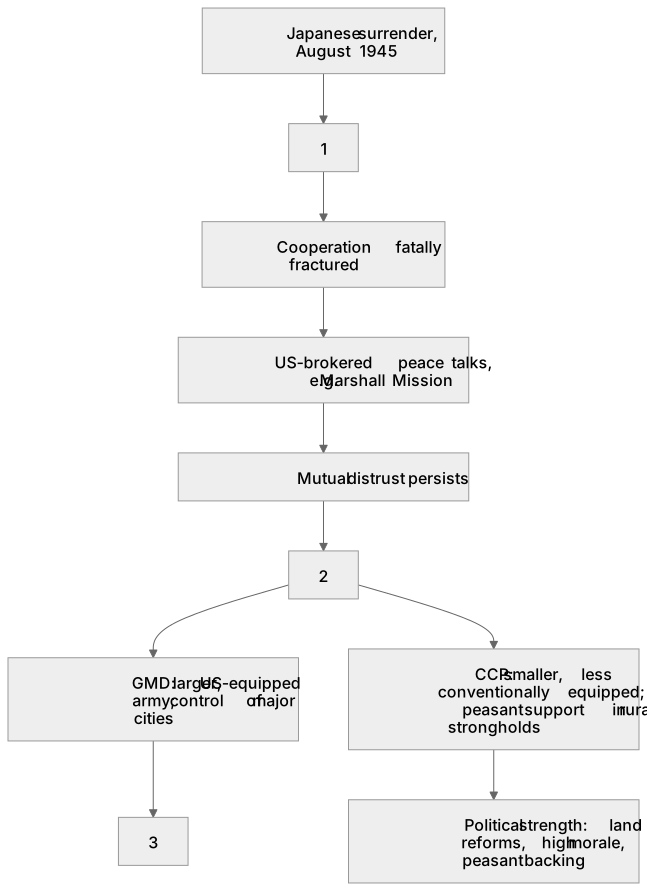
1Box 1
2Box 2
3Box 3
There is more to this lesson
The full lesson goes on to check your understanding and help you earn the marks. Create a free account to carry on, with your progress saved.
A week of Premium from your first lesson · Then the free plan continues · No card, no charge
Test your understanding of 2P The Transformation of China, 1936–1997 – 1962 The Origins of the Civil War, 1936–1946: The end of the Japanese war: the breakdown of Nationalist/Communist cooperation and outbreak of Civil War; the relative political and military strengths of the two sides
Active recall beats re-reading. Take an instant quiz now to test what you’ve learned and lock it into long-term memory.
A week of Premium from your first lesson · Then the free plan continues · No card, no charge