AQA · A-Level · History
Course version: 7042 · Version from Sept 2017
Economic developments: pragmatism and the policies of Liu Shaoqi and Deng…
Full specification wording
2P The Transformation of China, 1936–1997 – Reform and Control, 1962–1966 (A-level only): Economic developments: pragmatism and the policies of Liu Shaoqi and Deng Xiaoping
To rescue China from the famine caused by the Great Leap Forward, Liu Shaoqi and Deng Xiaoping implemented highly pragmatic economic policies between 1962 and 1966.
Checked against the AQA 7042 specification (opens in a new tab) on .
- Point 2 of 4
- 4 key terms
Study notes
From the checked teaching notes for this specification point.
The idea
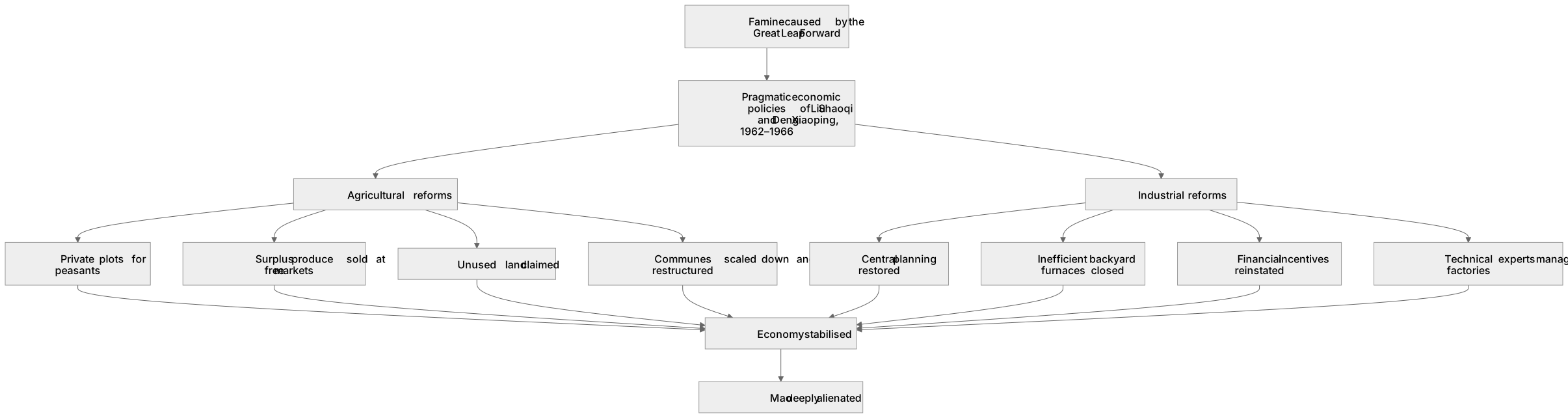
To rescue China from the famine caused by the Great Leap Forward, Liu Shaoqi and Deng Xiaoping implemented highly pragmatic economic policies between 1962 and 1966. Prioritising recovery over communist ideology, they dismantled many radical commune structures, allowing peasants to cultivate private plots, sell surplus produce at free markets, and claim unused land. In industry, they restored central planning, closed inefficient backyard furnaces, and reinstated financial incentives and technical experts to manage factories. This pragmatic shift, famously encapsulated by Deng's assertion that it does not matter if a cat is black or white as long as it catches mice, successfully stabilised the economy but deeply alienated Mao.
What earns the marks
- Identify the specific agricultural reforms introduced, such as the restoration of private plots and the reduction of commune sizes.
- Explain the industrial changes, including the closure of unprofitable state enterprises and the return to expert-led management.
- Evaluate the success of these pragmatic policies in ending the famine and restoring agricultural and industrial production levels by 1965.
- Analyse how these economic developments created ideological friction with Mao, who viewed them as a dangerous retreat towards capitalism.
Common mistakes and how to put them right
Claiming Liu and Deng abandoned communism entirely.
Put it right: Explain that they remained committed communists but believed temporary capitalist-style incentives were necessary for economic survival.
Confusing these 1960s reforms with Deng's later 1978 economic reforms.
Put it right: Focus strictly on the recovery policies of the Economic Readjustment period (1962-1965), rather than the Third Five-Year Plan which ran from 1966 to 1970.
Stating that communes were completely abolished.
Put it right: Clarify that communes were scaled down and restructured to give more autonomy to smaller production teams, not entirely dismantled.
Exam tips
- Quote Deng Xiaoping's 'cat theory' to effectively illustrate the shift from ideological purity to economic pragmatism.
- Use specific statistics, such as the recovery of grain production by 1965, to substantiate claims about the success of Liu and Deng's policies.
- Always connect these economic policies back to the political narrative, showing how they triggered Mao's fears of a capitalist restoration.
Try the lesson
The start of the 2P The Transformation of China, 1936–1997 – Reform and Control, 1962–1966 (A-level only): Economic developments: pragmatism and the policies of Liu Shaoqi and Deng Xiaoping lesson, made from checked teaching notes for this specification point.
Have a go first
Which phrase best summarises the pragmatic economic approach adopted by Deng Xiaoping in the early 1960s to recover from the Great Leap Forward?
Listen
To rescue China from the famine caused by the Great Leap Forward, Liu Shaoqi and Deng Xiaoping implemented highly pragmatic economic policies between 1962 and 1966. Prioritising recovery over communist ideology, they dismantled many radical commune structures, allowing peasants to cultivate private plots, sell surplus produce at free markets, and claim unused land. In industry, they restored central planning, closed inefficient backyard furnaces, and reinstated financial incentives and technical experts to manage factories. This pragmatic shift, famously encapsulated by Deng's assertion that it does not matter if a cat is black or white as long as it catches mice, successfully stabilised the economy but deeply alienated Mao. A strong answer earns marks for these points. Identify the specific agricultural reforms introduced, such as the restoration of private plots and the reduction of commune sizes. Explain the industrial changes, including the closure of unprofitable state enterprises and the return to expert-led management. Evaluate the success of these pragmatic policies in ending the famine and restoring agricultural and industrial production levels by 1965. Analyse how these economic developments created ideological friction with Mao, who viewed them as a dangerous retreat towards capitalism. A common slip: Claiming Liu and Deng abandoned communism entirely. Instead, Explain that they remained committed communists but believed temporary capitalist-style incentives were necessary for economic survival. Exam tip: Quote Deng Xiaoping's 'cat theory' to effectively illustrate the shift from ideological purity to economic pragmatism.
See it
Key words
Say what each word means before you turn the card.
Economic Policy
Try answering aloud or in your head before turning the card.
Pragmatism vs Ideology
Try answering aloud or in your head before turning the card.
Agriculture
Try answering aloud or in your head before turning the card.
Industrialisation
Try answering aloud or in your head before turning the card.
See every definition
- Economic Policy
- Highly pragmatic measures implemented between 1962 and 1966, prioritising recovery over communist ideology to rescue China from the famine caused by the Great Leap Forward.
- Pragmatism vs Ideology
- Prioritising recovery over communist ideology, a shift encapsulated by Deng's assertion that it does not matter if a cat is black or white as long as it catches mice.
- Agriculture
- Radical commune structures were dismantled, allowing peasants to cultivate private plots, sell surplus produce at free markets, and claim unused land.
- Industrialisation
- Central planning was restored, inefficient backyard furnaces were closed, and financial incentives and technical experts were reinstated to manage factories.
Label the diagram
Some boxes have lost their names. Pick the right name for each number.
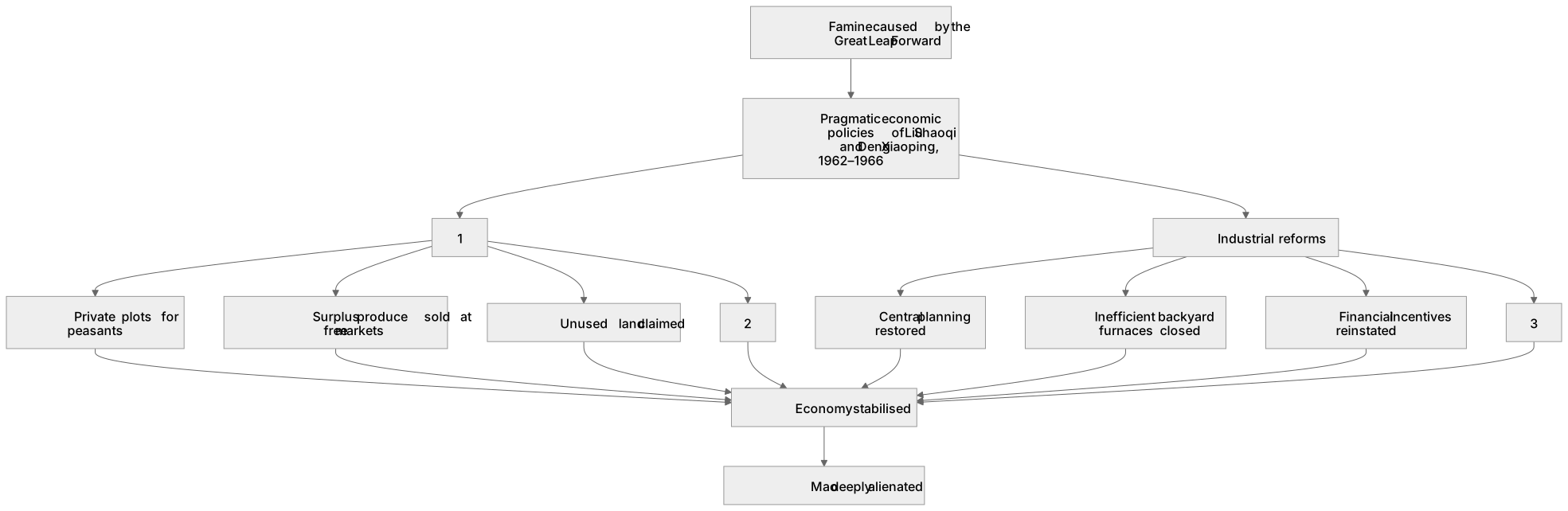
1Box 1
2Box 2
3Box 3
There is more to this lesson
The full lesson goes on to check your understanding and help you earn the marks. Create a free account to carry on, with your progress saved.
A week of Premium from your first lesson · Then the free plan continues · No card, no charge
Test your understanding of 2P The Transformation of China, 1936–1997 – Reform and Control, 1962–1966 (A-level only): Economic developments: pragmatism and the policies of Liu Shaoqi and Deng Xiaoping
Active recall beats re-reading. Take an instant quiz now to test what you’ve learned and lock it into long-term memory.
A week of Premium from your first lesson · Then the free plan continues · No card, no charge