AQA · A-Level · History
Course version: 7042 · Version from Sept 2017
International relations: Sino-Soviet relations and conflict over Xinjiang
Full specification wording
2P The Transformation of China, 1936–1997 – Reform and Control, 1962–1966 (A-level only): International relations: Sino-Soviet relations and conflict over Xinjiang
During 1962–1966, international relations were defined by the severe deterioration of Sino-Soviet relations, culminating in a formal split.
Checked against the AQA 7042 specification (opens in a new tab) on .
- Point 4 of 4
- 4 key terms
Study notes
From the checked teaching notes for this specification point.
The idea
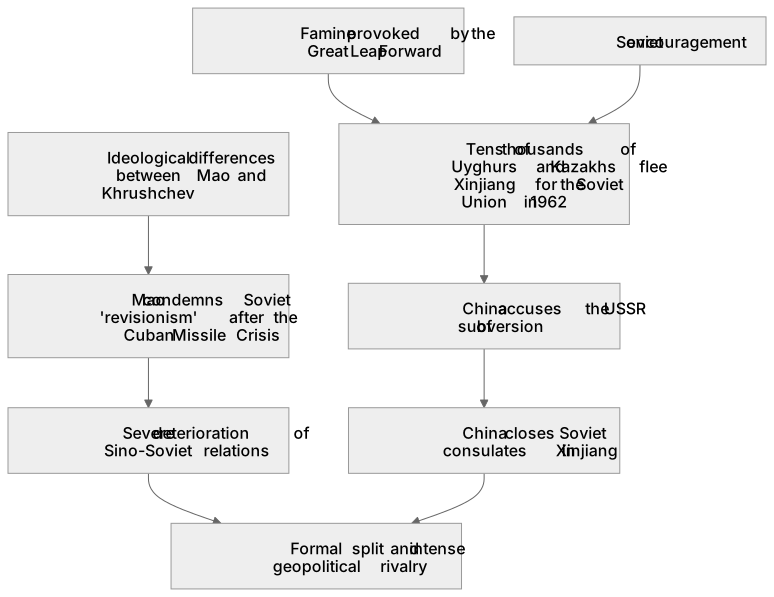
During 1962–1966, international relations were defined by the severe deterioration of Sino-Soviet relations, culminating in a formal split. Ideological differences between Mao and Khrushchev intensified, with Mao condemning Soviet 'revisionism' after the Cuban Missile Crisis. This rift manifested in physical border disputes, notably the conflict over Xinjiang. In 1962, tens of thousands of Uyghurs and Kazakhs fled Xinjiang for the Soviet Union, provoked by famine and Soviet encouragement. China accused the USSR of subversion and closed Soviet consulates in Xinjiang. This border tension highlighted the shift from communist solidarity to intense geopolitical rivalry, fundamentally altering Cold War dynamics and shaping China's defensive posture.
What earns the marks
- Analyse the ideological causes of the Sino-Soviet split, including Mao's accusations of Soviet revisionism.
- Evaluate the impact of the 1962 Xinjiang exodus on diplomatic relations between China and the Soviet Union.
- Assess how domestic failures, such as the aftermath of the Great Leap Forward, exacerbated border tensions in Xinjiang.
- Examine the geopolitical consequences of the Sino-Soviet split for the wider Cold War context between 1962 and 1966.
Common mistakes and how to put them right
Confusing the 1962 Xinjiang border incidents with the later 1969 Zhenbao Island clashes.
Put it right: Ensure the focus remains on the 1962 exodus of ethnic minorities from Xinjiang to the USSR.
Attributing the Sino-Soviet split solely to ideological differences.
Put it right: Discuss how ideological disputes were compounded by national security concerns and territorial conflicts like Xinjiang.
Ignoring the role of the local population in Xinjiang.
Put it right: Explicitly mention the agency and suffering of the Uyghur and Kazakh populations fleeing the famine.
Exam tips
- Link domestic policies (the famine caused by the Great Leap Forward) to foreign policy crises (the Xinjiang exodus).
- Use the term 'revisionism' accurately to explain Mao's ideological critique of Khrushchev and the Soviet leadership.
- When discussing international relations, evaluate how the Sino-Soviet split left China feeling encircled and vulnerable.
Try the lesson
The start of the 2P The Transformation of China, 1936–1997 – Reform and Control, 1962–1966 (A-level only): International relations: Sino-Soviet relations and conflict over Xinjiang lesson, made from checked teaching notes for this specification point.
Have a go first
What significant event occurred in the Xinjiang region in 1962 that severely escalated tensions between China and the Soviet Union?
Listen
During 1962–1966, international relations were defined by the severe deterioration of Sino-Soviet relations, culminating in a formal split. Ideological differences between Mao and Khrushchev intensified, with Mao condemning Soviet 'revisionism' after the Cuban Missile Crisis. This rift manifested in physical border disputes, notably the conflict over Xinjiang. In 1962, tens of thousands of Uyghurs and Kazakhs fled Xinjiang for the Soviet Union, provoked by famine and Soviet encouragement. China accused the USSR of subversion and closed Soviet consulates in Xinjiang. This border tension highlighted the shift from communist solidarity to intense geopolitical rivalry, fundamentally altering Cold War dynamics and shaping China's defensive posture. A strong answer earns marks for these points. Analyse the ideological causes of the Sino-Soviet split, including Mao's accusations of Soviet revisionism. Evaluate the impact of the 1962 Xinjiang exodus on diplomatic relations between China and the Soviet Union. Assess how domestic failures, such as the aftermath of the Great Leap Forward, exacerbated border tensions in Xinjiang. Examine the geopolitical consequences of the Sino-Soviet split for the wider Cold War context between 1962 and 1966.
See it
Key words
Say what each word means before you turn the card.
Ideological conflict
Try answering aloud or in your head before turning the card.
Geopolitics and borders
Try answering aloud or in your head before turning the card.
National security
Try answering aloud or in your head before turning the card.
Communist bloc fragmentation
Try answering aloud or in your head before turning the card.
See every definition
- Ideological conflict
- Differences between Mao and Khrushchev intensified, with Mao condemning Soviet 'revisionism' after the Cuban Missile Crisis.
- Geopolitics and borders
- The rift manifested in physical border disputes, notably the conflict over Xinjiang, highlighting a shift from communist solidarity to intense geopolitical rivalry.
- National security
- China accused the USSR of subversion and closed Soviet consulates in Xinjiang, shaping China's defensive posture.
- Communist bloc fragmentation
- Sino-Soviet relations deteriorated severely, culminating in a formal split that fundamentally altered Cold War dynamics.
Label the diagram
Some boxes have lost their names. Pick the right name for each number.
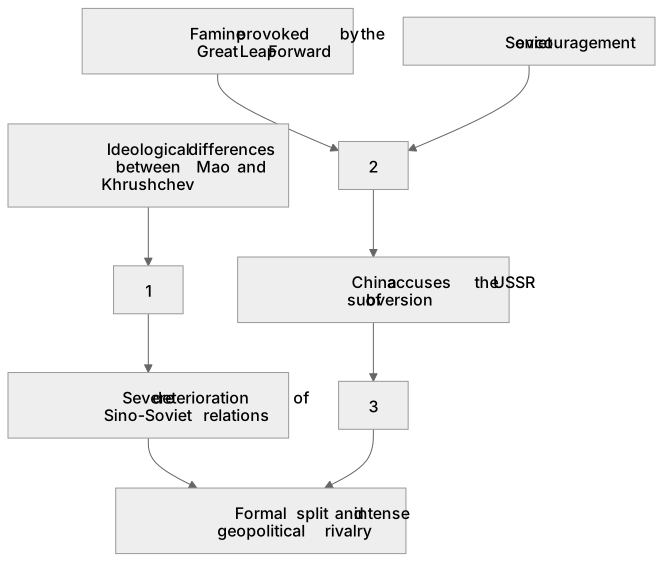
1Box 1
2Box 2
3Box 3
There is more to this lesson
The full lesson goes on to check your understanding and help you earn the marks. Create a free account to carry on, with your progress saved.
A week of Premium from your first lesson · Then the free plan continues · No card, no charge
Test your understanding of 2P The Transformation of China, 1936–1997 – Reform and Control, 1962–1966 (A-level only): International relations: Sino-Soviet relations and conflict over Xinjiang
Active recall beats re-reading. Take an instant quiz now to test what you’ve learned and lock it into long-term memory.
A week of Premium from your first lesson · Then the free plan continues · No card, no charge