AQA · A-Level · History
Course version: 7042 · Version from Sept 2017
The origins of the Cultural Revolution: the Shanghai radicals; Mao's aims;…
Full specification wording
2P The Transformation of China, 1936–1997 – The Cultural Revolution, 1966–1976 (A-level only): The origins of the Cultural Revolution: the Shanghai radicals; Mao's aims; political divisions and the power struggle within the CCP; the purge of the party leadership and the fall of Liu Shaoqi and Deng Xiaoping
The Cultural Revolution stemmed from Mao's desire to reassert dominance over the CCP after the Great Leap Forward.
Checked against the AQA 7042 specification (opens in a new tab) on .
- Point 1 of 4
- 4 key terms
Study notes
From the checked teaching notes for this specification point.
The idea
The Cultural Revolution stemmed from Mao's desire to reassert dominance over the CCP after the Great Leap Forward. His aims were ideological—preventing 'revisionism'—and personal, targeting political divisions and a power struggle with pragmatists. Mao allied with the Shanghai radicals, including Jiang Qing, who used cultural critiques like attacking the play 'Hai Rui Dismissed from Office' to launch the movement. This created a pretext for a sweeping purge of the party leadership. Consequently, pragmatists Liu Shaoqi and Deng Xiaoping, who had rebuilt the economy but sidelined Mao, were denounced as 'capitalist roaders' and fell from power, cementing Mao's absolute authority.
What earns the marks
- Explain Mao's ideological aims, specifically his fear of Soviet-style revisionism and his commitment to continuous revolution.
- Analyse the political divisions within the CCP, contrasting Mao's radicalism with the pragmatic economic policies of Liu Shaoqi and Deng Xiaoping.
- Evaluate the role of the Shanghai radicals, including Jiang Qing and Yao Wenyuan, in instigating the Cultural Revolution through cultural and literary criticism.
- Detail the mechanisms used to purge the party leadership, focusing on the mobilisation of the masses to bypass traditional party structures and remove Liu and Deng.
Common mistakes and how to put them right
Assuming the Cultural Revolution was purely an ideological movement.
Put it right: Acknowledge that it was also a calculated power struggle by Mao to eliminate political rivals like Liu Shaoqi.
Confusing the Shanghai radicals with the Red Guards.
Put it right: Distinguish the Shanghai radicals, a group of radical intellectuals and politicians, from the Red Guards, the mass student movement.
Stating that Deng Xiaoping was killed during the purges.
Put it right: Note that while Liu Shaoqi died in prison due to harsh treatment, Deng Xiaoping survived his internal exile and later returned to power.
Exam tips
- When discussing Mao's aims, explicitly link his ideological fear of revisionism to his personal fear of losing control over the CCP.
- Use the attack on the play 'Hai Rui Dismissed from Office' as a concrete example of how the Shanghai radicals initiated the political purge.
- Contrast the economic pragmatism of Liu and Deng with Mao's utopian vision to explain the root of the political divisions within the party leadership.
Try the lesson
The start of the 2P The Transformation of China, 1936–1997 – The Cultural Revolution, 1966–1976 (A-level only): The origins of the Cultural Revolution: the Shanghai radicals; Mao's aims; political divisions and the power struggle within the CCP; the purge of the party leadership and the fall of Liu Shaoqi and Deng Xiaoping lesson, made from checked teaching notes for this specification point.
Have a go first
Which group of political allies played a crucial role in launching the Cultural Revolution by supporting Mao Zedong's ideological aims in the press?
Listen
The Cultural Revolution stemmed from Mao's desire to reassert dominance over the CCP after the Great Leap Forward. His aims were ideological—preventing 'revisionism'—and personal, targeting political divisions and a power struggle with pragmatists. Mao allied with the Shanghai radicals, including Jiang Qing, who used cultural critiques like attacking the play 'Hai Rui Dismissed from Office' to launch the movement. This created a pretext for a sweeping purge of the party leadership. Consequently, pragmatists Liu Shaoqi and Deng Xiaoping, who had rebuilt the economy but sidelined Mao, were denounced as 'capitalist roaders' and fell from power, cementing Mao's absolute authority. A strong answer earns marks for these points. Explain Mao's ideological aims, specifically his fear of Soviet-style revisionism and his commitment to continuous revolution. Analyse the political divisions within the CCP, contrasting Mao's radicalism with the pragmatic economic policies of Liu Shaoqi and Deng Xiaoping. Evaluate the role of the Shanghai radicals, including Jiang Qing and Yao Wenyuan, in instigating the Cultural Revolution through cultural and literary criticism. Detail the mechanisms used to purge the party leadership, focusing on the mobilisation of the masses to bypass traditional party structures and remove Liu and Deng. A common slip: Assuming the Cultural Revolution was purely an ideological movement. Instead, Acknowledge that it was also a calculated power struggle by Mao to eliminate political rivals like Liu Shaoqi. Exam tip: When discussing Mao's aims, explicitly link his ideological fear of revisionism to his personal fear of losing control over the CCP.
See it
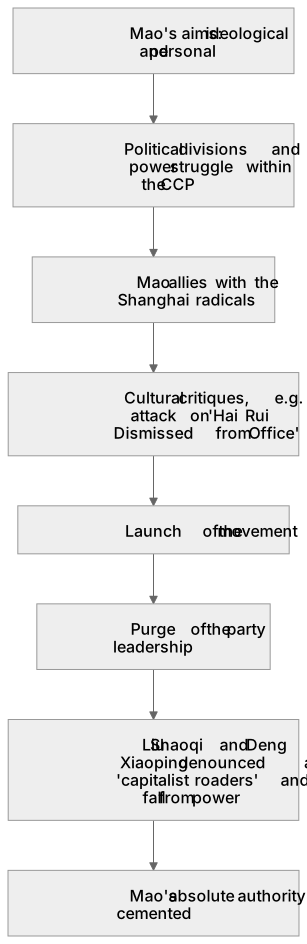
Put it in order
Put these steps in the order they happen.
- 1. Launch of the movement
- 2. Mao's absolute authority cemented
- 3. Purge of the party leadership
- 4. Mao's aims: ideological and personal
- 5. Political divisions and power struggle within the CCP
- 6. Liu Shaoqi and Deng Xiaoping denounced as 'capitalist roaders' and fall from power
- 7. Mao allies with the Shanghai radicals
- 8. Cultural critiques, e.g. attack on 'Hai Rui Dismissed from Office'
Key words
Say what each word means before you turn the card.
Ideology vs Pragmatism
Try answering aloud or in your head before turning the card.
Power and Authority
Try answering aloud or in your head before turning the card.
Factionalism
Try answering aloud or in your head before turning the card.
Mass Mobilisation
Try answering aloud or in your head before turning the card.
See every definition
- Ideology vs Pragmatism
- Mao's ideological aim of preventing 'revisionism' and commitment to continuous revolution contrasted with the pragmatic economic policies of Liu Shaoqi and Deng Xiaoping.
- Power and Authority
- Mao's desire to reassert dominance over the CCP and cement his absolute authority after the Great Leap Forward.
- Factionalism
- Political divisions and a power struggle within the CCP, with Mao allied with the Shanghai radicals against pragmatists in the party leadership.
- Mass Mobilisation
- The mobilisation of the masses to bypass traditional party structures and remove Liu and Deng.
Label the diagram
Some boxes have lost their names. Pick the right name for each number.
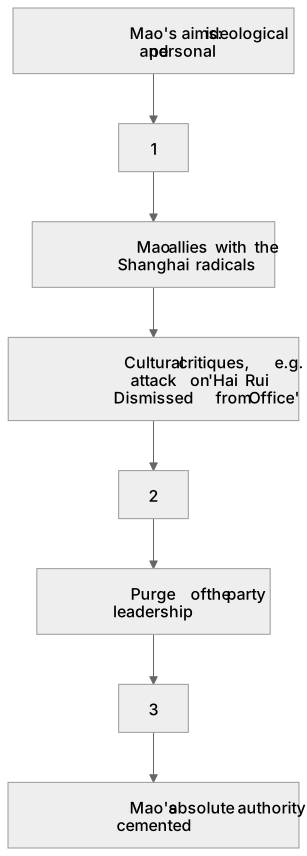
1Box 1
2Box 2
3Box 3
There is more to this lesson
The full lesson goes on to check your understanding and help you earn the marks. Create a free account to carry on, with your progress saved.
A week of Premium from your first lesson · Then the free plan continues · No card, no charge
Test your understanding of 2P The Transformation of China, 1936–1997 – The Cultural Revolution, 1966–1976 (A-level only): The origins of the Cultural Revolution: the Shanghai radicals; Mao's aims; political divisions and the power struggle within the CCP; the purge of the party leadership and the fall of Liu Shaoqi and Deng Xiaoping
Active recall beats re-reading. Take an instant quiz now to test what you’ve learned and lock it into long-term memory.
A week of Premium from your first lesson · Then the free plan continues · No card, no charge