AQA · A-Level · History
Course version: 7042 · Version from Sept 2017
China as a global power by 1997: diplomatic ties and role in UN Security…
Full specification wording
2P The Transformation of China, 1936–1997 – The PRC under Deng Xiaoping, 1976–1997 (A-level only): China as a global power by 1997: diplomatic ties and role in UN Security Council; IMF and World Bank; co-operation with Japan and growing trade links; improved relations with the USA and visits; Hong Kong regained
By 1997, China had transformed into a formidable global power, leveraging its permanent seat on the UN Security Council to assert diplomatic influence.
Checked against the AQA 7042 specification (opens in a new tab) on .
- Point 4 of 4
- 4 key terms
Study notes
From the checked teaching notes for this specification point.
The idea
By 1997, China had transformed into a formidable global power, leveraging its permanent seat on the UN Security Council to assert diplomatic influence. Integration into the global economy was accelerated by joining the IMF and World Bank in 1980, securing vital loans for modernisation. Regionally, China fostered co-operation with Japan, resulting in substantial Japanese investments and growing bilateral trade links. Improved relations with the USA were cemented through pivotal diplomatic visits, despite tensions over human rights and Taiwan, facilitating crucial trade agreements. This era of expanding international prestige culminated in the historic 1997 handover of Hong Kong from Britain, symbolising the end of a century of humiliation and confirming China's resurgence on the world stage.
What earns the marks
- Assess China's strategic use of its UN Security Council veto and diplomatic ties to protect its sovereignty and project global influence.
- Explain the significance of China's entry into the IMF and World Bank in 1980 for funding Deng's 'Four Modernisations'.
- Analyse the economic pragmatism driving co-operation with Japan, focusing on Japanese Official Development Assistance (ODA) and expanding trade links.
- Evaluate the trajectory of US-China relations, noting the impact of diplomatic visits and the balancing of economic interests against human rights disputes.
- Discuss the political and symbolic importance of regaining Hong Kong in 1997 under the 'One Country, Two Systems' framework.
Common mistakes and how to put them right
Claiming China joined the UN Security Council in the 1980s.
Put it right: Clarify that the PRC replaced the Republic of China (Taiwan) on the UN Security Council earlier, in 1971, but actively expanded its diplomatic role there by 1997.
Assuming US-China relations were entirely harmonious after normalisation.
Put it right: Highlight that relations fluctuated, particularly cooling after the 1989 Tiananmen Square crackdown, before stabilising due to mutual trade interests.
Stating Hong Kong was taken by military force in 1997.
Put it right: Explain that Hong Kong was regained through the peaceful 1984 Sino-British Joint Declaration, implementing the 'One Country, Two Systems' policy.
Exam tips
- Link China's membership in the IMF and World Bank directly to the success of Deng's domestic economic reforms to show interconnected knowledge.
- Use the 1997 handover of Hong Kong as a concluding milestone to evaluate the success of Deng Xiaoping's foreign policy and nationalist goals.
- When discussing Japan and the USA, emphasise Deng's pragmatic approach of prioritising trade and technological acquisition over ideological differences.
Try the lesson
The start of the 2P The Transformation of China, 1936–1997 – The PRC under Deng Xiaoping, 1976–1997 (A-level only): China as a global power by 1997: diplomatic ties and role in UN Security Council; IMF and World Bank; co-operation with Japan and growing trade links; improved relations with the USA and visits; Hong Kong regained lesson, made from checked teaching notes for this specification point.
Have a go first
Under which political principle was sovereignty over Hong Kong transferred from the United Kingdom to the People's Republic of China in 1997?
Listen
By 1997, China had transformed into a formidable global power, leveraging its permanent seat on the UN Security Council to assert diplomatic influence. Integration into the global economy was accelerated by joining the IMF and World Bank in 1980, securing vital loans for modernisation. Regionally, China fostered co-operation with Japan, resulting in substantial Japanese investments and growing bilateral trade links. Improved relations with the USA were cemented through pivotal diplomatic visits, despite tensions over human rights and Taiwan, facilitating crucial trade agreements. This era of expanding international prestige culminated in the historic 1997 handover of Hong Kong from Britain, symbolising the end of a century of humiliation and confirming China's resurgence on the world stage. A strong answer earns marks for these points. Assess China's strategic use of its UN Security Council veto and diplomatic ties to protect its sovereignty and project global influence. Explain the significance of China's entry into the IMF and World Bank in 1980 for funding Deng's 'Four Modernisations'. Analyse the economic pragmatism driving co-operation with Japan, focusing on Japanese Official Development Assistance (ODA) and expanding trade links. Evaluate the trajectory of US-China relations, noting the impact of diplomatic visits and the balancing of economic interests against human rights disputes. A common slip: Claiming China joined the UN Security Council in the 1980s. Instead, Clarify that the PRC replaced the Republic of China (Taiwan) on the UN Security Council earlier, in 1971, but actively expanded its diplomatic role there by 1997. Exam tip: Link China's membership in the IMF and World Bank directly to the success of Deng's domestic economic reforms to show interconnected knowledge.
See it

Key words
Say what each word means before you turn the card.
International diplomacy and global integration
Try answering aloud or in your head before turning the card.
Economic pragmatism and trade
Try answering aloud or in your head before turning the card.
Nationalism and sovereignty
Try answering aloud or in your head before turning the card.
Sino-Western relations
Try answering aloud or in your head before turning the card.
See every definition
- International diplomacy and global integration
- Using a permanent seat on the UN Security Council to assert diplomatic influence and joining the IMF and World Bank to accelerate integration into the global economy.
- Economic pragmatism and trade
- Prioritising trade and technological acquisition over ideological differences, driving co-operation with Japan and growing bilateral trade links.
- Nationalism and sovereignty
- Expanding international prestige and regaining Hong Kong in 1997, symbolising the end of a century of humiliation and confirming China's resurgence on the world stage.
- Sino-Western relations
- Improved relations with the USA cemented through pivotal diplomatic visits, despite tensions over human rights and Taiwan, facilitating crucial trade agreements.
Label the diagram
Some boxes have lost their names. Pick the right name for each number.
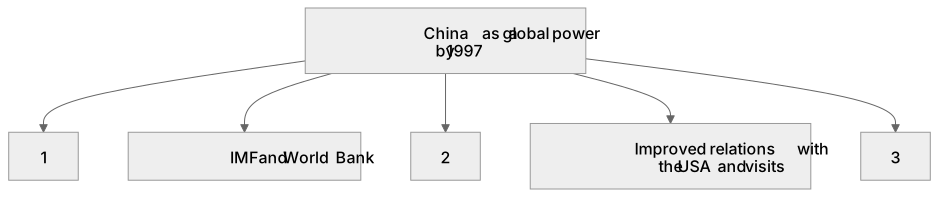
1Box 1
2Box 2
3Box 3
There is more to this lesson
The full lesson goes on to check your understanding and help you earn the marks. Create a free account to carry on, with your progress saved.
A week of Premium from your first lesson · Then the free plan continues · No card, no charge
Test your understanding of 2P The Transformation of China, 1936–1997 – The PRC under Deng Xiaoping, 1976–1997 (A-level only): China as a global power by 1997: diplomatic ties and role in UN Security Council; IMF and World Bank; co-operation with Japan and growing trade links; improved relations with the USA and visits; Hong Kong regained
Active recall beats re-reading. Take an instant quiz now to test what you’ve learned and lock it into long-term memory.
A week of Premium from your first lesson · Then the free plan continues · No card, no charge