AQA · A-Level · History
Course version: 7042 · Version from Sept 2017
Economic developments: the 'Four Modernisations' and economic growth;…
Full specification wording
2P The Transformation of China, 1936–1997 – The PRC under Deng Xiaoping, 1976–1997 (A-level only): Economic developments: the 'Four Modernisations' and economic growth; agriculture; industry; defence; science and technology
The Four Modernisations, first proposed by Zhou Enlai in 1964 and reiterated in 1975, were adopted by Deng Xiaoping after 1978 to transform China's economy.
Checked against the AQA 7042 specification (opens in a new tab) on .
- Point 2 of 4
- 4 key terms
Study notes
From the checked teaching notes for this specification point.
The idea
The Four Modernisations, first proposed by Zhou Enlai in 1964 and reiterated in 1975, were adopted by Deng Xiaoping after 1978 to transform China's economy. They targeted agriculture, industry, defence, and science and technology. In agriculture, the household responsibility system replaced collective farming, boosting output and rural incomes. Industry saw the growth of township and village enterprises and special economic zones, attracting foreign investment. Defence modernisation aimed to create a professional military. Science and technology benefited from increased funding and overseas study. These reforms drove rapid economic growth but also created regional inequalities and social tensions, posing new challenges for the Party.
What earns the marks
- Explains the origins and aims of the Four Modernisations, including Zhou Enlai’s 1964 proposal and Deng Xiaoping's adoption after 1978.
- Describes agricultural reforms, such as the household responsibility system, and their impact on output and rural incomes.
- Analyses industrial changes, including township and village enterprises and special economic zones, and their role in economic growth.
- Assesses developments in defence and science and technology, for example military professionalisation and increased research funding, and evaluates the overall economic growth and its consequences.
Common mistakes and how to put them right
Attributing the Four Modernisations solely to Deng Xiaoping or claiming they were first proposed in 1975.
Put it right: Zhou Enlai first proposed them in 1964; 1975 was a reiteration, and Deng adopted and implemented them after 1978.
Claiming that agricultural reforms immediately abolished collective farming nationwide.
Put it right: The household responsibility system was introduced gradually and varied by region.
Stating that special economic zones were established across the whole country.
Put it right: They were limited to specific coastal areas, such as Shenzhen, Zhuhai and Shantou, to control foreign influence.
Exam tips
- Use specific examples to illustrate each modernisation: for agriculture, the household responsibility system; for industry, special economic zones; for defence, the reduction of the People’s Liberation Army; for science and technology, the 863 Programme.
- Link economic growth to broader consequences, such as urbanisation, inequality, and the Tiananmen Square protests of 1989.
- When discussing defence and science and technology, explain how they supported economic modernisation and China’s global standing.
Try the lesson
The start of the 2P The Transformation of China, 1936–1997 – The PRC under Deng Xiaoping, 1976–1997 (A-level only): Economic developments: the 'Four Modernisations' and economic growth; agriculture; industry; defence; science and technology lesson, made from checked teaching notes for this specification point.
Have a go first
Which of the following areas was NOT one of the 'Four Modernisations' championed by Deng Xiaoping?
Listen
The Four Modernisations, first proposed by Zhou Enlai in 1964 and reiterated in 1975, were adopted by Deng Xiaoping after 1978 to transform China's economy. They targeted agriculture, industry, defence, and science and technology. In agriculture, the household responsibility system replaced collective farming, boosting output and rural incomes. Industry saw the growth of township and village enterprises and special economic zones, attracting foreign investment. Defence modernisation aimed to create a professional military. Science and technology benefited from increased funding and overseas study. These reforms drove rapid economic growth but also created regional inequalities and social tensions, posing new challenges for the Party. A strong answer earns marks for these points. Explains the origins and aims of the Four Modernisations, including Zhou Enlai’s 1964 proposal and Deng Xiaoping's adoption after 1978. Describes agricultural reforms, such as the household responsibility system, and their impact on output and rural incomes. Analyses industrial changes, including township and village enterprises and special economic zones, and their role in economic growth. Assesses developments in defence and science and technology, for example military professionalisation and increased research funding, and evaluates the overall economic growth and its consequences. A common slip: Attributing the Four Modernisations solely to Deng Xiaoping or claiming they were first proposed in 1975. Instead, Zhou Enlai first proposed them in 1964; 1975 was a reiteration, and Deng adopted and implemented them after 1978. Exam tip: Use specific examples to illustrate each modernisation: for agriculture, the household responsibility system; for industry, special economic zones; for defence, the reduction of the People’s Liberation Army; for science and technology, the 863 Programme.
See it

Key words
Say what each word means before you turn the card.
Four Modernisations
Try answering aloud or in your head before turning the card.
Household responsibility system
Try answering aloud or in your head before turning the card.
Township and village enterprises
Try answering aloud or in your head before turning the card.
Special economic zones
Try answering aloud or in your head before turning the card.
See every definition
- Four Modernisations
- First proposed by Zhou Enlai in 1964 and reiterated in 1975, they were adopted by Deng Xiaoping after 1978 to transform China's economy.
- Household responsibility system
- Replaced collective farming in agriculture, boosting output and rural incomes.
- Township and village enterprises
- Part of industrial change, growing alongside special economic zones that attracted foreign investment.
- Special economic zones
- Limited to specific coastal areas to control foreign influence, they attracted foreign investment as part of industrial change.
Label the diagram
Some boxes have lost their names. Pick the right name for each number.
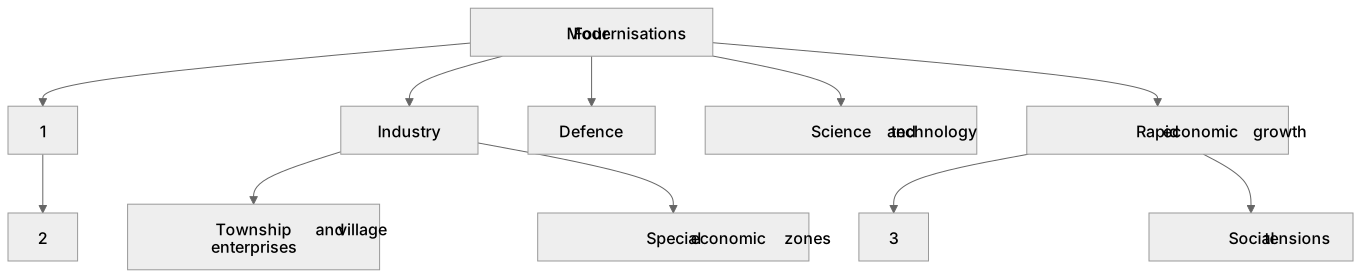
1Box 1
2Box 2
3Box 3
There is more to this lesson
The full lesson goes on to check your understanding and help you earn the marks. Create a free account to carry on, with your progress saved.
A week of Premium from your first lesson · Then the free plan continues · No card, no charge
Test your understanding of 2P The Transformation of China, 1936–1997 – The PRC under Deng Xiaoping, 1976–1997 (A-level only): Economic developments: the 'Four Modernisations' and economic growth; agriculture; industry; defence; science and technology
Active recall beats re-reading. Take an instant quiz now to test what you’ve learned and lock it into long-term memory.
A week of Premium from your first lesson · Then the free plan continues · No card, no charge