AQA · A-Level · History
Course version: 7042 · Version from Sept 2017
Foreign affairs: Korea; the Sino-Soviet split; clashes and the breakdown…
Full specification wording
2P The Transformation of China, 1936–1997 – The transition to Socialism, 1952–1962: Foreign affairs: Korea; the Sino-Soviet split; clashes and the breakdown of relations between Khrushchev and Mao
China's foreign policy from 1952 to 1962 was defined by its assertion of independence and shifting communist alliances.
Checked against the AQA 7042 specification (opens in a new tab) on .
- Point 4 of 4
Study notes
From the checked teaching notes for this specification point.
The idea
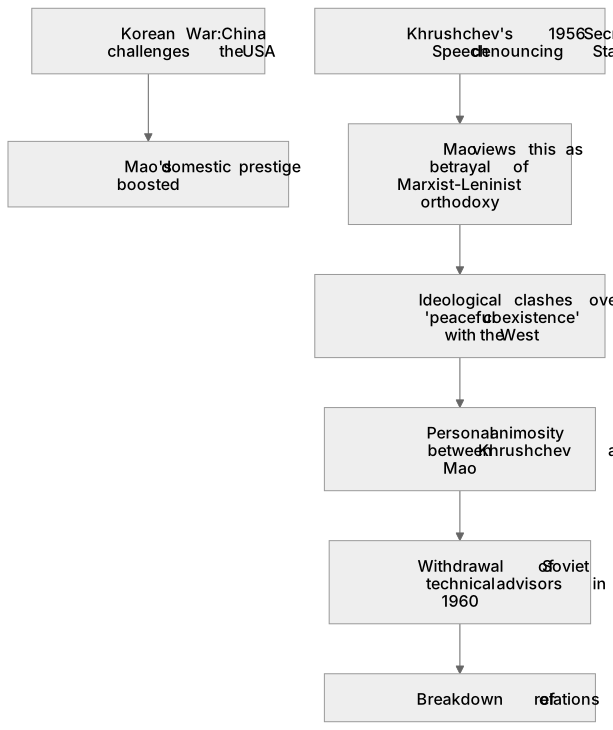
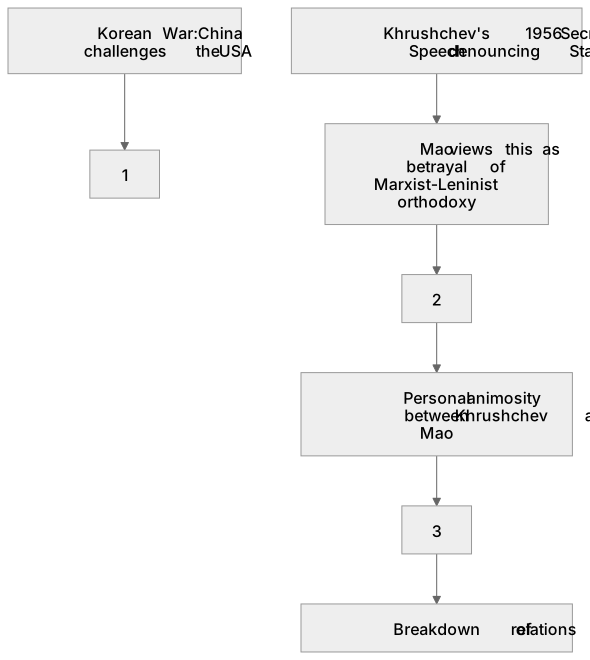
China's foreign policy from 1952 to 1962 was defined by its assertion of independence and shifting communist alliances. Intervention in the Korean War established China as a formidable military power capable of challenging the USA, boosting Mao's domestic prestige despite massive casualties. However, the Sino-Soviet split fractured the communist bloc. Relations deteriorated rapidly after Khrushchev's 1956 Secret Speech denouncing Stalin, which Mao viewed as a betrayal of Marxist-Leninist orthodoxy. Ideological clashes intensified over Khrushchev's policy of 'peaceful coexistence' with the West. Personal animosity between Khrushchev and Mao culminated in the withdrawal of Soviet technical advisors in 1960, cementing the breakdown of relations.
What earns the marks
- Evaluate the impact of the Korean War on China's international standing and its domestic consolidation of power.
- Analyse the ideological differences that contributed to the Sino-Soviet split, particularly differing views on Marxist-Leninist orthodoxy.
- Assess the significance of Khrushchev's Secret Speech and 'peaceful coexistence' in triggering the breakdown of relations with Mao.
- Examine the practical consequences of the split, such as the withdrawal of Soviet economic and technical advisors from China in 1960.
Common mistakes and how to put them right
Assuming the Sino-Soviet split happened overnight.
Put it right: It was a gradual deterioration of relations spanning several years of ideological and personal clashes.
Believing China and the Soviet Union fought directly in the Korean War.
Put it right: The USSR provided air support and supplies, but Chinese 'volunteers' provided the ground troops.
Overlooking the personal rivalry between Mao and Khrushchev.
Put it right: Ideological differences were exacerbated by Mao's perception of Khrushchev as an inferior leader.
Exam tips
- Connect China's involvement in Korea to the domestic 'Resist America, Aid Korea' campaign to show how foreign affairs influenced internal social control.
- Use the 1958 Taiwan Strait Crisis as a concrete example of Mao testing Khrushchev's commitment to supporting China militarily.
- Contrast Mao's aggressive stance on global revolution with Khrushchev's pursuit of peaceful coexistence to highlight their ideological divergence.
Try the lesson
The start of the 2P The Transformation of China, 1936–1997 – The transition to Socialism, 1952–1962: Foreign affairs: Korea; the Sino-Soviet split; clashes and the breakdown of relations between Khrushchev and Mao lesson, made from checked teaching notes for this specification point.
Have a go first
Which ideological shift by Nikita Khrushchev in 1956 significantly contributed to the deterioration of relations between the Soviet Union and Mao's China?
Listen
China's foreign policy from 1952 to 1962 was defined by its assertion of independence and shifting communist alliances. Intervention in the Korean War established China as a formidable military power capable of challenging the USA, boosting Mao's domestic prestige despite massive casualties. However, the Sino-Soviet split fractured the communist bloc. Relations deteriorated rapidly after Khrushchev's 1956 Secret Speech denouncing Stalin, which Mao viewed as a betrayal of Marxist-Leninist orthodoxy. Ideological clashes intensified over Khrushchev's policy of 'peaceful coexistence' with the West. Personal animosity between Khrushchev and Mao culminated in the withdrawal of Soviet technical advisors in 1960, cementing the breakdown of relations. A strong answer earns marks for these points. Evaluate the impact of the Korean War on China's international standing and its domestic consolidation of power. Analyse the ideological differences that contributed to the Sino-Soviet split, particularly differing views on Marxist-Leninist orthodoxy. Assess the significance of Khrushchev's Secret Speech and 'peaceful coexistence' in triggering the breakdown of relations with Mao. Examine the practical consequences of the split, such as the withdrawal of Soviet economic and technical advisors from China in 1960. Exam tip: Connect China's involvement in Korea to the domestic 'Resist America, Aid Korea' campaign to show how foreign affairs influenced internal social control.
See it
Put the events in order
Put these events in the order they happened, earliest first.
- 1. Khrushchev's Secret Speech denouncing Stalin
- 2. Soviet technical advisors withdrawn from China
- 3. Mao tested Khrushchev's commitment in the Taiwan Strait Crisis
Label the diagram
Some boxes have lost their names. Pick the right name for each number.
1Box 1
2Box 2
3Box 3
There is more to this lesson
The full lesson goes on to check your understanding and help you earn the marks. Create a free account to carry on, with your progress saved.
A week of Premium from your first lesson · Then the free plan continues · No card, no charge
Test your understanding of 2P The Transformation of China, 1936–1997 – The transition to Socialism, 1952–1962: Foreign affairs: Korea; the Sino-Soviet split; clashes and the breakdown of relations between Khrushchev and Mao
Active recall beats re-reading. Take an instant quiz now to test what you’ve learned and lock it into long-term memory.
A week of Premium from your first lesson · Then the free plan continues · No card, no charge