AQA · A-Level · History
Course version: 7042 · Version from Sept 2017
Reality and illusion, 1945–1980 – John F Kennedy and the 'New Frontier',…
Full specification wording
2Q The American Dream: reality and illusion, 1945–1980 – John F Kennedy and the 'New Frontier', 1960–1963: The presidential election of 1960 and reasons for Kennedy’s victory; the policies and personalities of the Kennedy administration; the ideas behind the ‘New Frontier’
The 1960 election pitted John F. Kennedy against Richard Nixon.
Checked against the AQA 7042 specification (opens in a new tab) on .
- Point 1 of 4
Study notes
From the checked teaching notes for this specification point.
The idea
The 1960 election pitted John F. Kennedy against Richard Nixon. Kennedy’s narrow victory hinged on his mastery of television during the first televised debates, his choice of Lyndon B. Johnson to secure Southern votes, and his appeal to African American voters. In office, Kennedy surrounded himself with 'the best and the brightest' personalities, including Robert Kennedy as Attorney General. His domestic agenda, the 'New Frontier', was driven by the idea of tackling uncharted challenges in science and social prejudice. Key policies included creating the Peace Corps, raising the minimum wage, and funding the Apollo programme, though conservative opposition in Congress frequently stalled his broader civil rights and healthcare ambitions.
What earns the marks
- Evaluate the impact of the televised debates and Kennedy's visual appeal versus Nixon's experience in the 1960 election outcome.
- Assess the strategic importance of Lyndon B. Johnson in delivering Texas and the wider South for the Democratic ticket.
- Analyse the influence of key personalities like Robert Kennedy and Robert McNamara on the administration's dynamic and policy direction.
- Examine the successes and failures of 'New Frontier' policies, contrasting executive actions like the Peace Corps with legislative defeats in healthcare.
Common mistakes and how to put them right
Claiming Kennedy won a landslide victory.
Put it right by noting that the popular vote margin was extremely narrow, at roughly 100,000 votes.
Assuming the 'New Frontier' was entirely successful.
Put it right by explaining that a conservative coalition in Congress blocked much of his domestic legislation.
Ignoring the role of personalities.
Put it right: Ensure you discuss how figures like Robert Kennedy actively shaped the administration's approach to civil rights and justice.
Exam tips
- Contrast Kennedy's rhetoric and the idealism of the 'New Frontier' with the practical legislative realities he faced in Congress.
- Use specific examples of Kennedy's campaign strategy, such as his phone call to Coretta Scott King, to explain his appeal to minority voters.
- When discussing his administration, explicitly name key figures like McNamara or Rusk to demonstrate detailed knowledge of his cabinet.
Try the lesson
The start of the 2Q The American Dream: reality and illusion, 1945–1980 – John F Kennedy and the 'New Frontier', 1960–1963: The presidential election of 1960 and reasons for Kennedy’s victory; the policies and personalities of the Kennedy administration; the ideas behind the ‘New Frontier’ lesson, made from checked teaching notes for this specification point.
Have a go first
Which of the following was a significant factor contributing to John F. Kennedy's victory in the 1960 presidential election?
Listen
The 1960 election pitted John F. Kennedy against Richard Nixon. Kennedy’s narrow victory hinged on his mastery of television during the first televised debates, his choice of Lyndon B. Johnson to secure Southern votes, and his appeal to African American voters. In office, Kennedy surrounded himself with 'the best and the brightest' personalities, including Robert Kennedy as Attorney General. His domestic agenda, the 'New Frontier', was driven by the idea of tackling uncharted challenges in science and social prejudice. Key policies included creating the Peace Corps, raising the minimum wage, and funding the Apollo programme, though conservative opposition in Congress frequently stalled his broader civil rights and healthcare ambitions. A strong answer earns marks for these points. Evaluate the impact of the televised debates and Kennedy's visual appeal versus Nixon's experience in the 1960 election outcome. Assess the strategic importance of Lyndon B. Johnson in delivering Texas and the wider South for the Democratic ticket. Analyse the influence of key personalities like Robert Kennedy and Robert McNamara on the administration's dynamic and policy direction. Examine the successes and failures of 'New Frontier' policies, contrasting executive actions like the Peace Corps with legislative defeats in healthcare. A common slip: Claiming Kennedy won a landslide victory. Instead, noting that the popular vote margin was extremely narrow, at roughly 100,000 votes. Exam tip: Contrast Kennedy's rhetoric and the idealism of the 'New Frontier' with the practical legislative realities he faced in Congress.
See it
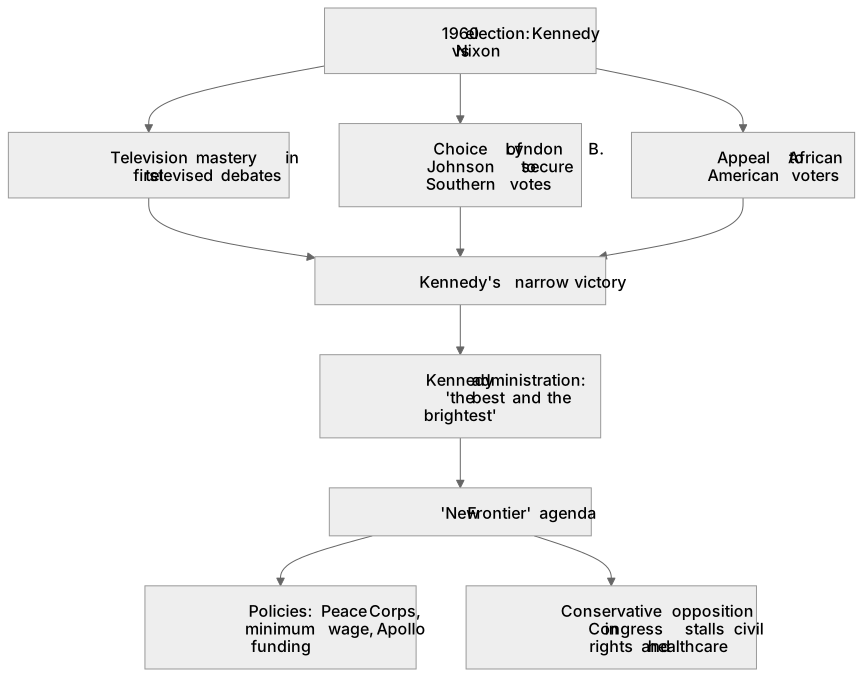
Label the diagram
Some boxes have lost their names. Pick the right name for each number.
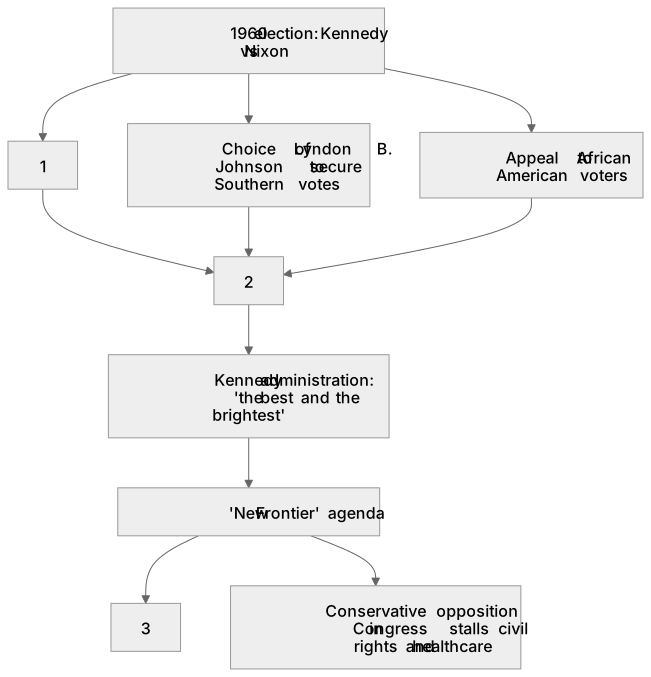
1Box 1
2Box 2
3Box 3
There is more to this lesson
The full lesson goes on to check your understanding and help you earn the marks. Create a free account to carry on, with your progress saved.
A week of Premium from your first lesson · Then the free plan continues · No card, no charge
Test your understanding of 2Q The American Dream: reality and illusion, 1945–1980 – John F Kennedy and the 'New Frontier', 1960–1963: The presidential election of 1960 and reasons for Kennedy’s victory; the policies and personalities of the Kennedy administration; the ideas behind the ‘New Frontier’
Active recall beats re-reading. Take an instant quiz now to test what you’ve learned and lock it into long-term memory.
A week of Premium from your first lesson · Then the free plan continues · No card, no charge