AQA · A-Level · History
Course version: 7042 · Version from Sept 2017
Reality and illusion, 1945–1980 – John F Kennedy and the 'New Frontier',…
Full specification wording
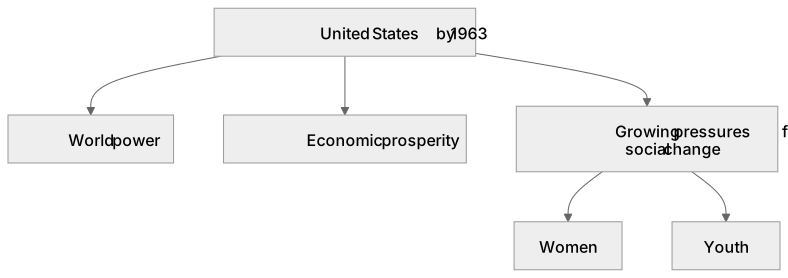
2Q The American Dream: reality and illusion, 1945–1980 – John F Kennedy and the 'New Frontier', 1960–1963: The United States by 1963: its position as a world power; economic prosperity; the growing pressures for social change from women and youth
By 1963, the United States stood as a dominant global superpower, having navigated the Cuban Missile Crisis and expanded its nuclear arsenal, though Cold War tensions remained high.
Checked against the AQA 7042 specification (opens in a new tab) on .
- Point 4 of 4
- 4 key terms
Study notes
From the checked teaching notes for this specification point.
The idea
By 1963, the United States stood as a dominant global superpower, having navigated the Cuban Missile Crisis and expanded its nuclear arsenal, though Cold War tensions remained high. Domestically, the nation enjoyed unprecedented economic prosperity, characterised by low inflation, rising wages, and a booming consumer culture stimulated by Kennedy's policies. However, beneath this affluent veneer, growing pressures for social change emerged. Women began challenging traditional domestic roles, spurred by Betty Friedan’s 1963 publication of 'The Feminine Mystique' and the Presidential Commission on the Status of Women. Simultaneously, a burgeoning youth culture, influenced by the baby boom and early anti-establishment sentiments, began to question conformity, laying the groundwork for the radical counterculture of the later 1960s.
What earns the marks
- Assess the United States' international standing by 1963, focusing on its military supremacy and leadership role in the Cold War following the Cuban Missile Crisis.
- Analyse the indicators of economic prosperity in the early 1960s, including consumerism, suburban growth, and the impact of Kennedy's economic policies.
- Evaluate the origins of the modern feminist movement, referencing the impact of 'The Feminine Mystique' and the Presidential Commission on the Status of Women.
- Explain the emergence of youth rebellion and counterculture, driven by demographic shifts (the baby boom) and dissatisfaction with 1950s conformity.
Common mistakes and how to put them right
Confusing the nascent youth and women's movements of 1963 with the fully developed radical movements of the late 1960s.
Put it right: Focus on the early, foundational pressures for change in 1963, such as the publication of 'The Feminine Mystique', rather than later events like Woodstock or radical feminism.
Assuming economic prosperity was universally experienced by all Americans.
Put it right: Acknowledge that while the national economy boomed, significant pockets of poverty remained, which Kennedy's 'New Frontier' attempted to address.
Overlooking the connection between the Cold War and domestic prosperity.
Put it right: Recognise that high defence spending was a major driver of the economic boom and technological advancement during this period.
Exam tips
- Use Betty Friedan's 'The Feminine Mystique' as a concrete example of the intellectual catalyst for the women's movement in 1963.
- Link the demographic reality of the 'baby boom' to the growing economic and cultural power of the youth demographic by 1963.
- When discussing the US as a world power, balance its military strength with the ongoing anxieties of the Cold War nuclear threat.
Try the lesson
The start of the 2Q The American Dream: reality and illusion, 1945–1980 – John F Kennedy and the 'New Frontier', 1960–1963: The United States by 1963: its position as a world power; economic prosperity; the growing pressures for social change from women and youth lesson, made from checked teaching notes for this specification point.
Have a go first
Which of the following best characterises the state of the United States economy by the end of 1963?
Listen
By 1963, the United States stood as a dominant global superpower, having navigated the Cuban Missile Crisis and expanded its nuclear arsenal, though Cold War tensions remained high. Domestically, the nation enjoyed unprecedented economic prosperity, characterised by low inflation, rising wages, and a booming consumer culture stimulated by Kennedy's policies. However, beneath this affluent veneer, growing pressures for social change emerged. Women began challenging traditional domestic roles, spurred by Betty Friedan’s 1963 publication of 'The Feminine Mystique' and the Presidential Commission on the Status of Women. Simultaneously, a burgeoning youth culture, influenced by the baby boom and early anti-establishment sentiments, began to question conformity, laying the groundwork for the radical counterculture of the later 1960s. A strong answer earns marks for these points. Assess the United States' international standing by 1963, focusing on its military supremacy and leadership role in the Cold War following the Cuban Missile Crisis. Analyse the indicators of economic prosperity in the early 1960s, including consumerism, suburban growth, and the impact of Kennedy's economic policies. Evaluate the origins of the modern feminist movement, referencing the impact of 'The Feminine Mystique' and the Presidential Commission on the Status of Women. Explain the emergence of youth rebellion and counterculture, driven by demographic shifts (the baby boom) and dissatisfaction with 1950s conformity. A common slip: Confusing the nascent youth and women's movements of 1963 with the fully developed radical movements of the late 1960s. Instead, Focus on the early, foundational pressures for change in 1963, such as the publication of 'The Feminine Mystique', rather than later events like Woodstock or radical feminism. Exam tip: Use Betty Friedan's 'The Feminine Mystique' as a concrete example of the intellectual catalyst for the women's movement in 1963.
See it
Key words
Say what each word means before you turn the card.
Cold War Superpower
Try answering aloud or in your head before turning the card.
Economic Affluence
Try answering aloud or in your head before turning the card.
Social Change
Try answering aloud or in your head before turning the card.
Demographic Shifts
Try answering aloud or in your head before turning the card.
See every definition
- Cold War Superpower
- A dominant global power that had navigated the Cuban Missile Crisis and expanded its nuclear arsenal, though Cold War tensions remained high.
- Economic Affluence
- Unprecedented economic prosperity characterised by low inflation, rising wages, and a booming consumer culture stimulated by Kennedy's policies.
- Social Change
- Growing pressures from women and youth, with women challenging traditional domestic roles and a burgeoning youth culture questioning conformity.
- Demographic Shifts
- The baby boom, which influenced a burgeoning youth culture and laid the groundwork for the radical counterculture of the later 1960s.
Label the diagram
Some boxes have lost their names. Pick the right name for each number.
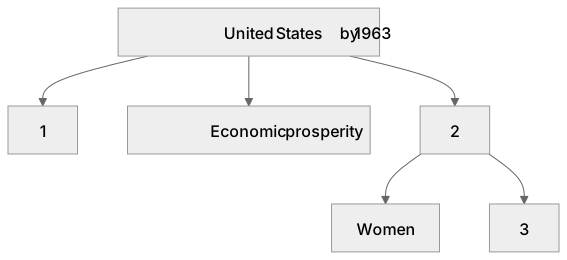
1Box 1
2Box 2
3Box 3
There is more to this lesson
The full lesson goes on to check your understanding and help you earn the marks. Create a free account to carry on, with your progress saved.
A week of Premium from your first lesson · Then the free plan continues · No card, no charge
Test your understanding of 2Q The American Dream: reality and illusion, 1945–1980 – John F Kennedy and the 'New Frontier', 1960–1963: The United States by 1963: its position as a world power; economic prosperity; the growing pressures for social change from women and youth
Active recall beats re-reading. Take an instant quiz now to test what you’ve learned and lock it into long-term memory.
A week of Premium from your first lesson · Then the free plan continues · No card, no charge