AQA · A-Level · History
Course version: 7042 · Version from Sept 2017
Reality and illusion, 1945–1980 – Republican reaction: the Nixon…
Full specification wording
2Q The American Dream: reality and illusion, 1945–1980 – Republican reaction: the Nixon Presidency, 1968–1974 (A-level only): The limits of American world power: peace negotiations and the continuation of the war in Vietnam and Cambodia; the influence of Kissinger on US policies towards the USSR, Latin America and China
Nixon's era exposed the limits of American world power.
Checked against the AQA 7042 specification (opens in a new tab) on .
- Point 3 of 4
- 2 key terms
Study notes
From the checked teaching notes for this specification point.
The idea
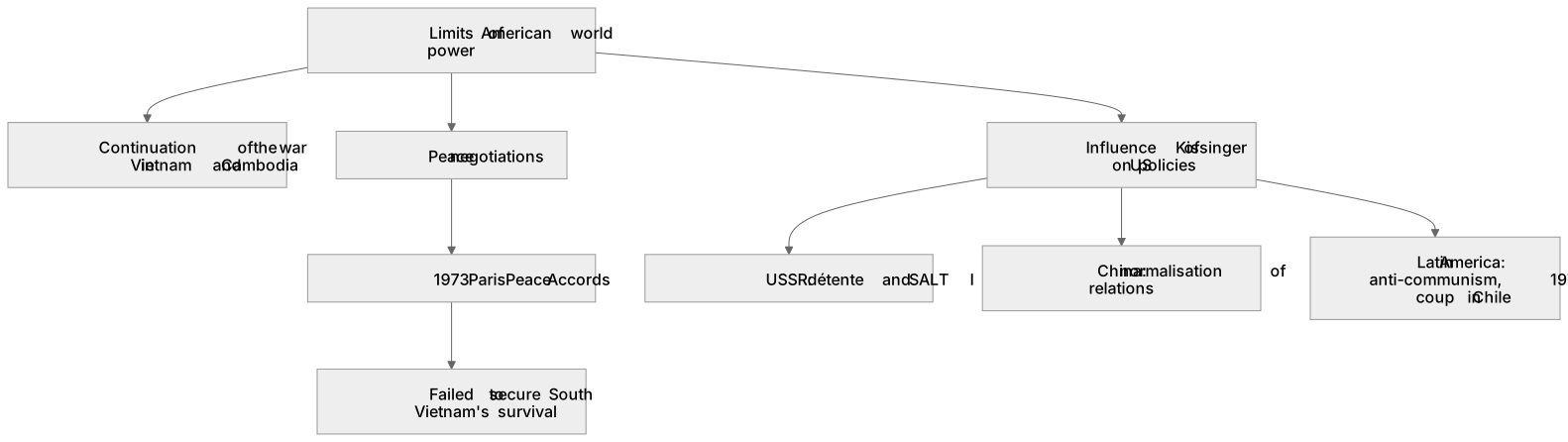
Nixon's era exposed the limits of American world power. The continuation of the war in Vietnam and the secret bombing of Cambodia highlighted severe military constraints. Peace negotiations dragged on until the 1973 Paris Peace Accords, failing to secure South Vietnam's survival. Concurrently, Henry Kissinger exerted immense influence over US foreign policy through realpolitik. He orchestrated détente with the USSR, yielding the SALT I treaty, and facilitated the historic normalisation of relations with China. In Latin America, Kissinger prioritised anti-communism, notably backing the 1973 coup against Allende in Chile. This demonstrated a ruthless assertion of regional hegemony, even as global American dominance waned.
What earns the marks
- Evaluate the effectiveness of Nixon's 'Vietnamization' and the impact of expanding the conflict into Cambodia.
- Assess the outcomes of the Paris Peace Accords and whether they represented a genuine peace or merely a US exit strategy.
- Analyse Kissinger's role in shaping détente with the USSR, including the significance of the SALT I agreement.
- Examine the strategic motivations and consequences of opening diplomatic channels with the People's Republic of China.
- Discuss the application of realpolitik in Latin America, specifically US involvement in the Chilean coup of 1973.
Common mistakes and how to put them right
Claiming Nixon immediately ended the Vietnam War.
Put it right: Nixon prolonged the war for four years while negotiating and expanding bombing into Cambodia.
Confusing the roles of Nixon and Kissinger.
Put it right: While Nixon was President, Kissinger was the primary architect of foreign policy, serving as National Security Advisor and later Secretary of State.
Assuming détente meant an end to the Cold War.
Put it right: Détente was a relaxation of tensions and a management strategy, not a resolution of the underlying ideological conflict with the USSR.
Exam tips
- Use the concept of 'realpolitik' to link Kissinger's policies across different regions, showing a cohesive foreign policy strategy.
- Contrast the diplomatic successes in China and the USSR with the military and political failures in Vietnam to evaluate the 'limits of power'.
- Be prepared to discuss how domestic pressures, such as the anti-war movement, influenced foreign policy decisions and peace negotiations.
Try the lesson
The start of the 2Q The American Dream: reality and illusion, 1945–1980 – Republican reaction: the Nixon Presidency, 1968–1974 (A-level only): The limits of American world power: peace negotiations and the continuation of the war in Vietnam and Cambodia; the influence of Kissinger on US policies towards the USSR, Latin America and China lesson, made from checked teaching notes for this specification point.
Have a go first
What was the primary purpose of Henry Kissinger's secret trip to Beijing in July 1971?
Listen
Nixon's era exposed the limits of American world power. The continuation of the war in Vietnam and the secret bombing of Cambodia highlighted severe military constraints. Peace negotiations dragged on until the 1973 Paris Peace Accords, failing to secure South Vietnam's survival. Concurrently, Henry Kissinger exerted immense influence over US foreign policy through realpolitik. He orchestrated détente with the USSR, yielding the SALT I treaty, and facilitated the historic normalisation of relations with China. In Latin America, Kissinger prioritised anti-communism, notably backing the 1973 coup against Allende in Chile. This demonstrated a ruthless assertion of regional hegemony, even as global American dominance waned. A strong answer earns marks for these points. Evaluate the effectiveness of Nixon's 'Vietnamization' and the impact of expanding the conflict into Cambodia. Assess the outcomes of the Paris Peace Accords and whether they represented a genuine peace or merely a US exit strategy. Analyse Kissinger's role in shaping détente with the USSR, including the significance of the SALT I agreement. Examine the strategic motivations and consequences of opening diplomatic channels with the People's Republic of China. A common slip: Claiming Nixon immediately ended the Vietnam War. Instead, Nixon prolonged the war for four years while negotiating and expanding bombing into Cambodia. Exam tip: Use the concept of 'realpolitik' to link Kissinger's policies across different regions, showing a cohesive foreign policy strategy.
See it
Key words
Say what each word means before you turn the card.
The limits of military intervention
Try answering aloud or in your head before turning the card.
Cold War diplomacy and détente
Try answering aloud or in your head before turning the card.
See every definition
- The limits of military intervention
- The constraints exposed by the continuation of the war in Vietnam and the secret bombing of Cambodia during the Nixon era.
- Cold War diplomacy and détente
- A relaxation of tensions and a management strategy, not a resolution of the underlying ideological conflict with the USSR.
Label the diagram
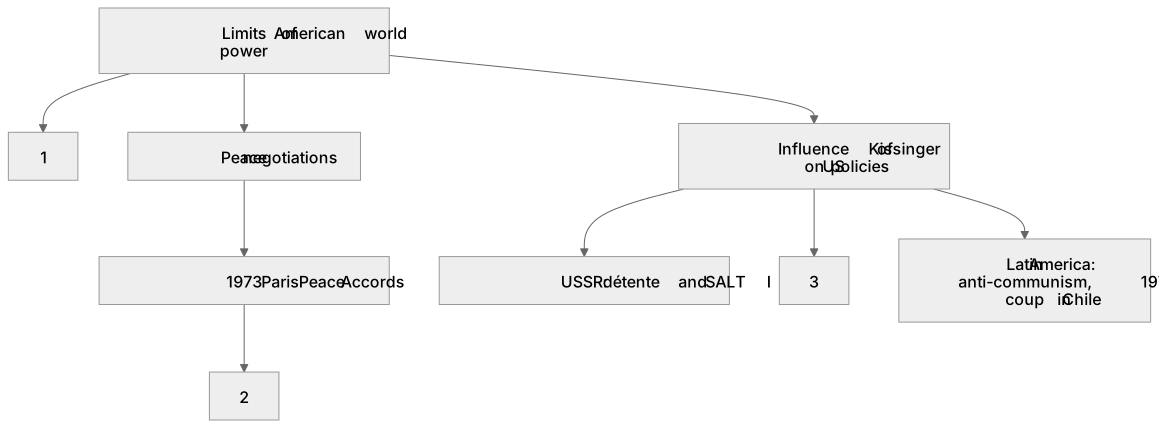
Some boxes have lost their names. Pick the right name for each number.
1Box 1
2Box 2
3Box 3
There is more to this lesson
The full lesson goes on to check your understanding and help you earn the marks. Create a free account to carry on, with your progress saved.
A week of Premium from your first lesson · Then the free plan continues · No card, no charge
Test your understanding of 2Q The American Dream: reality and illusion, 1945–1980 – Republican reaction: the Nixon Presidency, 1968–1974 (A-level only): The limits of American world power: peace negotiations and the continuation of the war in Vietnam and Cambodia; the influence of Kissinger on US policies towards the USSR, Latin America and China
Active recall beats re-reading. Take an instant quiz now to test what you’ve learned and lock it into long-term memory.
A week of Premium from your first lesson · Then the free plan continues · No card, no charge