AQA · A-Level · History
Course version: 7042 · Version from Sept 2017
Pressures on USSR: the crisis in Czechoslovakia and the Brezhnev doctrine;…
Full specification wording
2R The Cold War, c1945–1991 – Confrontation and cooperation, c1963–1972 (A-level only): Pressures on USSR: the crisis in Czechoslovakia and the Brezhnev doctrine; relations with China
The late 1960s presented severe pressures on the USSR.
Checked against the AQA 7042 specification (opens in a new tab) on .
- Point 4 of 4
- 3 key terms
Study notes
From the checked teaching notes for this specification point.
The idea
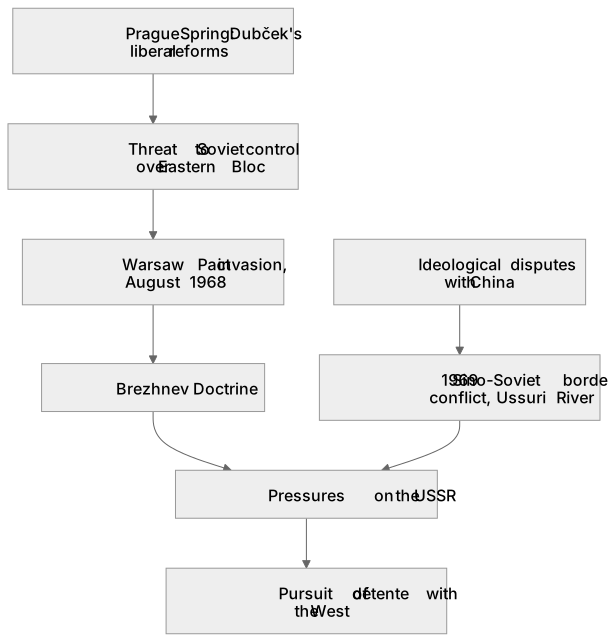
The late 1960s presented severe pressures on the USSR. In Czechoslovakia, Alexander Dubček's 1968 'Prague Spring' introduced liberal reforms, threatening Soviet control over the Eastern Bloc. Fearing a domino effect, Warsaw Pact forces invaded in August 1968 to crush the movement. This crisis prompted the Brezhnev Doctrine, asserting the USSR's right to intervene in any socialist country where communist rule was threatened. Simultaneously, relations with China deteriorated sharply due to ideological disputes, culminating in the 1969 Sino-Soviet border conflict along the Ussuri River. These dual pressures forced the USSR to manage internal bloc dissent while facing a hostile rival, influencing its pursuit of détente with the West.
What earns the marks
- Explain the motivations behind the 'Prague Spring' and how Dubček's 'socialism with a human face' threatened Soviet hegemony.
- Analyse the justification provided by the Brezhnev Doctrine for the Warsaw Pact invasion of Czechoslovakia in 1968.
- Evaluate the causes and consequences of the Sino-Soviet split, focusing on the 1969 Ussuri River border clashes.
- Assess how the dual pressures of Eastern Bloc instability and Chinese hostility motivated the USSR to pursue détente with the West.
Common mistakes and how to put them right
Confusing the Brezhnev Doctrine with the Truman Doctrine.
Put it right: Ensure the Brezhnev Doctrine is defined as the Soviet policy justifying intervention in socialist states to protect communism, whereas the Truman Doctrine was the US policy of containment.
Assuming the Prague Spring was an attempt to overthrow communism.
Put it right: Clarify that Dubček sought to reform communism ('socialism with a human face'), not to abolish it or leave the Warsaw Pact.
Treating the Sino-Soviet split as a purely ideological disagreement.
Put it right: Highlight that while ideology was a factor, national security, border disputes, and competition for leadership of the communist world were equally significant.
Exam tips
- Link the Brezhnev Doctrine directly to the events in Czechoslovakia to demonstrate an understanding of cause and effect.
- Use the 1969 Ussuri River conflict as a concrete example of how ideological differences between the USSR and China escalated into military confrontation.
- When discussing pressures on the USSR, contrast the internal pressure from the Eastern Bloc with the external pressure from China to provide a balanced analysis.
Try the lesson
The start of the 2R The Cold War, c1945–1991 – Confrontation and cooperation, c1963–1972 (A-level only): Pressures on USSR: the crisis in Czechoslovakia and the Brezhnev doctrine; relations with China lesson, made from checked teaching notes for this specification point.
Have a go first
What was the primary justification provided by the Brezhnev Doctrine for the 1968 Warsaw Pact invasion of Czechoslovakia?
Listen
The late 1960s presented severe pressures on the USSR. In Czechoslovakia, Alexander Dubček's 1968 'Prague Spring' introduced liberal reforms, threatening Soviet control over the Eastern Bloc. Fearing a domino effect, Warsaw Pact forces invaded in August 1968 to crush the movement. This crisis prompted the Brezhnev Doctrine, asserting the USSR's right to intervene in any socialist country where communist rule was threatened. Simultaneously, relations with China deteriorated sharply due to ideological disputes, culminating in the 1969 Sino-Soviet border conflict along the Ussuri River. These dual pressures forced the USSR to manage internal bloc dissent while facing a hostile rival, influencing its pursuit of détente with the West. A strong answer earns marks for these points. Explain the motivations behind the 'Prague Spring' and how Dubček's 'socialism with a human face' threatened Soviet hegemony. Analyse the justification provided by the Brezhnev Doctrine for the Warsaw Pact invasion of Czechoslovakia in 1968. Evaluate the causes and consequences of the Sino-Soviet split, focusing on the 1969 Ussuri River border clashes. Assess how the dual pressures of Eastern Bloc instability and Chinese hostility motivated the USSR to pursue détente with the West. A common slip: Confusing the Brezhnev Doctrine with the Truman Doctrine. Instead, Ensure the Brezhnev Doctrine is defined as the Soviet policy justifying intervention in socialist states to protect communism, whereas the Truman Doctrine was the US policy of containment. Exam tip: Link the Brezhnev Doctrine directly to the events in Czechoslovakia to demonstrate an understanding of cause and effect.
See it
Key words
Say what each word means before you turn the card.
Brezhnev Doctrine
Try answering aloud or in your head before turning the card.
Prague Spring
Try answering aloud or in your head before turning the card.
Sino-Soviet border conflict
Try answering aloud or in your head before turning the card.
See every definition
- Brezhnev Doctrine
- A policy asserting the USSR's right to intervene in any socialist country where communist rule was threatened.
- Prague Spring
- Alexander Dubček's 1968 introduction of liberal reforms in Czechoslovakia, threatening Soviet control over the Eastern Bloc.
- Sino-Soviet border conflict
- The 1969 conflict along the Ussuri River, culminating from sharply deteriorating relations with China due to ideological disputes.
Label the diagram
Some boxes have lost their names. Pick the right name for each number.
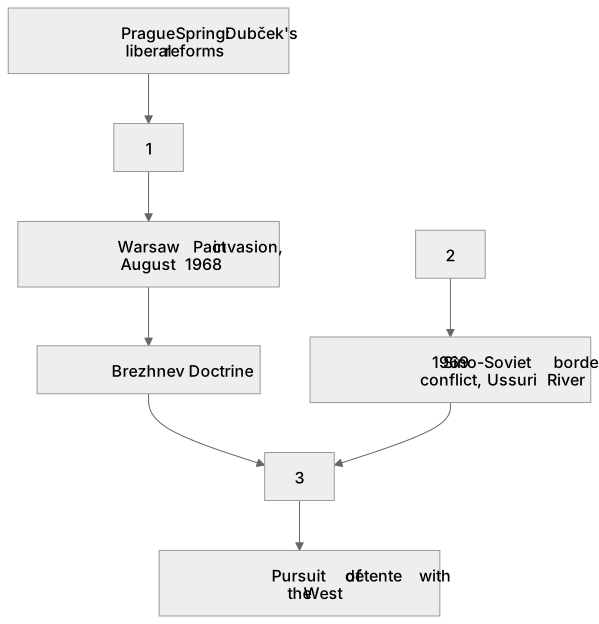
1Box 1
2Box 2
3Box 3
There is more to this lesson
The full lesson goes on to check your understanding and help you earn the marks. Create a free account to carry on, with your progress saved.
A week of Premium from your first lesson · Then the free plan continues · No card, no charge
Test your understanding of 2R The Cold War, c1945–1991 – Confrontation and cooperation, c1963–1972 (A-level only): Pressures on USSR: the crisis in Czechoslovakia and the Brezhnev doctrine; relations with China
Active recall beats re-reading. Take an instant quiz now to test what you’ve learned and lock it into long-term memory.
A week of Premium from your first lesson · Then the free plan continues · No card, no charge