AQA · A-Level · History
Course version: 7042 · Version from Sept 2017
The ending of Cold War tensions in Asia: Afghanistan; the Americas: Cuba,…
Full specification wording
2R The Cold War, c1945–1991 – The ending of the Cold War, 1985–1991 (A-level only): The ending of Cold War tensions in Asia: Afghanistan; the Americas: Cuba, Nicaragua and El Salvador; Africa: Angola and Ethiopia; the end of the Cold War: the Malta summit and its aftermath, including the reunification of Germany; the collapse of the USSR and resignation of Gorbachev
The late 1980s saw the global de-escalation of Cold War proxy conflicts.
Checked against the AQA 7042 specification (opens in a new tab) on .
- Point 4 of 4
- 4 key terms
Study notes
From the checked teaching notes for this specification point.
The idea
The late 1980s saw the global de-escalation of Cold War proxy conflicts. In Asia, Gorbachev withdrew Soviet troops from Afghanistan by 1989, ending a draining quagmire. In the Americas, Soviet subsidies to Cuba ceased, while peace accords were negotiated in Nicaragua and El Salvador, reducing US-Soviet friction. In Africa, superpower disengagement facilitated peace settlements in Angola and the fall of the Marxist regime in Ethiopia. The 1989 Malta Summit between Bush and Gorbachev symbolically ended the Cold War, paving the way for the rapid reunification of Germany in 1990. Ultimately, Gorbachev's domestic reforms failed to prevent nationalist uprisings, leading to the collapse of the USSR and his resignation in December 1991.
What earns the marks
- Explain the impact of Soviet economic decline on Gorbachev's decision to withdraw from Afghanistan and cut subsidies to Cuba and Marxist regimes in Africa.
- Analyse how the cessation of superpower funding facilitated negotiated settlements in Central America, specifically Nicaragua and El Salvador.
- Evaluate the significance of the 1989 Malta Summit as a diplomatic milestone that formally acknowledged the end of the Cold War.
- Assess the rapid process of German reunification in 1990 and how Gorbachev's non-interventionist stance enabled it.
- Examine the internal political and economic pressures, including the August 1991 coup, that culminated in the dissolution of the USSR and Gorbachev's resignation.
Common mistakes and how to put them right
Claiming the Malta Summit caused the fall of the Berlin Wall.
Put it right: The Berlin Wall fell weeks before the Malta Summit; the summit acknowledged the changing reality rather than causing the wall's collapse.
Assuming the US militarily defeated the USSR in proxy wars like Angola and Ethiopia.
Put it right: The conflicts ended primarily because the USSR could no longer afford to fund its allies, leading to mutual superpower disengagement.
Confusing Gorbachev's resignation with the fall of the Berlin Wall.
Put it right: The Berlin Wall fell in November 1989, whereas Gorbachev resigned over two years later in December 1991 following the collapse of the Soviet Union.
Exam tips
- Link regional de-escalation in Asia, Africa, and the Americas directly to Gorbachev's 'New Political Thinking' and the Soviet economic crisis.
- When discussing German reunification, highlight the diplomatic negotiations, such as the Two Plus Four Agreement, that secured Soviet agreement for a unified Germany to join NATO.
- Use the August 1991 coup attempt as a pivotal turning point that fatally undermined Gorbachev's authority and accelerated the collapse of the USSR.
Try the lesson
The start of the 2R The Cold War, c1945–1991 – The ending of the Cold War, 1985–1991 (A-level only): The ending of Cold War tensions in Asia: Afghanistan; the Americas: Cuba, Nicaragua and El Salvador; Africa: Angola and Ethiopia; the end of the Cold War: the Malta summit and its aftermath, including the reunification of Germany; the collapse of the USSR and resignation of Gorbachev lesson, made from checked teaching notes for this specification point.
Have a go first
Which agreement, signed in 1988, established the formal framework for the withdrawal of Soviet military forces from Afghanistan?
Listen
The late 1980s saw the global de-escalation of Cold War proxy conflicts. In Asia, Gorbachev withdrew Soviet troops from Afghanistan by 1989, ending a draining quagmire. In the Americas, Soviet subsidies to Cuba ceased, while peace accords were negotiated in Nicaragua and El Salvador, reducing US-Soviet friction. In Africa, superpower disengagement facilitated peace settlements in Angola and the fall of the Marxist regime in Ethiopia. The 1989 Malta Summit between Bush and Gorbachev symbolically ended the Cold War, paving the way for the rapid reunification of Germany in 1990. Ultimately, Gorbachev's domestic reforms failed to prevent nationalist uprisings, leading to the collapse of the USSR and his resignation in December 1991. A strong answer earns marks for these points. Explain the impact of Soviet economic decline on Gorbachev's decision to withdraw from Afghanistan and cut subsidies to Cuba and Marxist regimes in Africa. Analyse how the cessation of superpower funding facilitated negotiated settlements in Central America, specifically Nicaragua and El Salvador. Evaluate the significance of the 1989 Malta Summit as a diplomatic milestone that formally acknowledged the end of the Cold War. Assess the rapid process of German reunification in 1990 and how Gorbachev's non-interventionist stance enabled it. A common slip: Claiming the Malta Summit caused the fall of the Berlin Wall. Instead, The Berlin Wall fell weeks before the Malta Summit; the summit acknowledged the changing reality rather than causing the wall's collapse. Exam tip: Link regional de-escalation in Asia, Africa, and the Americas directly to Gorbachev's 'New Political Thinking' and the Soviet economic crisis.
See it
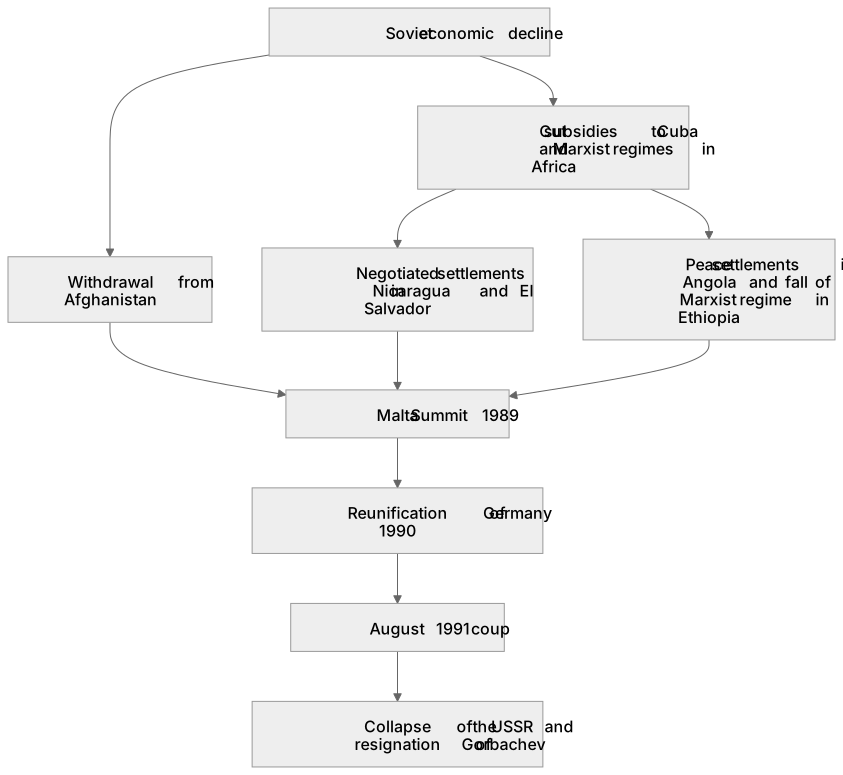
Put the events in order
Put these events in the order they happened, earliest first.
- 1. Soviet troops withdrawn from Afghanistan
- 2. Collapse of the USSR and resignation of Gorbachev
- 3. Rapid reunification of Germany
Key words
Say what each word means before you turn the card.
Superpower diplomacy and de-escalation
Try answering aloud or in your head before turning the card.
Economic decline and imperial overstretch
Try answering aloud or in your head before turning the card.
Nationalism and the collapse of empires
Try answering aloud or in your head before turning the card.
Proxy wars and regional conflicts
Try answering aloud or in your head before turning the card.
See every definition
- Superpower diplomacy and de-escalation
- The late 1980s saw the global de-escalation of Cold War proxy conflicts, with the 1989 Malta Summit between Bush and Gorbachev symbolically ending the Cold War.
- Economic decline and imperial overstretch
- The USSR could no longer afford to fund its allies, and Soviet economic decline shaped Gorbachev's decisions to withdraw from Afghanistan and cut subsidies.
- Nationalism and the collapse of empires
- Gorbachev's domestic reforms failed to prevent nationalist uprisings, leading to the collapse of the USSR and his resignation in December 1991.
- Proxy wars and regional conflicts
- Superpower disengagement facilitated peace settlements in Angola and the fall of the Marxist regime in Ethiopia, while peace accords were negotiated in Nicaragua and El Salvador.
Label the diagram
Some boxes have lost their names. Pick the right name for each number.
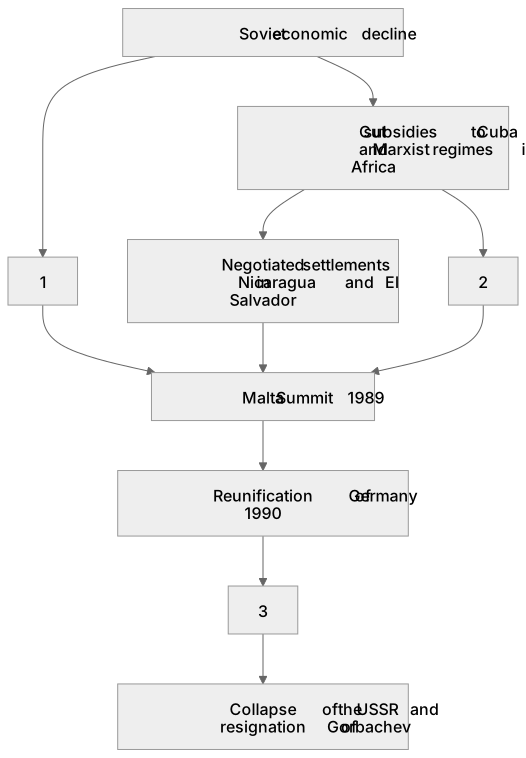
1Box 1
2Box 2
3Box 3
There is more to this lesson
The full lesson goes on to check your understanding and help you earn the marks. Create a free account to carry on, with your progress saved.
A week of Premium from your first lesson · Then the free plan continues · No card, no charge
Test your understanding of 2R The Cold War, c1945–1991 – The ending of the Cold War, 1985–1991 (A-level only): The ending of Cold War tensions in Asia: Afghanistan; the Americas: Cuba, Nicaragua and El Salvador; Africa: Angola and Ethiopia; the end of the Cold War: the Malta summit and its aftermath, including the reunification of Germany; the collapse of the USSR and resignation of Gorbachev
Active recall beats re-reading. Take an instant quiz now to test what you’ve learned and lock it into long-term memory.
A week of Premium from your first lesson · Then the free plan continues · No card, no charge