AQA · A-Level · History
Course version: 7042 · Version from Sept 2017
Economic developments: post-war boom; balance of payments issues and…
Full specification wording
2S The Making of Modern Britain, 1951–2007 – The Affluent Society, 1951–1964: Economic developments: post-war boom; balance of payments issues and 'stop-go' policies
The 1951–1964 period saw a sustained post-war economic boom, characterised by full employment, rising wages, and increased consumer credit.
Checked against the AQA 7042 specification (opens in a new tab) on .
- Point 2 of 4
- 3 key terms
Study notes
From the checked teaching notes for this specification point.
The idea
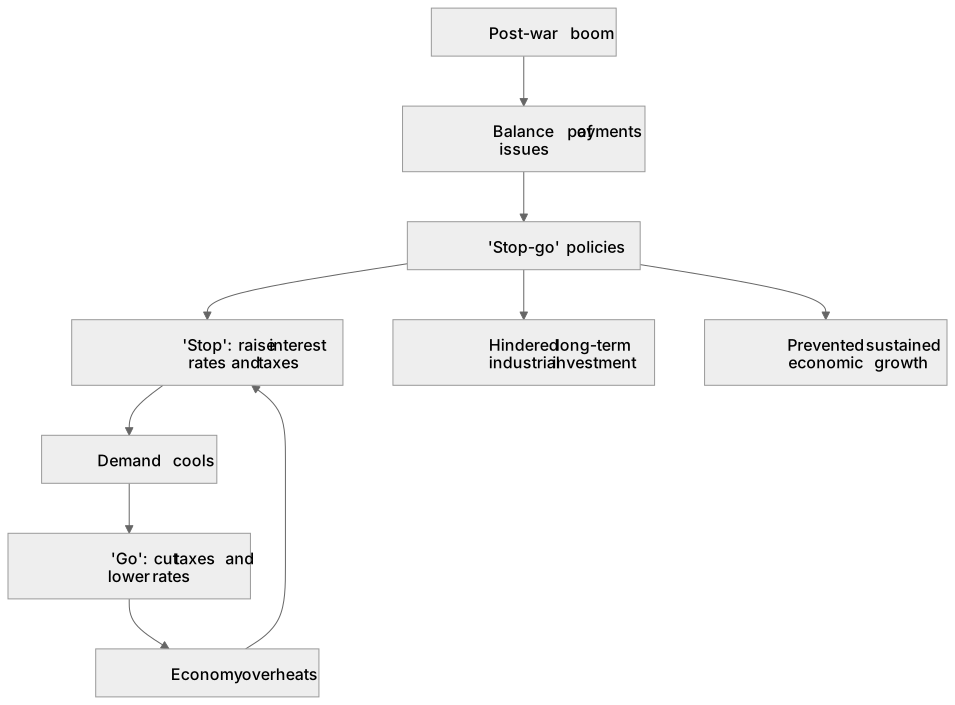
The 1951–1964 period saw a sustained post-war economic boom, characterised by full employment, rising wages, and increased consumer credit. However, this prosperity masked structural weaknesses, notably persistent balance of payments issues where import costs frequently exceeded export revenues, threatening the pound's value. To manage inflationary pressures and protect sterling, Conservative Chancellors utilised 'stop-go' policies. When the economy overheated, they applied the 'stop' by raising interest rates and taxes. Once demand cooled, they initiated the 'go' phase by cutting taxes and lowering rates. This cycle hindered long-term industrial investment and prevented sustained economic growth despite the superficial affluence.
What earns the marks
- Explain the features of the post-war boom, such as full employment, rising real wages, and the expansion of consumer credit.
- Analyse the causes of balance of payments deficits, specifically the UK's high propensity to import consumer goods compared to its export performance.
- Evaluate the mechanics of 'stop-go' economics, detailing how interest rates and taxation were manipulated to control demand.
- Assess the long-term impact of 'stop-go' policies on British industry, noting how fluctuating demand discouraged long-term capital investment.
Common mistakes and how to put them right
Confusing the balance of payments with the government budget deficit.
Put it right: The former relates to international trade (imports versus exports), while the latter concerns government income versus expenditure.
Assuming 'stop-go' policies were entirely successful.
Put it right: While they managed short-term crises, they failed to address underlying structural weaknesses in British manufacturing.
Exam tips
- Use specific examples of Chancellors, such as Peter Thorneycroft or Derick Heathcoat-Amory, to illustrate the application of 'stop-go' policies.
- Link economic policies directly to political outcomes, such as how 'go' phases were often timed to coincide with general elections to secure Conservative victories.
- Contrast the superficial affluence of the era with the underlying economic indicators, such as Britain's declining share of world trade, to build a nuanced evaluation.
Try the lesson
The start of the 2S The Making of Modern Britain, 1951–2007 – The Affluent Society, 1951–1964: Economic developments: post-war boom; balance of payments issues and 'stop-go' policies lesson, made from checked teaching notes for this specification point.
Have a go first
What was the primary characteristic of the 'stop-go' economic policies used by British governments between 1951 and 1964?
Listen
The 1951–1964 period saw a sustained post-war economic boom, characterised by full employment, rising wages, and increased consumer credit. However, this prosperity masked structural weaknesses, notably persistent balance of payments issues where import costs frequently exceeded export revenues, threatening the pound's value. To manage inflationary pressures and protect sterling, Conservative Chancellors utilised 'stop-go' policies. When the economy overheated, they applied the 'stop' by raising interest rates and taxes. Once demand cooled, they initiated the 'go' phase by cutting taxes and lowering rates. This cycle hindered long-term industrial investment and prevented sustained economic growth despite the superficial affluence. A strong answer earns marks for these points. Explain the features of the post-war boom, such as full employment, rising real wages, and the expansion of consumer credit. Analyse the causes of balance of payments deficits, specifically the UK's high propensity to import consumer goods compared to its export performance. Evaluate the mechanics of 'stop-go' economics, detailing how interest rates and taxation were manipulated to control demand. Assess the long-term impact of 'stop-go' policies on British industry, noting how fluctuating demand discouraged long-term capital investment. Exam tip: Use specific examples of Chancellors, such as Peter Thorneycroft or Derick Heathcoat-Amory, to illustrate the application of 'stop-go' policies.
See it
Key words
Say what each word means before you turn the card.
Post-war boom
Try answering aloud or in your head before turning the card.
Balance of payments issues
Try answering aloud or in your head before turning the card.
'Stop-go' policies
Try answering aloud or in your head before turning the card.
See every definition
- Post-war boom
- A sustained period of prosperity marked by full employment, rising wages and increased consumer credit.
- Balance of payments issues
- Persistent problems where import costs frequently exceeded export revenues, threatening the pound's value.
- 'Stop-go' policies
- Policies used by Conservative Chancellors to manage inflationary pressures and protect sterling by raising interest rates and taxes, then cutting them once demand cooled.
Label the diagram
Some boxes have lost their names. Pick the right name for each number.
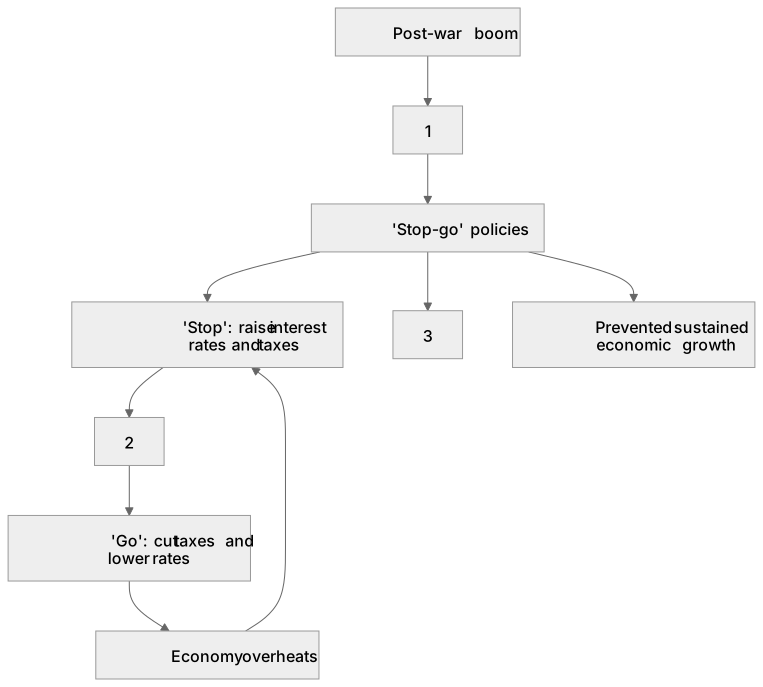
1Box 1
2Box 2
3Box 3
There is more to this lesson
The full lesson goes on to check your understanding and help you earn the marks. Create a free account to carry on, with your progress saved.
A week of Premium from your first lesson · Then the free plan continues · No card, no charge
Test your understanding of 2S The Making of Modern Britain, 1951–2007 – The Affluent Society, 1951–1964: Economic developments: post-war boom; balance of payments issues and 'stop-go' policies
Active recall beats re-reading. Take an instant quiz now to test what you’ve learned and lock it into long-term memory.
A week of Premium from your first lesson · Then the free plan continues · No card, no charge