AQA · A-Level · History
Course version: 7042 · Version from Sept 2017
Foreign relations: EFTA and attempts to join the EEC; relations with and…
Full specification wording
2S The Making of Modern Britain, 1951–2007 – The Affluent Society, 1951–1964: Foreign relations: EFTA and attempts to join the EEC; relations with and policies towards USA and USSR; debates over the nuclear deterrent; Korean War; Suez; the ‘Winds of Change' and decolonisation
Between 1951 and 1964, Britain's global role shifted.
Checked against the AQA 7042 specification (opens in a new tab) on .
- Point 4 of 4
- 4 key terms
Study notes
From the checked teaching notes for this specification point.
The idea
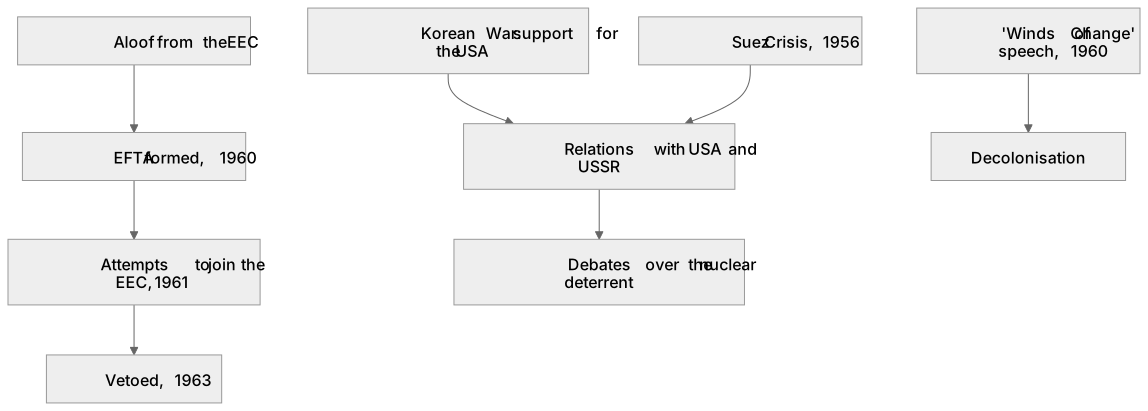
Between 1951 and 1964, Britain's global role shifted. Initially aloof from the EEC, Britain formed EFTA in 1960 but made attempts to join the EEC in 1961, only to be vetoed in 1963. Foreign relations with and policies towards USA and USSR were complex; Britain supported the USA in the Korean War but faced humiliation during the 1956 Suez Crisis when US pressure forced a withdrawal, highlighting diminished superpower status. This era saw intense debates over the nuclear deterrent, spurred by CND. Finally, Macmillan’s 1960 'Winds of Change' speech acknowledged the inevitability of African independence, accelerating decolonisation as Britain adjusted to its reduced imperial standing.
What earns the marks
- Assess the impact of the 1956 Suez Crisis and the Korean War on foreign relations with and policies towards USA and USSR, and Britain's self-perception as a global power.
- Evaluate the economic and political motivations behind the formation of EFTA in 1960 and attempts to join the EEC in 1961, and the significance of de Gaulle's veto.
- Analyse the domestic debates over the nuclear deterrent, including the influence of the Campaign for Nuclear Disarmament (CND).
- Explain the drivers of decolonisation, using Macmillan's 'Winds of Change' speech as a turning point in imperial policy.
Common mistakes and how to put them right
Claiming Britain joined the EEC in the 1960s.
Put it right: State that Britain formed EFTA in 1960 and its 1961 attempts to join the EEC were vetoed in 1963; entry did not occur until 1973.
Viewing the Suez Crisis solely as a military defeat.
Put it right: Explain that Suez was a political and economic failure caused by a lack of US support and a run on the pound, not a military defeat.
Assuming decolonisation was entirely peaceful and voluntary.
Put it right: Acknowledge that while some transitions following the 'Winds of Change' speech were smooth, others involved conflict, and the process was often driven by economic necessity and nationalist pressure.
Exam tips
- Link foreign policy failures, such as Suez and the failed attempts to join the EEC, to Britain's relative economic decline during this period.
- Use the Korean War and the debates over the nuclear deterrent to illustrate Britain's complex relations with and policies towards USA and USSR.
- When discussing decolonisation, explicitly reference the 'Winds of Change' speech to demonstrate an understanding of shifting Conservative policy.
Try the lesson
The start of the 2S The Making of Modern Britain, 1951–2007 – The Affluent Society, 1951–1964: Foreign relations: EFTA and attempts to join the EEC; relations with and policies towards USA and USSR; debates over the nuclear deterrent; Korean War; Suez; the ‘Winds of Change' and decolonisation lesson, made from checked teaching notes for this specification point.
Have a go first
Which of the following best describes the primary reason for the withdrawal of British and French forces during the 1956 Suez Crisis?
Listen
Between 1951 and 1964, Britain's global role shifted. Initially aloof from the EEC, Britain formed EFTA in 1960 but made attempts to join the EEC in 1961, only to be vetoed in 1963. Foreign relations with and policies towards USA and USSR were complex; Britain supported the USA in the Korean War but faced humiliation during the 1956 Suez Crisis when US pressure forced a withdrawal, highlighting diminished superpower status. This era saw intense debates over the nuclear deterrent, spurred by CND. Finally, Macmillan’s 1960 'Winds of Change' speech acknowledged the inevitability of African independence, accelerating decolonisation as Britain adjusted to its reduced imperial standing. A strong answer earns marks for these points. Assess the impact of the 1956 Suez Crisis and the Korean War on foreign relations with and policies towards USA and USSR, and Britain's self-perception as a global power. Evaluate the economic and political motivations behind the formation of EFTA in 1960 and attempts to join the EEC in 1961, and the significance of de Gaulle's veto. Analyse the domestic debates over the nuclear deterrent, including the influence of the Campaign for Nuclear Disarmament (CND). Explain the drivers of decolonisation, using Macmillan's 'Winds of Change' speech as a turning point in imperial policy. A common slip: Claiming Britain joined the EEC in the 1960s. Instead, State that Britain formed EFTA in 1960 and its 1961 attempts to join the EEC were vetoed in 1963; entry did not occur until 1973. Exam tip: Link foreign policy failures, such as Suez and the failed attempts to join the EEC, to Britain's relative economic decline during this period.
See it
Put the events in order
Put these events in the order they happened, earliest first.
- 1. Veto on EEC entry
- 2. Suez Crisis forced withdrawal under US pressure
- 3. Attempts to join the EEC
- 4. Britain formed EFTA
Key words
Say what each word means before you turn the card.
EFTA
Try answering aloud or in your head before turning the card.
EEC
Try answering aloud or in your head before turning the card.
Suez Crisis
Try answering aloud or in your head before turning the card.
Winds of Change
Try answering aloud or in your head before turning the card.
See every definition
- EFTA
- Formed by Britain in 1960 as an alternative to the EEC, which Britain had initially remained aloof from.
- EEC
- Britain made attempts to join in 1961, only to be vetoed in 1963.
- Suez Crisis
- A humiliation in 1956 when US pressure forced a withdrawal, highlighting Britain's diminished superpower status.
- Winds of Change
- Macmillan's 1960 speech acknowledging the inevitability of African independence, accelerating decolonisation as Britain adjusted to its reduced imperial standing.
Label the diagram
Some boxes have lost their names. Pick the right name for each number.
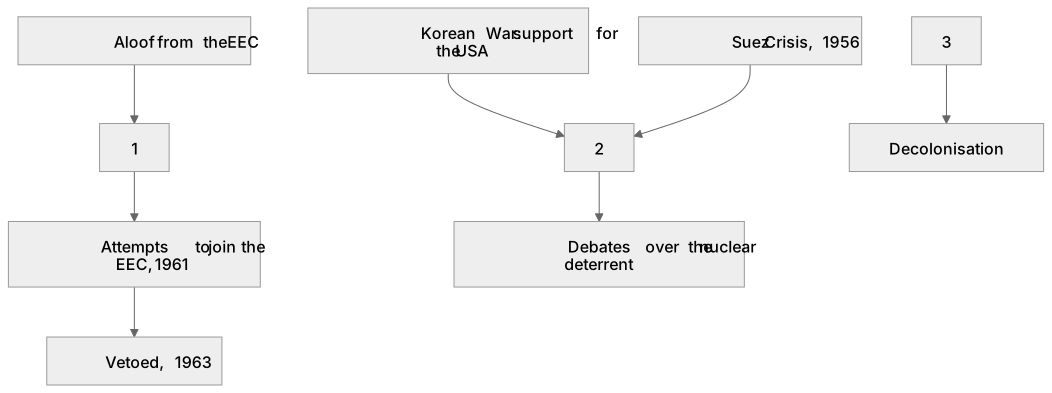
1Box 1
2Box 2
3Box 3
There is more to this lesson
The full lesson goes on to check your understanding and help you earn the marks. Create a free account to carry on, with your progress saved.
A week of Premium from your first lesson · Then the free plan continues · No card, no charge
Test your understanding of 2S The Making of Modern Britain, 1951–2007 – The Affluent Society, 1951–1964: Foreign relations: EFTA and attempts to join the EEC; relations with and policies towards USA and USSR; debates over the nuclear deterrent; Korean War; Suez; the ‘Winds of Change' and decolonisation
Active recall beats re-reading. Take an instant quiz now to test what you’ve learned and lock it into long-term memory.
A week of Premium from your first lesson · Then the free plan continues · No card, no charge