AQA · A-Level · History
Course version: 7042 · Version from Sept 2017
Britain's entry into and relations with Europe; the state of the 'special…
Full specification wording
2S The Making of Modern Britain, 1951–2007 – The end of Post-War Consensus, 1970–1979: Britain's entry into and relations with Europe; the state of the 'special relationship' with USA; attitudes to USSR and China
During the 1970s, British foreign policy shifted significantly.
Checked against the AQA 7042 specification (opens in a new tab) on .
- Point 4 of 4
Study notes
From the checked teaching notes for this specification point.
The idea
During the 1970s, British foreign policy shifted significantly. Edward Heath prioritised Europe, successfully negotiating Britain's entry into the EEC in 1973. Harold Wilson subsequently cemented this through the 1975 referendum, despite deep internal party divisions over sovereignty. Consequently, the 'special relationship' with the USA cooled; Heath notably refused to support Nixon during the 1973 Yom Kippur War, though Callaghan later restored warmer ties with Carter. Regarding the USSR, Britain maintained a firm stance, exemplified by the expulsion of 105 Soviet diplomats in 1971 for espionage. Conversely, attitudes towards China thawed in line with global détente, leading to the establishment of full ambassadorial relations in 1972.
What earns the marks
- Evaluate the significance of the 1973 EEC entry and the 1975 referendum in shaping Britain's European relations.
- Analyse the fluctuations in the Anglo-American 'special relationship', contrasting Heath's European focus with Callaghan's Atlanticist approach.
- Assess the impact of the 1971 expulsion of Soviet diplomats on Anglo-Soviet relations during the broader period of détente.
- Explain the strategic and diplomatic reasons behind the normalisation of relations with the People's Republic of China in 1972.
Common mistakes and how to put them right
Claiming Britain joined the EU in 1973.
Put it right: State that Britain joined the European Economic Community (EEC), as the EU was not formally established until the 1993 Maastricht Treaty.
Assuming the 'special relationship' with the USA was consistently strong throughout the 1970s.
Put it right: Acknowledge the significant cooling under Heath, who explicitly prioritised European integration over American alignment.
Treating British attitudes towards all communist states as identical.
Put it right: Distinguish between the hostile stance towards the USSR, such as the 1971 expulsions, and the improving diplomatic relations with China.
Exam tips
- Use the 1975 EEC referendum to demonstrate how foreign policy was heavily influenced by domestic political management, particularly within the Labour Party.
- Contrast Heath's relationship with Nixon against Callaghan's relationship with Carter to evaluate the changing nature of the 'special relationship'.
- When discussing the USSR and China, contextualise Britain's actions within the broader Cold War framework of détente and the Sino-Soviet split.
Try the lesson
The start of the 2S The Making of Modern Britain, 1951–2007 – The end of Post-War Consensus, 1970–1979: Britain's entry into and relations with Europe; the state of the 'special relationship' with USA; attitudes to USSR and China lesson, made from checked teaching notes for this specification point.
Have a go first
Under which Prime Minister did Britain formally enter the European Economic Community (EEC) in 1973?
Listen
During the 1970s, British foreign policy shifted significantly. Edward Heath prioritised Europe, successfully negotiating Britain's entry into the EEC in 1973. Harold Wilson subsequently cemented this through the 1975 referendum, despite deep internal party divisions over sovereignty. Consequently, the 'special relationship' with the USA cooled; Heath notably refused to support Nixon during the 1973 Yom Kippur War, though Callaghan later restored warmer ties with Carter. Regarding the USSR, Britain maintained a firm stance, exemplified by the expulsion of 105 Soviet diplomats in 1971 for espionage. Conversely, attitudes towards China thawed in line with global détente, leading to the establishment of full ambassadorial relations in 1972. A strong answer earns marks for these points. Evaluate the significance of the 1973 EEC entry and the 1975 referendum in shaping Britain's European relations. Analyse the fluctuations in the Anglo-American 'special relationship', contrasting Heath's European focus with Callaghan's Atlanticist approach. Assess the impact of the 1971 expulsion of Soviet diplomats on Anglo-Soviet relations during the broader period of détente. Explain the strategic and diplomatic reasons behind the normalisation of relations with the People's Republic of China in 1972. A common slip: Claiming Britain joined the EU in 1973. Instead, State that Britain joined the European Economic Community (EEC), as the EU was not formally established until the 1993 Maastricht Treaty. Exam tip: Use the 1975 EEC referendum to demonstrate how foreign policy was heavily influenced by domestic political management, particularly within the Labour Party.
See it
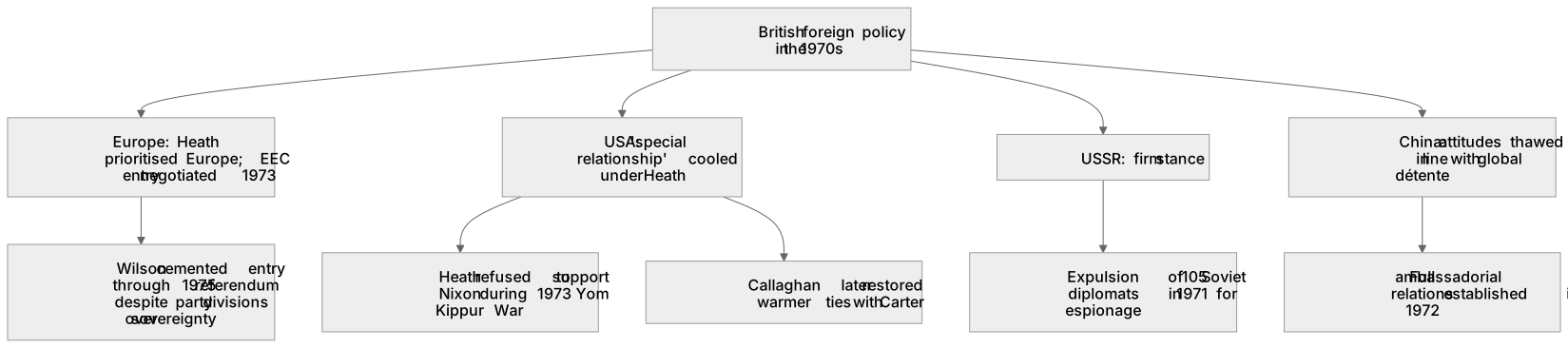
Put the events in order
Put these events in the order they happened, earliest first.
- 1. Referendum cemented Britain's EEC membership
- 2. Expulsion of Soviet diplomats for espionage
- 3. Britain negotiated entry into the EEC
- 4. Full ambassadorial relations established with China
Label the diagram
Some boxes have lost their names. Pick the right name for each number.
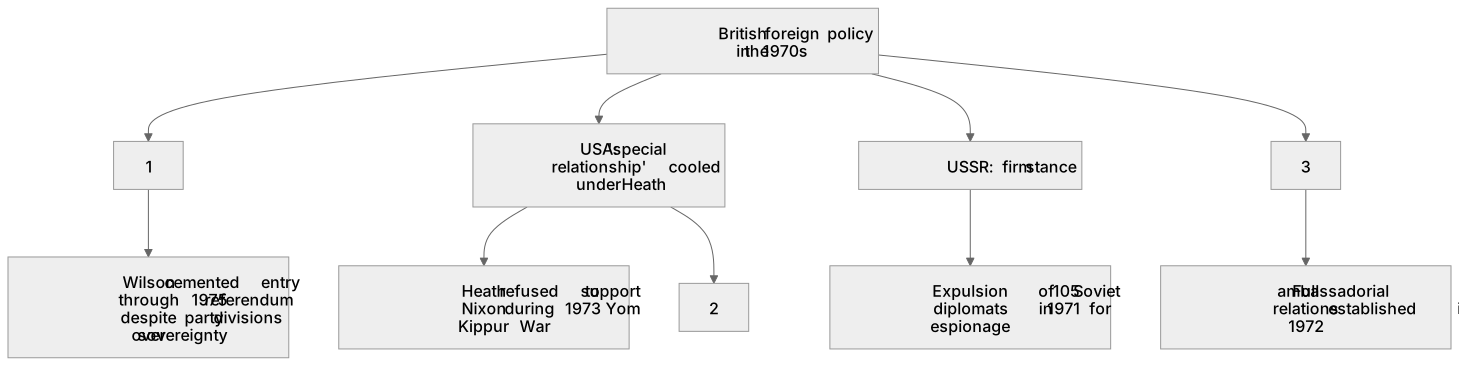
1Box 1
2Box 2
3Box 3
There is more to this lesson
The full lesson goes on to check your understanding and help you earn the marks. Create a free account to carry on, with your progress saved.
A week of Premium from your first lesson · Then the free plan continues · No card, no charge
Test your understanding of 2S The Making of Modern Britain, 1951–2007 – The end of Post-War Consensus, 1970–1979: Britain's entry into and relations with Europe; the state of the 'special relationship' with USA; attitudes to USSR and China
Active recall beats re-reading. Take an instant quiz now to test what you’ve learned and lock it into long-term memory.
A week of Premium from your first lesson · Then the free plan continues · No card, no charge