AQA · A-Level · History
Course version: 7042 · Version from Sept 2017
Heath’s government: Heath as leader; political and economic policies;…
Full specification wording
2S The Making of Modern Britain, 1951–2007 – The end of Post-War Consensus, 1970–1979: Heath’s government: Heath as leader; political and economic policies; industrial relations and the miners' strikes; the 'troubles' in Northern Ireland, including the Sunningdale Agreement
Edward Heath’s 1970-1974 premiership attempted to break the post-war consensus but was derailed by economic and social crises.
Checked against the AQA 7042 specification (opens in a new tab) on .
- Point 1 of 4
- 4 key terms
Study notes
From the checked teaching notes for this specification point.
The idea
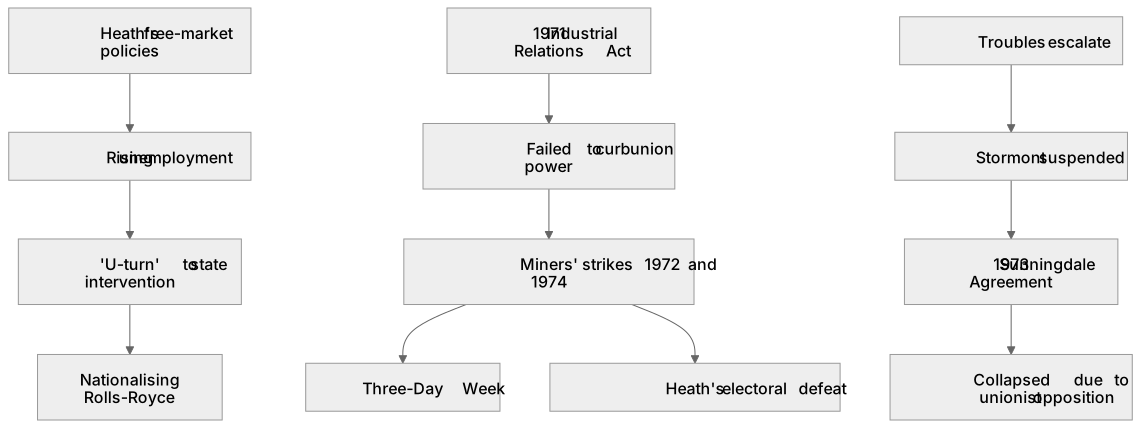
Edward Heath’s 1970-1974 premiership attempted to break the post-war consensus but was derailed by economic and social crises. Initially pursuing free-market political and economic policies (the Selsdon manifesto), Heath was forced into a 'U-turn' by rising unemployment, nationalising Rolls-Royce. Industrial relations deteriorated sharply; the 1971 Industrial Relations Act failed to curb union power, leading to crippling miners' strikes in 1972 and 1974, which forced the implementation of the Three-Day Week. Simultaneously, the 'Troubles' in Northern Ireland escalated dramatically following Bloody Sunday in 1972. Heath suspended the Stormont parliament and attempted a power-sharing solution through the 1973 Sunningdale Agreement, which ultimately collapsed due to unionist opposition.
What earns the marks
- Analyse Heath's initial free-market economic policies and the subsequent 'U-turn' involving state intervention to rescue failing industries.
- Evaluate the impact of the 1971 Industrial Relations Act and its failure to prevent widespread industrial action.
- Assess the causes and consequences of the 1972 and 1974 miners' strikes, including the imposition of the Three-Day Week and Heath's electoral defeat.
- Examine the escalation of violence in Northern Ireland, the introduction of direct rule, and the significance of the Sunningdale Agreement.
Common mistakes and how to put them right
Assuming the Sunningdale Agreement successfully resolved the Northern Ireland conflict.
Put it right: The agreement collapsed in 1974 following the Ulster Workers' Council strike.
Confusing the 1972 and 1974 miners' strikes.
Put it right: The 1972 strike led to a pay settlement, while the 1974 strike prompted Heath to call a general election which he lost.
Stating Heath maintained his free-market policies throughout his premiership.
Put it right: Heath performed a famous 'U-turn' in 1972, returning to state intervention to manage the economy.
Exam tips
- Evaluate how far Heath's downfall was caused by his own leadership failures versus inherited economic problems like global inflation.
- Connect the failure of the Industrial Relations Act to the broader breakdown of the post-war consensus on trade union cooperation.
- Use the Sunningdale Agreement as a key example of early, albeit unsuccessful, attempts at power-sharing in Northern Ireland.
Try the lesson
The start of the 2S The Making of Modern Britain, 1951–2007 – The end of Post-War Consensus, 1970–1979: Heath’s government: Heath as leader; political and economic policies; industrial relations and the miners' strikes; the 'troubles' in Northern Ireland, including the Sunningdale Agreement lesson, made from checked teaching notes for this specification point.
Have a go first
What was the primary objective of the Sunningdale Agreement signed during Edward Heath's government in 1973?
Listen
Edward Heath’s 1970-1974 premiership attempted to break the post-war consensus but was derailed by economic and social crises. Initially pursuing free-market political and economic policies (the Selsdon manifesto), Heath was forced into a 'U-turn' by rising unemployment, nationalising Rolls-Royce. Industrial relations deteriorated sharply; the 1971 Industrial Relations Act failed to curb union power, leading to crippling miners' strikes in 1972 and 1974, which forced the implementation of the Three-Day Week. Simultaneously, the 'Troubles' in Northern Ireland escalated dramatically following Bloody Sunday in 1972. Heath suspended the Stormont parliament and attempted a power-sharing solution through the 1973 Sunningdale Agreement, which ultimately collapsed due to unionist opposition. A strong answer earns marks for these points. Analyse Heath's initial free-market economic policies and the subsequent 'U-turn' involving state intervention to rescue failing industries. Evaluate the impact of the 1971 Industrial Relations Act and its failure to prevent widespread industrial action. Assess the causes and consequences of the 1972 and 1974 miners' strikes, including the imposition of the Three-Day Week and Heath's electoral defeat. Examine the escalation of violence in Northern Ireland, the introduction of direct rule, and the significance of the Sunningdale Agreement. A common slip: Assuming the Sunningdale Agreement successfully resolved the Northern Ireland conflict. Instead, the agreement collapsed in 1974 following the Ulster Workers' Council strike. Exam tip: Evaluate how far Heath's downfall was caused by his own leadership failures versus inherited economic problems like global inflation.
See it
Put the events in order
Put these events in the order they happened, earliest first.
- 1. Miners' strike prompted Heath to call a general election
- 2. Industrial Relations Act failed to curb union power
- 3. Sunningdale Agreement attempted power-sharing in Northern Ireland
- 4. Miners' strike led to a pay settlement
Key words
Say what each word means before you turn the card.
Breakdown of Consensus
Try answering aloud or in your head before turning the card.
Trade Union Power
Try answering aloud or in your head before turning the card.
Economic Crisis
Try answering aloud or in your head before turning the card.
Sectarian Conflict
Try answering aloud or in your head before turning the card.
See every definition
- Breakdown of Consensus
- Heath attempted to break the post-war consensus but was derailed by economic and social crises, later performing a 'U-turn' returning to state intervention.
- Trade Union Power
- The 1971 Industrial Relations Act failed to curb union power, leading to crippling miners' strikes in 1972 and 1974.
- Economic Crisis
- Rising unemployment forced Heath into a 'U-turn', including nationalising Rolls-Royce, while the miners' strikes forced the Three-Day Week.
- Sectarian Conflict
- The 'Troubles' in Northern Ireland escalated dramatically following Bloody Sunday in 1972, leading Heath to suspend the Stormont parliament.
Label the diagram
Some boxes have lost their names. Pick the right name for each number.
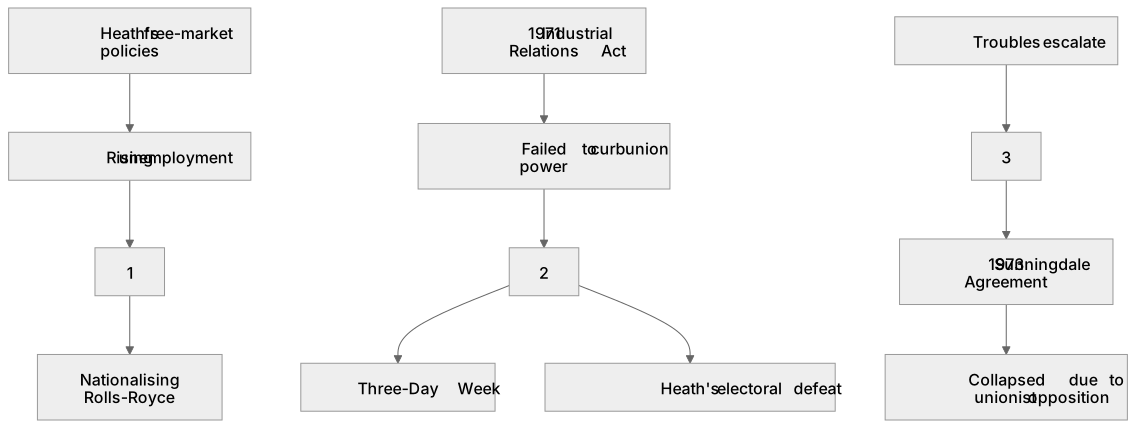
1Box 1
2Box 2
3Box 3
There is more to this lesson
The full lesson goes on to check your understanding and help you earn the marks. Create a free account to carry on, with your progress saved.
A week of Premium from your first lesson · Then the free plan continues · No card, no charge
Test your understanding of 2S The Making of Modern Britain, 1951–2007 – The end of Post-War Consensus, 1970–1979: Heath’s government: Heath as leader; political and economic policies; industrial relations and the miners' strikes; the 'troubles' in Northern Ireland, including the Sunningdale Agreement
Active recall beats re-reading. Take an instant quiz now to test what you’ve learned and lock it into long-term memory.
A week of Premium from your first lesson · Then the free plan continues · No card, no charge