AQA · A-Level · History
Course version: 7042 · Version from Sept 2017
Foreign affairs: attitudes to Europe; the 'special relationship' with USA;…
Full specification wording
2S The Making of Modern Britain, 1951–2007 – The Era of New Labour, 1997–2007 (A-level only): Foreign affairs: attitudes to Europe; the 'special relationship' with USA; military interventions and the 'war on terror'; Britain's position in the world by 2007
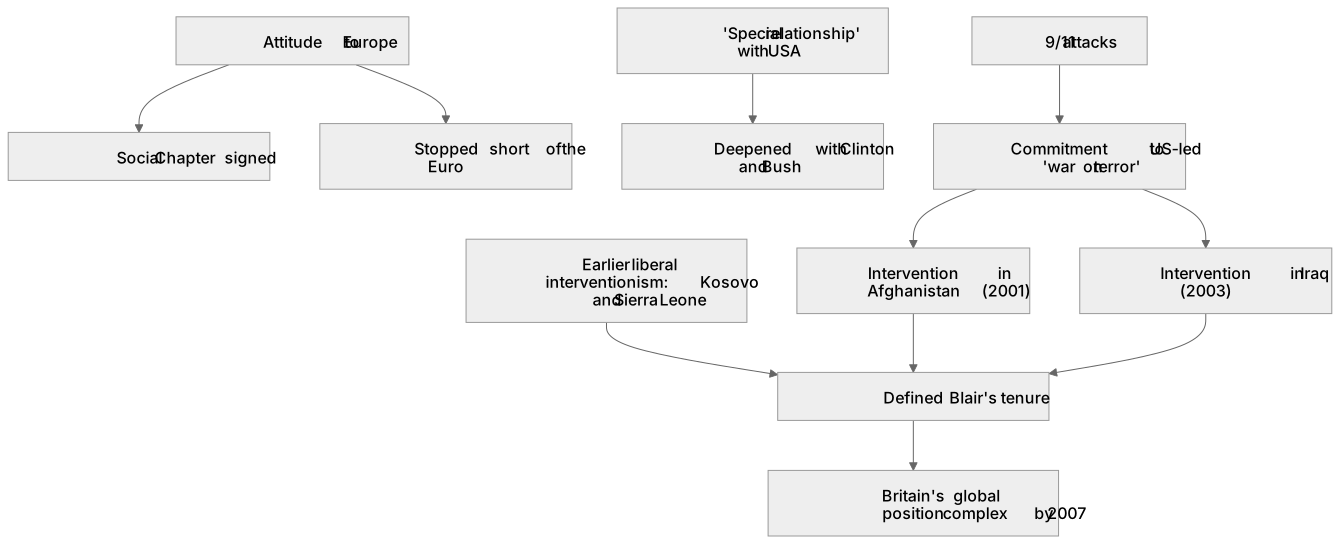
Under Tony Blair, New Labour's foreign policy initially sought to place Britain at the heart of Europe, signing the Social Chapter, though stopping short of adopting the Euro.
Checked against the AQA 7042 specification (opens in a new tab) on .
- Point 4 of 4
Study notes
From the checked teaching notes for this specification point.
The idea
Under Tony Blair, New Labour's foreign policy initially sought to place Britain at the heart of Europe, signing the Social Chapter, though stopping short of adopting the Euro. The 'special relationship' with the USA deepened significantly, particularly with Presidents Clinton and Bush. Following the 9/11 attacks, Blair committed Britain to the US-led 'war on terror', resulting in highly controversial military interventions in Afghanistan (2001) and Iraq (2003). These conflicts, alongside earlier liberal interventionist actions in Kosovo and Sierra Leone, defined Blair's tenure. By 2007, Britain's global position was complex; while retaining significant soft power and a permanent UN Security Council seat, its international reputation was severely damaged by the Iraq War's fallout and domestic divisions over foreign policy.
What earns the marks
- Assess the extent to which Blair achieved his goal of placing Britain at the 'heart of Europe', noting the refusal to join the single currency.
- Evaluate the dynamics of the 'special relationship', particularly Blair's alignment with George W. Bush post-9/11.
- Analyse the motivations and consequences of military interventions, contrasting the successes in Kosovo and Sierra Leone with the protracted conflicts in Afghanistan and Iraq.
- Examine the impact of the 'war on terror' on Britain's international standing and domestic security by 2007.
Common mistakes and how to put them right
Claiming Britain joined the Euro under Blair.
Put it right: Clarify that while Blair was pro-European and signed the Social Chapter, Gordon Brown's 'five economic tests' kept Britain out of the Eurozone.
Viewing the 'war on terror' solely through the lens of Iraq.
Put it right: Ensure you also discuss the 2001 invasion of Afghanistan and the broader global counter-terrorism strategy.
Assuming Blair's military interventions were entirely unpopular from the start.
Put it right: Note that earlier interventions in Kosovo (1999) and Sierra Leone (2000) were widely praised as successful liberal interventionism.
Exam tips
- Use the contrast between Blair's early successes in liberal interventionism (Kosovo) and the later quagmire of Iraq to evaluate his foreign policy legacy.
- When discussing Britain's position in the world by 2007, balance the negative fallout of Iraq with Britain's continued economic strength and diplomatic influence.
- Refer to the Group of Eight summits to discuss Britain's role in global economic diplomacy and debt relief, demonstrating an understanding of soft power.
Try the lesson
The start of the 2S The Making of Modern Britain, 1951–2007 – The Era of New Labour, 1997–2007 (A-level only): Foreign affairs: attitudes to Europe; the 'special relationship' with USA; military interventions and the 'war on terror'; Britain's position in the world by 2007 lesson, made from checked teaching notes for this specification point.
Have a go first
Which military intervention by Tony Blair's government in 1999 was undertaken without a UN Security Council resolution, primarily to prevent ethnic cleansing?
Listen
Under Tony Blair, New Labour's foreign policy initially sought to place Britain at the heart of Europe, signing the Social Chapter, though stopping short of adopting the Euro. The 'special relationship' with the USA deepened significantly, particularly with Presidents Clinton and Bush. Following the 9/11 attacks, Blair committed Britain to the US-led 'war on terror', resulting in highly controversial military interventions in Afghanistan (2001) and Iraq (2003). These conflicts, alongside earlier liberal interventionist actions in Kosovo and Sierra Leone, defined Blair's tenure. By 2007, Britain's global position was complex; while retaining significant soft power and a permanent UN Security Council seat, its international reputation was severely damaged by the Iraq War's fallout and domestic divisions over foreign policy. A strong answer earns marks for these points. Assess the extent to which Blair achieved his goal of placing Britain at the 'heart of Europe', noting the refusal to join the single currency. Evaluate the dynamics of the 'special relationship', particularly Blair's alignment with George W. Bush post-9/11. Analyse the motivations and consequences of military interventions, contrasting the successes in Kosovo and Sierra Leone with the protracted conflicts in Afghanistan and Iraq. Examine the impact of the 'war on terror' on Britain's international standing and domestic security by 2007. A common slip: Claiming Britain joined the Euro under Blair. Instead, Clarify that while Blair was pro-European and signed the Social Chapter, Gordon Brown's 'five economic tests' kept Britain out of the Eurozone. Exam tip: Use the contrast between Blair's early successes in liberal interventionism (Kosovo) and the later quagmire of Iraq to evaluate his foreign policy legacy.
See it
Put the events in order
Put these events in the order they happened, earliest first.
- 1. Britain joined the military intervention in Iraq
- 2. British intervention in Kosovo
- 3. Britain committed to the US-led invasion of Afghanistan
- 4. British intervention in Sierra Leone
Label the diagram
Some boxes have lost their names. Pick the right name for each number.
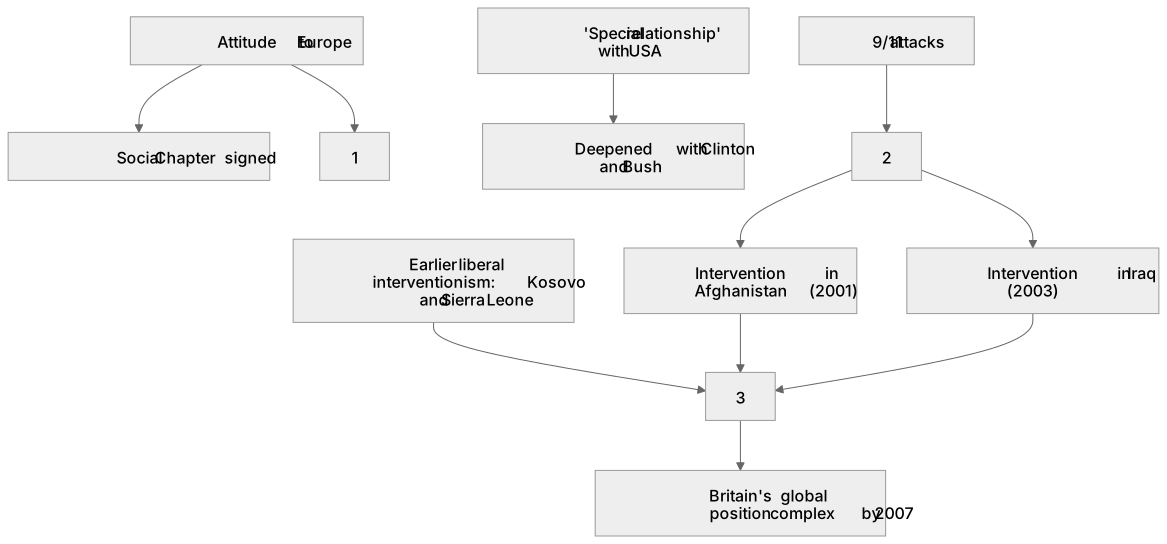
1Box 1
2Box 2
3Box 3
There is more to this lesson
The full lesson goes on to check your understanding and help you earn the marks. Create a free account to carry on, with your progress saved.
A week of Premium from your first lesson · Then the free plan continues · No card, no charge
Test your understanding of 2S The Making of Modern Britain, 1951–2007 – The Era of New Labour, 1997–2007 (A-level only): Foreign affairs: attitudes to Europe; the 'special relationship' with USA; military interventions and the 'war on terror'; Britain's position in the world by 2007
Active recall beats re-reading. Take an instant quiz now to test what you’ve learned and lock it into long-term memory.
A week of Premium from your first lesson · Then the free plan continues · No card, no charge