AQA · A-Level · History
Course version: 7042 · Version from Sept 2017
The Conservative Party: leaders and reason for divisions; reason for…
Full specification wording
2S The Making of Modern Britain, 1951–2007 – The Era of New Labour, 1997–2007 (A-level only): The Conservative Party: leaders and reason for divisions; reason for electoral failures in 2001 and 2005
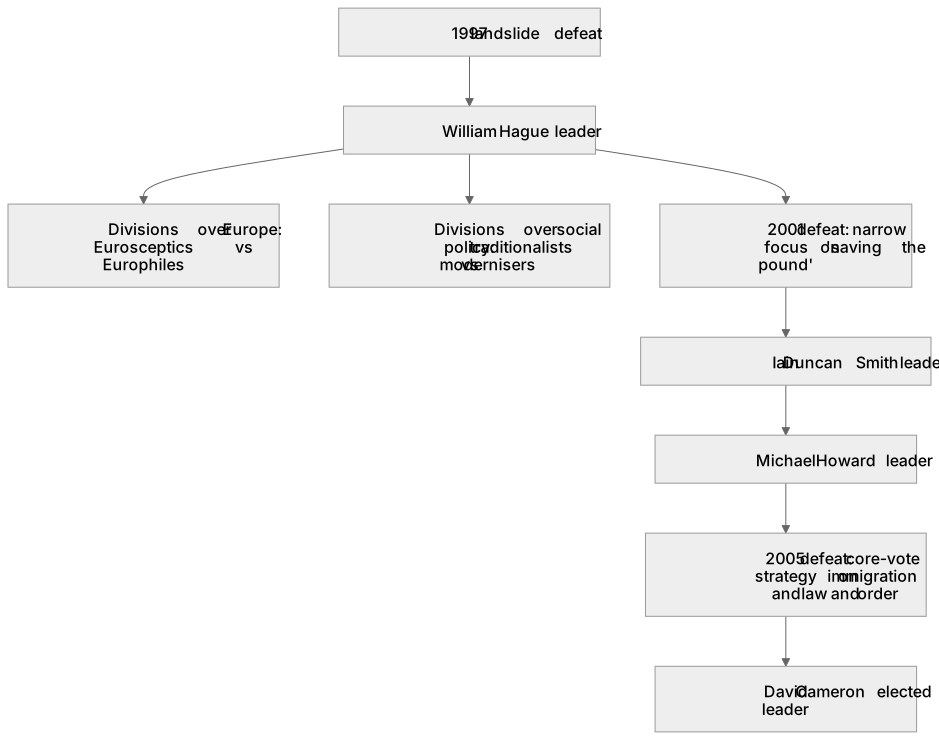
Between 1997 and 2007, the Conservative Party struggled to recover from their 1997 landslide defeat, cycling through leaders William Hague, Iain Duncan Smith, and Michael Howard before David…
Checked against the AQA 7042 specification (opens in a new tab) on .
- Point 2 of 4
- 4 key terms
Study notes
From the checked teaching notes for this specification point.
The idea
Between 1997 and 2007, the Conservative Party struggled to recover from their 1997 landslide defeat, cycling through leaders William Hague, Iain Duncan Smith, and Michael Howard before David Cameron's election. Divisions persisted primarily over Europe (Eurosceptics vs. Europhiles) and social policy (traditionalists vs. modernisers). These internal conflicts projected an image of a divided, out-of-touch party. Electoral failure in 2001 under Hague stemmed from a narrow focus on 'saving the pound' and failing to challenge Labour's public service agenda. In 2005, Howard's core-vote strategy, emphasising immigration and law and order, failed to attract centrist voters, allowing Tony Blair to secure a third consecutive victory despite the Iraq War backlash.
What earns the marks
- Identify the succession of Conservative leaders (Hague, Duncan Smith, Howard) and how frequent leadership changes undermined party stability and public confidence.
- Explain the ideological divisions within the party, particularly the toxic split over European integration and the tension between social conservatives and modernisers.
- Analyse the reasons for the 2001 electoral defeat, focusing on Hague's inability to broaden the party's appeal beyond the single issue of European currency integration.
- Evaluate the 2005 election failure, assessing how Michael Howard's defensive 'core vote' strategy on immigration alienated moderate voters despite Labour's vulnerability over Iraq.
Common mistakes and how to put them right
Claiming David Cameron led the party during the 2001 or 2005 elections.
Put it right: Specify that William Hague led in 2001 and Michael Howard led in 2005; Cameron became leader after the 2005 defeat.
Assuming the Conservative Party was entirely united against European integration.
Put it right: Acknowledge the deep divisions between the dominant Eurosceptic wing and the marginalised but vocal Europhile minority.
Attributing the 2001 and 2005 defeats solely to Conservative weaknesses.
Put it right: Balance Conservative failings with the enduring electoral strength of New Labour's economic record and public spending pledges.
Exam tips
- When evaluating Conservative divisions, use the leadership contests (such as Iain Duncan Smith defeating Ken Clarke) to illustrate the dominance of Euroscepticism over electoral pragmatism.
- Contrast the Conservative election campaigns of 2001 and 2005 to show continuity in their failure to capture the political centre ground from New Labour.
- Link internal party divisions directly to electoral performance, explaining how a disunited party struggles to present a credible alternative government to the electorate.
Try the lesson
The start of the 2S The Making of Modern Britain, 1951–2007 – The Era of New Labour, 1997–2007 (A-level only): The Conservative Party: leaders and reason for divisions; reason for electoral failures in 2001 and 2005 lesson, made from checked teaching notes for this specification point.
Have a go first
Which sequence correctly identifies the leaders of the Conservative Party between the general elections of 1997 and 2005?
Listen
Between 1997 and 2007, the Conservative Party struggled to recover from their 1997 landslide defeat, cycling through leaders William Hague, Iain Duncan Smith, and Michael Howard before David Cameron's election. Divisions persisted primarily over Europe (Eurosceptics vs. Europhiles) and social policy (traditionalists vs. modernisers). These internal conflicts projected an image of a divided, out-of-touch party. Electoral failure in 2001 under Hague stemmed from a narrow focus on 'saving the pound' and failing to challenge Labour's public service agenda. In 2005, Howard's core-vote strategy, emphasising immigration and law and order, failed to attract centrist voters, allowing Tony Blair to secure a third consecutive victory despite the Iraq War backlash. A strong answer earns marks for these points. Identify the succession of Conservative leaders (Hague, Duncan Smith, Howard) and how frequent leadership changes undermined party stability and public confidence. Explain the ideological divisions within the party, particularly the toxic split over European integration and the tension between social conservatives and modernisers. Analyse the reasons for the 2001 electoral defeat, focusing on Hague's inability to broaden the party's appeal beyond the single issue of European currency integration. Evaluate the 2005 election failure, assessing how Michael Howard's defensive 'core vote' strategy on immigration alienated moderate voters despite Labour's vulnerability over Iraq. A common slip: Claiming David Cameron led the party during the 2001 or 2005 elections. Instead, Specify that William Hague led in 2001 and Michael Howard led in 2005; Cameron became leader after the 2005 defeat. Exam tip: When evaluating Conservative divisions, use the leadership contests (such as Iain Duncan Smith defeating Ken Clarke) to illustrate the dominance of Euroscepticism over electoral pragmatism.
See it
Key words
Say what each word means before you turn the card.
Eurosceptics
Try answering aloud or in your head before turning the card.
Europhiles
Try answering aloud or in your head before turning the card.
Modernisers
Try answering aloud or in your head before turning the card.
Traditionalists
Try answering aloud or in your head before turning the card.
See every definition
- Eurosceptics
- The dominant wing of the Conservative Party that was opposed to European integration, in conflict with the Europhiles.
- Europhiles
- The marginalised but vocal minority within the Conservative Party that was not opposed to European integration.
- Modernisers
- One side of the social policy division within the Conservative Party, in tension with the traditionalists.
- Traditionalists
- One side of the social policy division within the Conservative Party, in tension with the modernisers.
Label the diagram
Some boxes have lost their names. Pick the right name for each number.
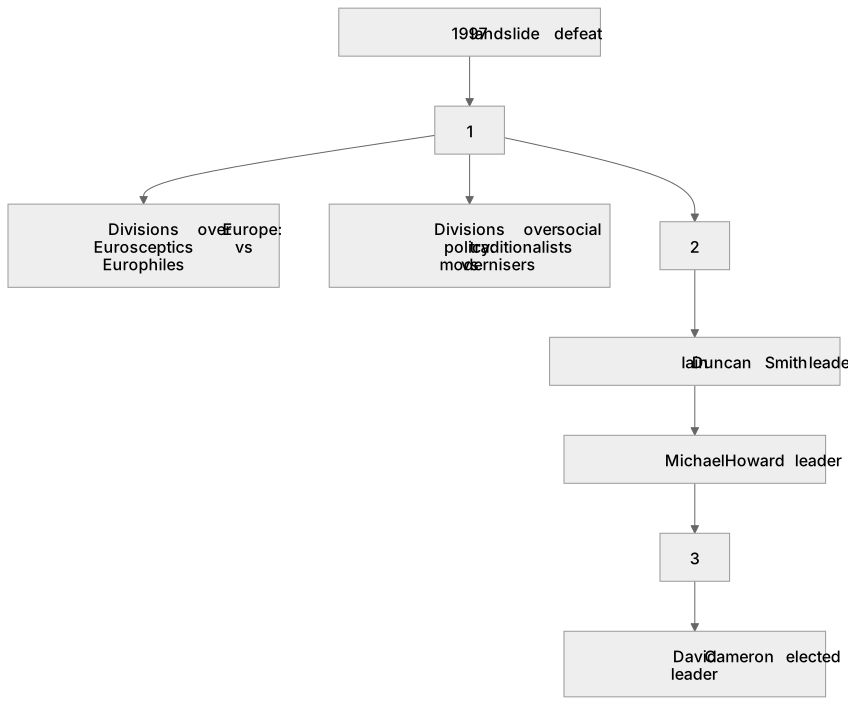
1Box 1
2Box 2
3Box 3
There is more to this lesson
The full lesson goes on to check your understanding and help you earn the marks. Create a free account to carry on, with your progress saved.
A week of Premium from your first lesson · Then the free plan continues · No card, no charge
Test your understanding of 2S The Making of Modern Britain, 1951–2007 – The Era of New Labour, 1997–2007 (A-level only): The Conservative Party: leaders and reason for divisions; reason for electoral failures in 2001 and 2005
Active recall beats re-reading. Take an instant quiz now to test what you’ve learned and lock it into long-term memory.
A week of Premium from your first lesson · Then the free plan continues · No card, no charge