AQA · A-Level · History
Course version: 7042 · Version from Sept 2017
Foreign affairs: relations with Europe, including the impact of the Single…
Full specification wording
2S The Making of Modern Britain, 1951–2007 – Towards a new Consensus, 1987–1997 (A-level only): Foreign affairs: relations with Europe, including the impact of the Single European Act and Maastricht Treaty; interventions in the Balkans; contribution and attitude to the end of the Cold War
British foreign policy from 1987 to 1997 was defined by European integration and the Soviet bloc's collapse.
Checked against the AQA 7042 specification (opens in a new tab) on .
- Point 4 of 4
Study notes
From the checked teaching notes for this specification point.
The idea
British foreign policy from 1987 to 1997 was defined by European integration and the Soviet bloc's collapse. Thatcher supported the 1986 Single European Act to create a single market but fiercely opposed further political union. Conversely, Major signed the 1992 Maastricht Treaty, securing opt-outs but deeply dividing the Conservative Party. Concurrently, Britain navigated the end of the Cold War; Thatcher acted as a crucial diplomatic bridge between Reagan and Gorbachev, fostering dialogue while maintaining a firm anti-communist stance. Following the Soviet collapse, Major’s government faced new challenges, notably the complex British and UN interventions in the Balkans during Yugoslavia's violent breakup, which exposed the limitations of European peacekeeping without robust US support.
What earns the marks
- Assess the impact of the Single European Act (1986) in advancing economic integration while triggering Thatcher's Bruges Speech (1988) against a European superstate.
- Evaluate John Major's negotiation of the Maastricht Treaty (1992), specifically securing opt-outs from the Social Chapter and the single currency, and its role in fracturing the Conservative Party.
- Analyse Thatcher's diplomatic role in the late Cold War, particularly her early recognition of Mikhail Gorbachev as a leader the West could 'do business with'.
- Examine the British military and diplomatic response to the Bosnian War (1992-1995), including the deployment of troops to UNPROFOR and the perceived failures of Western intervention prior to the Dayton Agreement.
Common mistakes and how to put them right
Claiming Thatcher opposed the Single European Act.
Put it right: Thatcher strongly supported the Single European Act for its free-market benefits, only later opposing the political integration it facilitated.
Confusing the terms of the Maastricht Treaty with the Treaty of Rome.
Put it right: Ensure you specify that Maastricht established the European Union and the framework for the Euro, from which Major secured a British opt-out.
Stating Britain acted alone in the Balkans.
Put it right: Emphasise that British interventions in the Balkans were conducted as part of multilateral UN and NATO operations, such as UNPROFOR.
Exam tips
- Link foreign policy directly to domestic politics, particularly how the Maastricht Treaty rebellions undermined John Major's parliamentary authority.
- Contrast Thatcher's ideological approach to the Cold War with Major's pragmatic, crisis-management approach to the Balkans.
- Use specific examples of Thatcher's diplomacy, such as her 1984 meeting with Gorbachev, to evaluate Britain's influence on superpower relations.
Try the lesson
The start of the 2S The Making of Modern Britain, 1951–2007 – Towards a new Consensus, 1987–1997 (A-level only): Foreign affairs: relations with Europe, including the impact of the Single European Act and Maastricht Treaty; interventions in the Balkans; contribution and attitude to the end of the Cold War lesson, made from checked teaching notes for this specification point.
Have a go first
What was a significant domestic political consequence of the 1992 Maastricht Treaty for John Major's Conservative government?
Listen
British foreign policy from 1987 to 1997 was defined by European integration and the Soviet bloc's collapse. Thatcher supported the 1986 Single European Act to create a single market but fiercely opposed further political union. Conversely, Major signed the 1992 Maastricht Treaty, securing opt-outs but deeply dividing the Conservative Party. Concurrently, Britain navigated the end of the Cold War; Thatcher acted as a crucial diplomatic bridge between Reagan and Gorbachev, fostering dialogue while maintaining a firm anti-communist stance. Following the Soviet collapse, Major’s government faced new challenges, notably the complex British and UN interventions in the Balkans during Yugoslavia's violent breakup, which exposed the limitations of European peacekeeping without robust US support. A strong answer earns marks for these points. Assess the impact of the Single European Act (1986) in advancing economic integration while triggering Thatcher's Bruges Speech (1988) against a European superstate. Evaluate John Major's negotiation of the Maastricht Treaty (1992), specifically securing opt-outs from the Social Chapter and the single currency, and its role in fracturing the Conservative Party. Analyse Thatcher's diplomatic role in the late Cold War, particularly her early recognition of Mikhail Gorbachev as a leader the West could 'do business with'. Examine the British military and diplomatic response to the Bosnian War (1992-1995), including the deployment of troops to UNPROFOR and the perceived failures of Western intervention prior to the Dayton Agreement. A common slip: Claiming Thatcher opposed the Single European Act. Instead, Thatcher strongly supported the Single European Act for its free-market benefits, only later opposing the political integration it facilitated. Exam tip: Link foreign policy directly to domestic politics, particularly how the Maastricht Treaty rebellions undermined John Major's parliamentary authority.
See it
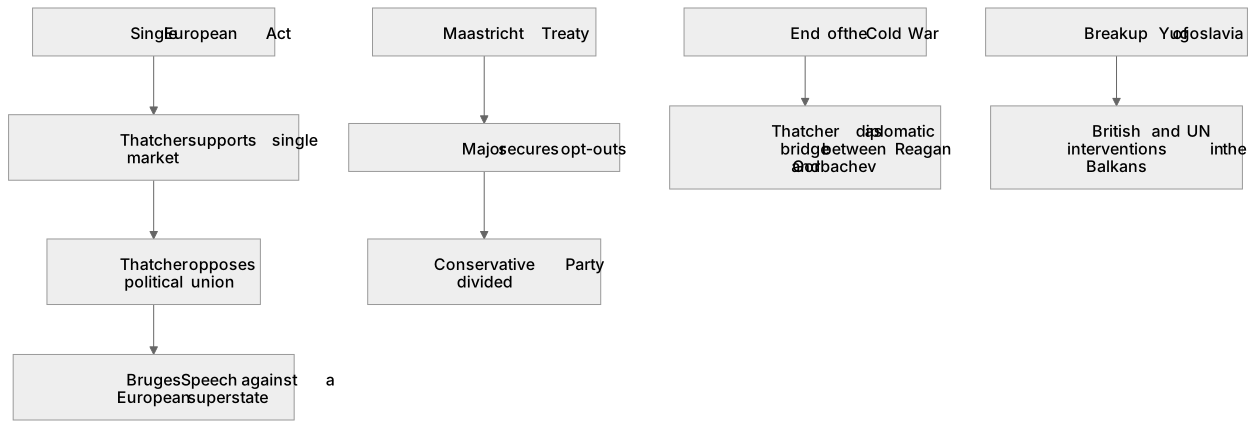
Put the events in order
Put these events in the order they happened, earliest first.
- 1. Major signed the Maastricht Treaty, securing opt-outs
- 2. Thatcher's meeting with Gorbachev
- 3. Thatcher's Bruges Speech against a European superstate
- 4. Thatcher supported the Single European Act to create a single market
Label the diagram
Some boxes have lost their names. Pick the right name for each number.
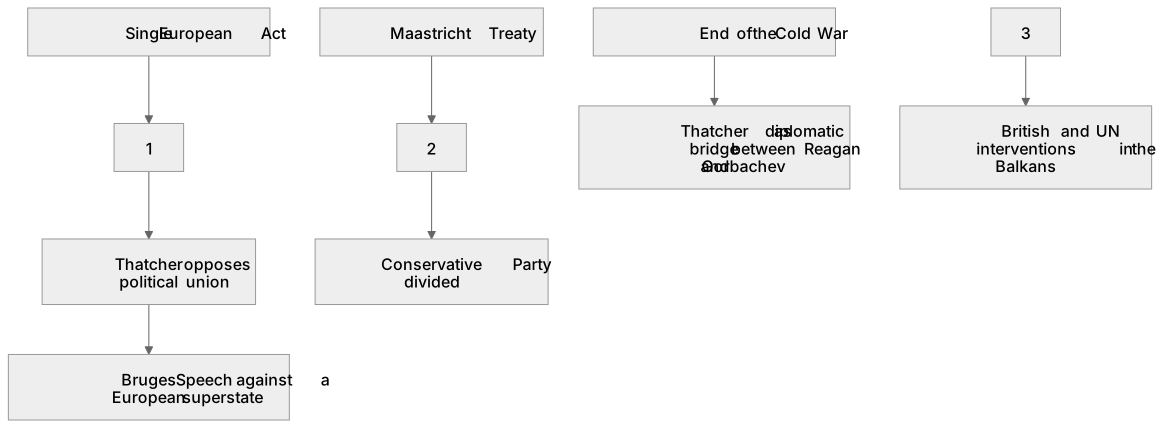
1Box 1
2Box 2
3Box 3
There is more to this lesson
The full lesson goes on to check your understanding and help you earn the marks. Create a free account to carry on, with your progress saved.
A week of Premium from your first lesson · Then the free plan continues · No card, no charge
Test your understanding of 2S The Making of Modern Britain, 1951–2007 – Towards a new Consensus, 1987–1997 (A-level only): Foreign affairs: relations with Europe, including the impact of the Single European Act and Maastricht Treaty; interventions in the Balkans; contribution and attitude to the end of the Cold War
Active recall beats re-reading. Take an instant quiz now to test what you’ve learned and lock it into long-term memory.
A week of Premium from your first lesson · Then the free plan continues · No card, no charge