AQA · A-Level · History
Course version: 7042 · Version from Sept 2017
Realignment of the Labour Party under Kinnock, Smith and Blair; reasons…
Full specification wording
2S The Making of Modern Britain, 1951–2007 – Towards a new Consensus, 1987–1997 (A-level only): Realignment of the Labour Party under Kinnock, Smith and Blair; reasons for Labour victory in 1997
The realignment of the Labour Party transformed it from an unelectable socialist faction into the centrist 'New Labour' election machine.
Checked against the AQA 7042 specification (opens in a new tab) on .
- Point 2 of 4
- 4 key terms
Study notes
From the checked teaching notes for this specification point.
The idea
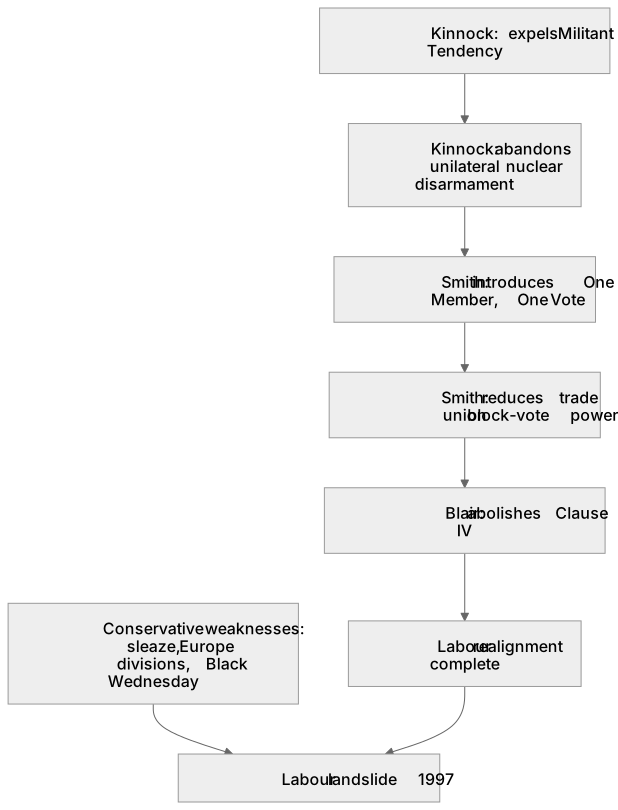
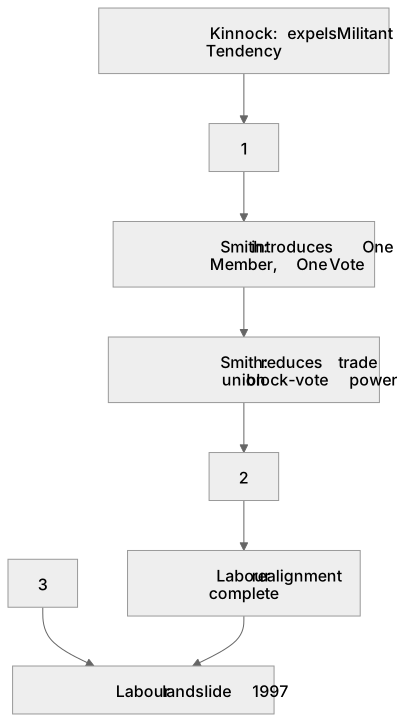
The realignment of the Labour Party transformed it from an unelectable socialist faction into the centrist 'New Labour' election machine. Neil Kinnock initiated this by expelling the far-left Militant Tendency and abandoning unilateral nuclear disarmament. John Smith further democratised the party by introducing 'One Member, One Vote' (OMOV) for parliamentary selections, reducing trade union block-vote power. Tony Blair completed the ideological shift by abolishing Clause IV, formally ending Labour's commitment to mass nationalisation. This realignment, combined with severe Conservative weaknesses—including 'sleaze' scandals, deep divisions over Europe, and the economic humiliation of Black Wednesday—secured Labour's landslide 1997 victory, aided by strategic media endorsements like The Sun.
What earns the marks
- Assess Kinnock's role in making the party electable by tackling the hard left (Militant) and modernising communications.
- Evaluate Smith's crucial structural reform of OMOV, which weakened union dominance over party policy.
- Analyse Blair's symbolic and ideological rebranding, particularly the 1995 revision of Clause IV, to appeal to Middle England.
- Weigh the impact of Conservative failures (Black Wednesday, sleaze, European divisions) against Labour's modernisation in explaining the 1997 landslide.
Common mistakes and how to put them right
Attributing the abolition of Clause IV to Kinnock or Smith.
Put it right: Tony Blair achieved the revision of Clause IV in 1995.
Assuming Labour's 1997 victory was solely due to Blair's appeal.
Put it right: Acknowledge the critical role of Conservative economic failures, particularly Black Wednesday in 1992, which destroyed their reputation for economic competence.
Overlooking John Smith's contribution.
Put it right: Explicitly mention Smith's introduction of OMOV, which was vital for reducing trade union influence before Blair took over.
Exam tips
- When evaluating the 1997 election, always balance Labour's internal reforms against the Conservatives' self-destruction.
- Use specific examples of 'sleaze' (e.g., the Cash for Questions scandal) to illustrate the decline of Conservative authority.
- Trace the continuity of modernisation from Kinnock to Blair to show that 'New Labour' was a long-term process, not an overnight change.
Try the lesson
The start of the 2S The Making of Modern Britain, 1951–2007 – Towards a new Consensus, 1987–1997 (A-level only): Realignment of the Labour Party under Kinnock, Smith and Blair; reasons for Labour victory in 1997 lesson, made from checked teaching notes for this specification point.
Have a go first
Which significant constitutional change did Tony Blair secure in 1995 to demonstrate the realignment of the Labour Party?
Listen
The realignment of the Labour Party transformed it from an unelectable socialist faction into the centrist 'New Labour' election machine. Neil Kinnock initiated this by expelling the far-left Militant Tendency and abandoning unilateral nuclear disarmament. John Smith further democratised the party by introducing 'One Member, One Vote' (OMOV) for parliamentary selections, reducing trade union block-vote power. Tony Blair completed the ideological shift by abolishing Clause IV, formally ending Labour's commitment to mass nationalisation. This realignment, combined with severe Conservative weaknesses—including 'sleaze' scandals, deep divisions over Europe, and the economic humiliation of Black Wednesday—secured Labour's landslide 1997 victory, aided by strategic media endorsements like The Sun. A strong answer earns marks for these points. Assess Kinnock's role in making the party electable by tackling the hard left (Militant) and modernising communications. Evaluate Smith's crucial structural reform of OMOV, which weakened union dominance over party policy. Analyse Blair's symbolic and ideological rebranding, particularly the 1995 revision of Clause IV, to appeal to Middle England. Weigh the impact of Conservative failures (Black Wednesday, sleaze, European divisions) against Labour's modernisation in explaining the 1997 landslide. A common slip: Attributing the abolition of Clause IV to Kinnock or Smith. Instead, Tony Blair achieved the revision of Clause IV in 1995. Exam tip: When evaluating the 1997 election, always balance Labour's internal reforms against the Conservatives' self-destruction.
See it
Key words
Say what each word means before you turn the card.
Political modernisation
Try answering aloud or in your head before turning the card.
Party leadership
Try answering aloud or in your head before turning the card.
Ideological shifts
Try answering aloud or in your head before turning the card.
Electoral strategy
Try answering aloud or in your head before turning the card.
See every definition
- Political modernisation
- The realignment of the Labour Party under Kinnock, Smith and Blair, transforming it from an unelectable socialist faction into the centrist 'New Labour' election machine.
- Party leadership
- The roles of Kinnock, Smith and Blair in reforming the Labour Party, from tackling the hard left to the ideological rebranding of 'New Labour'.
- Ideological shifts
- The party's move away from unilateral nuclear disarmament and its commitment to mass nationalisation, formally ended by abolishing Clause IV.
- Electoral strategy
- The realignment of the Labour Party combined with Conservative weaknesses, aided by strategic media endorsements like The Sun, securing the 1997 landslide victory.
Label the diagram
Some boxes have lost their names. Pick the right name for each number.
1Box 1
2Box 2
3Box 3
There is more to this lesson
The full lesson goes on to check your understanding and help you earn the marks. Create a free account to carry on, with your progress saved.
A week of Premium from your first lesson · Then the free plan continues · No card, no charge
Test your understanding of 2S The Making of Modern Britain, 1951–2007 – Towards a new Consensus, 1987–1997 (A-level only): Realignment of the Labour Party under Kinnock, Smith and Blair; reasons for Labour victory in 1997
Active recall beats re-reading. Take an instant quiz now to test what you’ve learned and lock it into long-term memory.
A week of Premium from your first lesson · Then the free plan continues · No card, no charge