AQA · A-Level · History
Course version: 7042 · Version from Sept 2017
The USSR and the Soviet Empire, 1953–2000 (A-level only) –…
Full specification wording
2T The Crisis of Communism: The USSR and the Soviet Empire, 1953–2000 (A-level only) – De-Stalinisation, 1953–1964: Economic and social developments: the reasons for and results of reform of industry and agriculture, including partial decentralisation and the virgin lands scheme; social conditions and living standards; the extent of the 'thaw' culturally
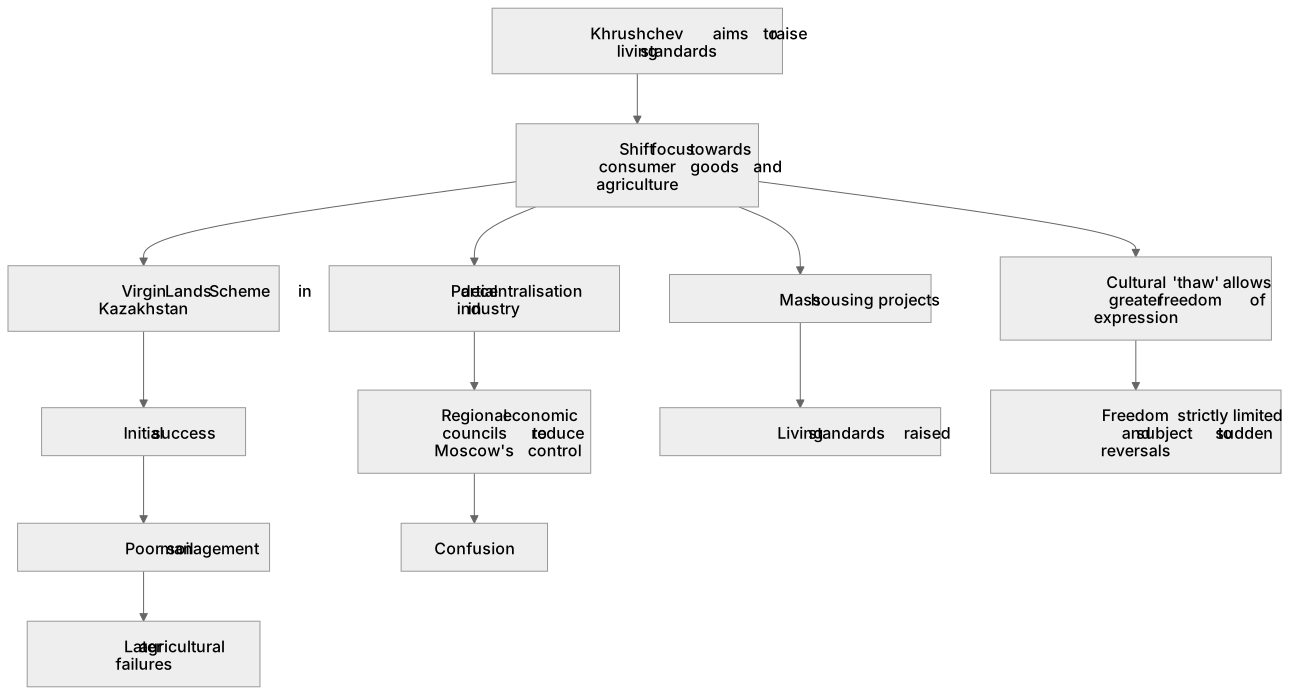
Khrushchev aimed to raise Soviet living standards by shifting economic focus towards consumer goods and agriculture.
Checked against the AQA 7042 specification (opens in a new tab) on .
- Point 3 of 4
- 4 key terms
Study notes
From the checked teaching notes for this specification point.
The idea
Khrushchev aimed to raise Soviet living standards by shifting economic focus towards consumer goods and agriculture. To boost food production, he launched the Virgin Lands Scheme in Kazakhstan. Despite initial success, poor soil management caused later agricultural failures. In industry, he attempted partial decentralisation by creating regional economic councils to reduce Moscow's control, though this often caused confusion. Social conditions improved significantly, with mass housing projects raising living standards. Culturally, the 'thaw' allowed greater freedom of expression, permitting works like Solzhenitsyn's 'One Day in the Life of Ivan Denisovich', though this freedom remained strictly limited and subject to sudden reversals.
What earns the marks
- Evaluate the reasons for and results of the Virgin Lands Scheme, noting its initial successes and subsequent ecological and production failures.
- Analyse the impact of partial decentralisation in industry, specifically the introduction of Sovnarkhozy and the resulting administrative confusion.
- Assess the improvements in social conditions and living standards, highlighting the mass construction of prefabricated housing (Khrushchyovkas).
- Examine the extent of the cultural 'thaw', balancing the publication of previously banned literature against ongoing state censorship and crackdowns on abstract art.
Common mistakes and how to put them right
Assuming the Virgin Lands Scheme was a complete failure from the start.
Put it right: The scheme produced record harvests in its first few years (e.g., 1956) before soil erosion and poor planning led to severe declines.
Stating that the cultural 'thaw' meant complete freedom of speech.
Put it right: The 'thaw' was highly controlled and inconsistent; criticism of Stalin was permitted, but criticism of the Communist Party or Lenin remained strictly forbidden.
Claiming Khrushchev abandoned heavy industry entirely.
Put it right: While he shifted more resources to consumer goods and agriculture, heavy industry and military spending still dominated the Soviet economy.
Exam tips
- Use the mass housing programme as concrete evidence when arguing that Khrushchev successfully improved everyday social conditions and living standards.
- Contrast the aims of partial decentralisation (efficiency and local decision-making) with its actual results (bureaucratic confusion and localism).
- When discussing the cultural 'thaw', use specific examples like the publication of Solzhenitsyn or the Pasternak affair to demonstrate its limits.
Try the lesson
The start of the 2T The Crisis of Communism: The USSR and the Soviet Empire, 1953–2000 (A-level only) – De-Stalinisation, 1953–1964: Economic and social developments: the reasons for and results of reform of industry and agriculture, including partial decentralisation and the virgin lands scheme; social conditions and living standards; the extent of the 'thaw' culturally lesson, made from checked teaching notes for this specification point.
Have a go first
What was the primary objective of Khrushchev's Virgin Lands scheme introduced in the 1950s?
Listen
Khrushchev aimed to raise Soviet living standards by shifting economic focus towards consumer goods and agriculture. To boost food production, he launched the Virgin Lands Scheme in Kazakhstan. Despite initial success, poor soil management caused later agricultural failures. In industry, he attempted partial decentralisation by creating regional economic councils to reduce Moscow's control, though this often caused confusion. Social conditions improved significantly, with mass housing projects raising living standards. Culturally, the 'thaw' allowed greater freedom of expression, permitting works like Solzhenitsyn's 'One Day in the Life of Ivan Denisovich', though this freedom remained strictly limited and subject to sudden reversals. A strong answer earns marks for these points. Evaluate the reasons for and results of the Virgin Lands Scheme, noting its initial successes and subsequent ecological and production failures. Analyse the impact of partial decentralisation in industry, specifically the introduction of Sovnarkhozy and the resulting administrative confusion. Assess the improvements in social conditions and living standards, highlighting the mass construction of prefabricated housing (Khrushchyovkas). Examine the extent of the cultural 'thaw', balancing the publication of previously banned literature against ongoing state censorship and crackdowns on abstract art. A common slip: Assuming the Virgin Lands Scheme was a complete failure from the start. Instead, The scheme produced record harvests in its first few years (e.g., 1956) before soil erosion and poor planning led to severe declines. Exam tip: Use the mass housing programme as concrete evidence when arguing that Khrushchev successfully improved everyday social conditions and living standards.
See it
Key words
Say what each word means before you turn the card.
Economic Reform
Try answering aloud or in your head before turning the card.
Living Standards
Try answering aloud or in your head before turning the card.
Cultural Thaw
Try answering aloud or in your head before turning the card.
Decentralisation
Try answering aloud or in your head before turning the card.
See every definition
- Economic Reform
- Khrushchev aimed to raise Soviet living standards by shifting economic focus towards consumer goods and agriculture.
- Living Standards
- Social conditions improved significantly, with mass housing projects raising living standards.
- Cultural Thaw
- Greater freedom of expression was allowed, permitting works like Solzhenitsyn's 'One Day in the Life of Ivan Denisovich', though this freedom remained strictly limited and subject to sudden reversals.
- Decentralisation
- In industry, partial decentralisation was attempted by creating regional economic councils to reduce Moscow's control, though this often caused confusion.
Label the diagram
Some boxes have lost their names. Pick the right name for each number.
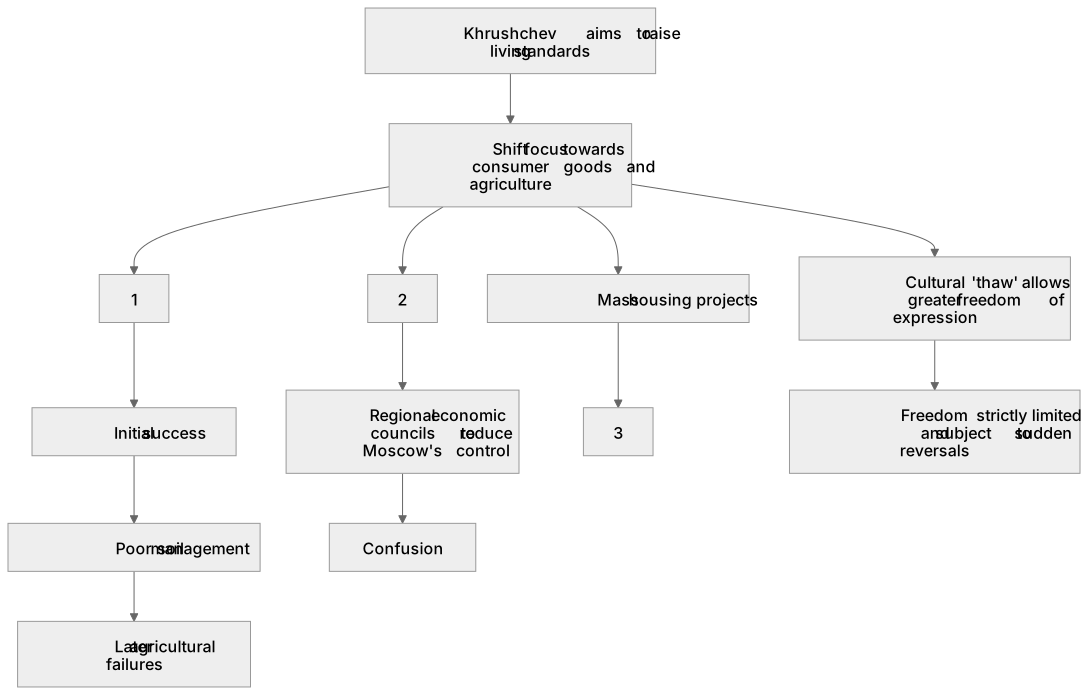
1Box 1
2Box 2
3Box 3
There is more to this lesson
The full lesson goes on to check your understanding and help you earn the marks. Create a free account to carry on, with your progress saved.
A week of Premium from your first lesson · Then the free plan continues · No card, no charge
Test your understanding of 2T The Crisis of Communism: The USSR and the Soviet Empire, 1953–2000 (A-level only) – De-Stalinisation, 1953–1964: Economic and social developments: the reasons for and results of reform of industry and agriculture, including partial decentralisation and the virgin lands scheme; social conditions and living standards; the extent of the 'thaw' culturally
Active recall beats re-reading. Take an instant quiz now to test what you’ve learned and lock it into long-term memory.
A week of Premium from your first lesson · Then the free plan continues · No card, no charge