AQA · A-Level · History
Course version: 7042 · Version from Sept 2017
The USSR and the Soviet Empire, 1953–2000 (A-level only) –…
Full specification wording
2T The Crisis of Communism: The USSR and the Soviet Empire, 1953–2000 (A-level only) – De-Stalinisation, 1953–1964: The USSR in 1953: the Stalinist legacy; terror and paranoia; economic centralisation; the power vacuum and contenders: Malenkov, Beria, Molotov and Khrushchev; Khrushchev's success
In 1953, the USSR was defined by the Stalinist legacy: a highly centralised command economy, and a society paralysed by terror and Stalin's intense paranoia, exemplified by the Doctors' Plot.
Checked against the AQA 7042 specification (opens in a new tab) on .
- Point 1 of 4
- 4 key terms
Study notes
From the checked teaching notes for this specification point.
The idea
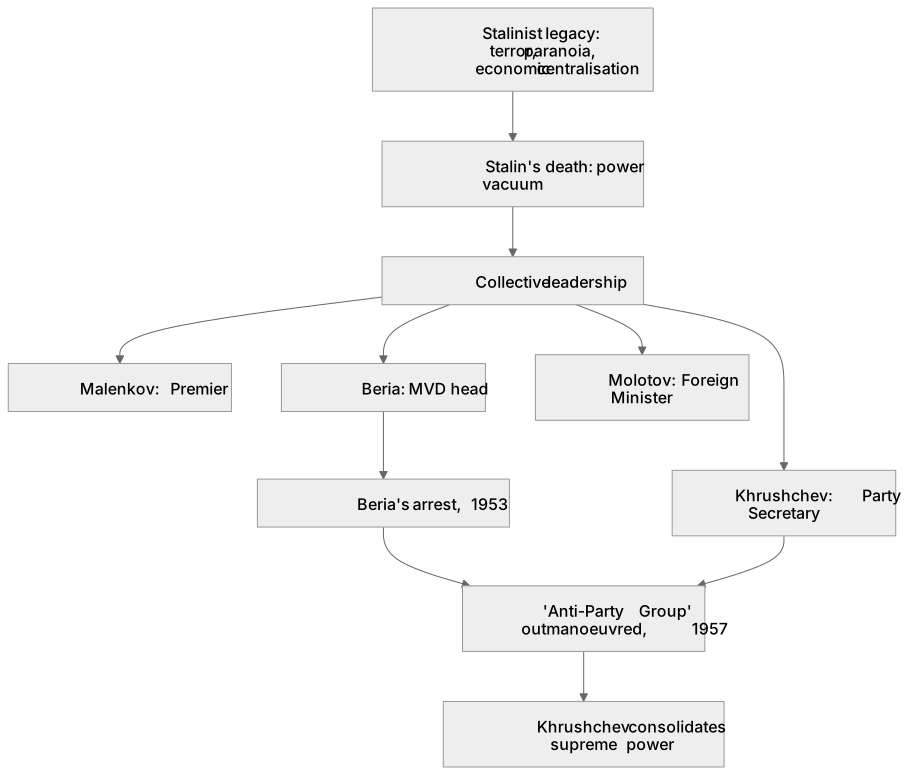
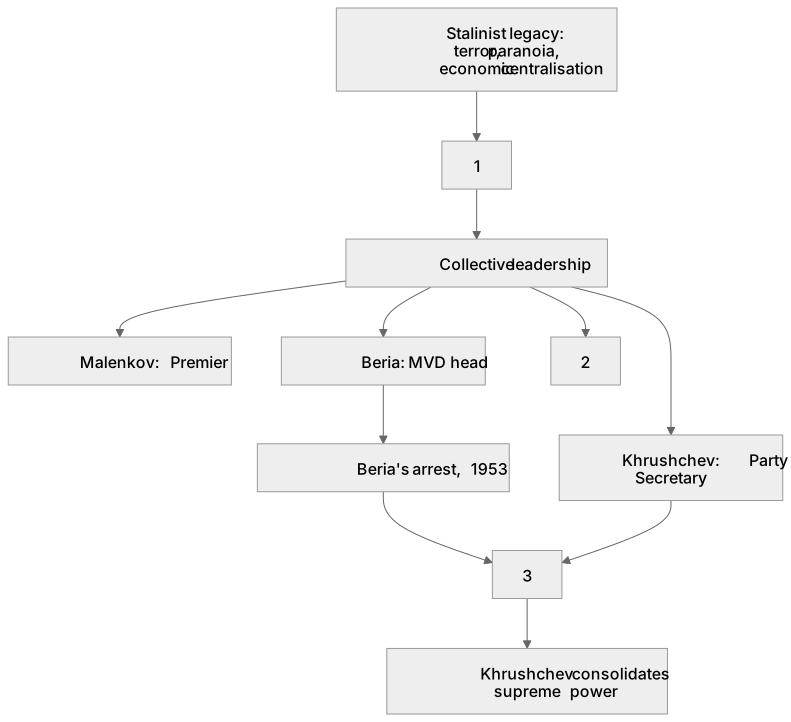
In 1953, the USSR was defined by the Stalinist legacy: a highly centralised command economy, and a society paralysed by terror and Stalin's intense paranoia, exemplified by the Doctors' Plot. Stalin's sudden death created a dangerous power vacuum. A collective leadership initially emerged, featuring key contenders: Georgy Malenkov (Premier), Lavrentiy Beria (MVD head), Vyacheslav Molotov (Foreign Minister), and Nikita Khrushchev (Party Secretary). Khrushchev's ultimate success stemmed from his strategic control of the party apparatus. By orchestrating Beria's arrest in 1953, and later outmanoeuvring the 'Anti-Party Group' of Malenkov and Molotov in 1957, Khrushchev consolidated supreme power.
What earns the marks
- Identify the key features of the Stalinist legacy in 1953, specifically the reliance on state terror, the secret police, and strict economic centralisation.
- Analyse the immediate political crisis and power vacuum triggered by Stalin's death, noting the absence of a clear succession plan.
- Evaluate the strengths and weaknesses of the main contenders: Malenkov's state position, Beria's control of security (MVD), Molotov's prestige, and Khrushchev's party influence.
- Explain the tactics used by Khrushchev to achieve success, including his alliance with Zhukov to eliminate Beria and his use of the Central Committee to defeat his rivals.
Common mistakes and how to put them right
Stating that Khrushchev immediately became the sole leader upon Stalin's death in 1953.
Put it right: Emphasise that there was a period of 'collective leadership' and Khrushchev did not fully consolidate power until 1957.
Confusing the roles of the contenders, such as claiming Malenkov controlled the secret police or referring to Beria as the head of the NKVD in 1953.
Put it right: Accurately assign their power bases: Beria controlled the MVD (the NKVD ceased to exist in 1946), Malenkov the state bureaucracy, and Khrushchev the Party apparatus.
Ignoring the economic aspect of Stalin's legacy.
Put it right: Ensure you discuss the rigid economic centralisation (Gosplan) and the imbalance between heavy industry and consumer goods.
Exam tips
- Contrast the power bases of the contenders to explain why Khrushchev's control over the Party machinery ultimately proved more decisive than Malenkov's control of the state.
- Use the arrest of Beria as a key turning point to demonstrate how the contenders temporarily united out of shared fear before turning on each other.
- Link the atmosphere of terror and paranoia directly to the difficulty of the succession, as no official heir could be groomed under Stalin's watchful eye.
Try the lesson
The start of the 2T The Crisis of Communism: The USSR and the Soviet Empire, 1953–2000 (A-level only) – De-Stalinisation, 1953–1964: The USSR in 1953: the Stalinist legacy; terror and paranoia; economic centralisation; the power vacuum and contenders: Malenkov, Beria, Molotov and Khrushchev; Khrushchev's success lesson, made from checked teaching notes for this specification point.
Have a go first
Following the death of Joseph Stalin in March 1953, which contender for power was quickly arrested and executed due to fears among the leadership about his control over the secret police?
Listen
In 1953, the USSR was defined by the Stalinist legacy: a highly centralised command economy, and a society paralysed by terror and Stalin's intense paranoia, exemplified by the Doctors' Plot. Stalin's sudden death created a dangerous power vacuum. A collective leadership initially emerged, featuring key contenders: Georgy Malenkov (Premier), Lavrentiy Beria (MVD head), Vyacheslav Molotov (Foreign Minister), and Nikita Khrushchev (Party Secretary). Khrushchev's ultimate success stemmed from his strategic control of the party apparatus. By orchestrating Beria's arrest in 1953, and later outmanoeuvring the 'Anti-Party Group' of Malenkov and Molotov in 1957, Khrushchev consolidated supreme power. A strong answer earns marks for these points. Identify the key features of the Stalinist legacy in 1953, specifically the reliance on state terror, the secret police, and strict economic centralisation. Analyse the immediate political crisis and power vacuum triggered by Stalin's death, noting the absence of a clear succession plan. Evaluate the strengths and weaknesses of the main contenders: Malenkov's state position, Beria's control of security (MVD), Molotov's prestige, and Khrushchev's party influence. Explain the tactics used by Khrushchev to achieve success, including his alliance with Zhukov to eliminate Beria and his use of the Central Committee to defeat his rivals. A common slip: Stating that Khrushchev immediately became the sole leader upon Stalin's death in 1953. Instead, Emphasise that there was a period of 'collective leadership' and Khrushchev did not fully consolidate power until 1957. Exam tip: Contrast the power bases of the contenders to explain why Khrushchev's control over the Party machinery ultimately proved more decisive than Malenkov's control of the state.
See it
Key words
Say what each word means before you turn the card.
Stalinist legacy
Try answering aloud or in your head before turning the card.
Power vacuum
Try answering aloud or in your head before turning the card.
Collective leadership
Try answering aloud or in your head before turning the card.
Economic centralisation
Try answering aloud or in your head before turning the card.
See every definition
- Stalinist legacy
- A highly centralised command economy and a society paralysed by terror and Stalin's intense paranoia, exemplified by the Doctors' Plot.
- Power vacuum
- The dangerous situation created by Stalin's sudden death, with no clear succession plan in place.
- Collective leadership
- The initial arrangement that emerged after Stalin's death, featuring key contenders such as Malenkov, Beria, Molotov and Khrushchev.
- Economic centralisation
- A highly centralised command economy, with strict economic centralisation and a rigid system noted in the Stalinist legacy.
Label the diagram
Some boxes have lost their names. Pick the right name for each number.
1Box 1
2Box 2
3Box 3
There is more to this lesson
The full lesson goes on to check your understanding and help you earn the marks. Create a free account to carry on, with your progress saved.
A week of Premium from your first lesson · Then the free plan continues · No card, no charge
Test your understanding of 2T The Crisis of Communism: The USSR and the Soviet Empire, 1953–2000 (A-level only) – De-Stalinisation, 1953–1964: The USSR in 1953: the Stalinist legacy; terror and paranoia; economic centralisation; the power vacuum and contenders: Malenkov, Beria, Molotov and Khrushchev; Khrushchev's success
Active recall beats re-reading. Take an instant quiz now to test what you’ve learned and lock it into long-term memory.
A week of Premium from your first lesson · Then the free plan continues · No card, no charge