AQA · A-Level · History
Course version: 7042 · Version from Sept 2017
The USSR and the Soviet Empire, 1953–2000 (A-level only) – 'Real existing…
Full specification wording
2T The Crisis of Communism: The USSR and the Soviet Empire, 1953–2000 (A-level only) – 'Real existing Socialism', 1968–1980: Challenges to Soviet control in the Soviet satellite states: Western influence and the media; the impact of the Helsinki accords; political activism including Charter 77 and KOR (Czechoslovakia); Church organisations (Poland and GDR); contested elections (Hungary)
Soviet control faced mounting challenges between 1968 and 1980.
Checked against the AQA 7042 specification (opens in a new tab) on .
- Point 3 of 4
- 4 key terms
Study notes
From the checked teaching notes for this specification point.
The idea
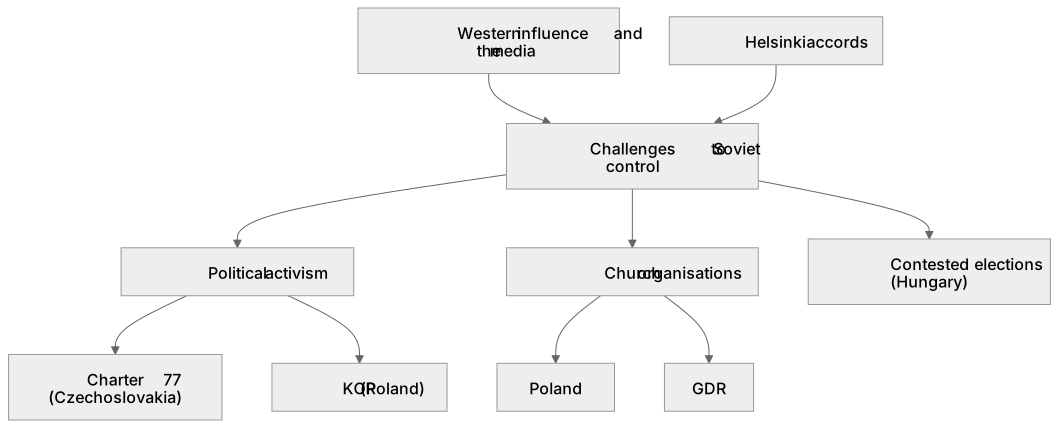
Soviet control faced mounting challenges between 1968 and 1980. Western influence and media, such as Radio Free Europe, pierced state censorship, exposing citizens to democratic ideals. The 1975 Helsinki Accords were pivotal; by committing the USSR to respect human rights, they provided a legal framework for dissidents. This spurred political activism, notably Charter 77 in Czechoslovakia, which demanded the government honour Helsinki, and KOR in Poland, which defended striking workers. Church organisations also provided crucial alternative spaces for opposition, particularly the Catholic Church in Poland and the Protestant Church in the GDR. Furthermore, early political shifts emerged, such as the introduction of contested elections in Hungary, subtly challenging the absolute monopoly of the ruling communist parties.
What earns the marks
- Assess how Western media, particularly radio broadcasts, undermined state monopolies on information and fostered dissent.
- Evaluate the impact of the Helsinki Accords in legitimising human rights demands and providing a platform for dissident groups.
- Analyse the role of political activism, contrasting the intellectual focus of Charter 77 in Czechoslovakia with the worker-intellectual alliance of KOR in Poland.
- Explain the significance of Church organisations in providing sanctuary and ideological opposition in Poland and the GDR.
- Discuss the emergence of limited political pluralism, such as the introduction of multiple candidates in Hungarian elections.
Common mistakes and how to put them right
Treating KOR as a Czechoslovakian organisation due to ambiguous specification grouping.
Put it right: Clearly identify KOR (Workers' Defence Committee) as a Polish organisation and Charter 77 as Czechoslovakian.
Stating the Helsinki Accords immediately ended Soviet control.
Put it right: Explain that the Accords provided a long-term moral and legal framework for dissidents rather than causing immediate regime collapse.
Assuming Church opposition was identical across the bloc.
Put it right: Distinguish between the powerful, nationalistic Catholic Church in Poland and the more fragmented, state-accommodating Protestant Church in the GDR.
Exam tips
- Use the Helsinki Accords as a turning point to explain the shift from violent uprisings to legalistic, human rights-based dissent.
- Compare the methods of opposition, such as the intellectual petitions of Charter 77 versus the grassroots worker support provided by KOR.
- Highlight the unique role of the Catholic Church in Poland as an alternative source of national authority that the communist regime could not suppress.
Try the lesson
The start of the 2T The Crisis of Communism: The USSR and the Soviet Empire, 1953–2000 (A-level only) – 'Real existing Socialism', 1968–1980: Challenges to Soviet control in the Soviet satellite states: Western influence and the media; the impact of the Helsinki accords; political activism including Charter 77 and KOR (Czechoslovakia); Church organisations (Poland and GDR); contested elections (Hungary) lesson, made from checked teaching notes for this specification point.
Have a go first
What was the primary focus of the Charter 77 movement in Czechoslovakia?
Listen
Soviet control faced mounting challenges between 1968 and 1980. Western influence and media, such as Radio Free Europe, pierced state censorship, exposing citizens to democratic ideals. The 1975 Helsinki Accords were pivotal; by committing the USSR to respect human rights, they provided a legal framework for dissidents. This spurred political activism, notably Charter 77 in Czechoslovakia, which demanded the government honour Helsinki, and KOR in Poland, which defended striking workers. Church organisations also provided crucial alternative spaces for opposition, particularly the Catholic Church in Poland and the Protestant Church in the GDR. Furthermore, early political shifts emerged, such as the introduction of contested elections in Hungary, subtly challenging the absolute monopoly of the ruling communist parties. A strong answer earns marks for these points. Assess how Western media, particularly radio broadcasts, undermined state monopolies on information and fostered dissent. Evaluate the impact of the Helsinki Accords in legitimising human rights demands and providing a platform for dissident groups. Analyse the role of political activism, contrasting the intellectual focus of Charter 77 in Czechoslovakia with the worker-intellectual alliance of KOR in Poland. Explain the significance of Church organisations in providing sanctuary and ideological opposition in Poland and the GDR. A common slip: Treating KOR as a Czechoslovakian organisation due to ambiguous specification grouping. Instead, Clearly identify KOR (Workers' Defence Committee) as a Polish organisation and Charter 77 as Czechoslovakian. Exam tip: Use the Helsinki Accords as a turning point to explain the shift from violent uprisings to legalistic, human rights-based dissent.
See it
Key words
Say what each word means before you turn the card.
Dissent
Try answering aloud or in your head before turning the card.
Human rights
Try answering aloud or in your head before turning the card.
Religious opposition
Try answering aloud or in your head before turning the card.
Political pluralism
Try answering aloud or in your head before turning the card.
See every definition
- Dissent
- Opposition within the Soviet bloc that was fostered by Western media undermining state monopolies on information.
- Human rights
- Demands legitimised by the Helsinki Accords, which committed the USSR to respect them and provided a legal framework for dissidents.
- Religious opposition
- Church organisations providing sanctuary and ideological opposition, particularly the Catholic Church in Poland and the Protestant Church in the GDR.
- Political pluralism
- Limited emergence of multiple candidates in Hungarian elections, subtly challenging the absolute monopoly of the ruling communist parties.
Label the diagram
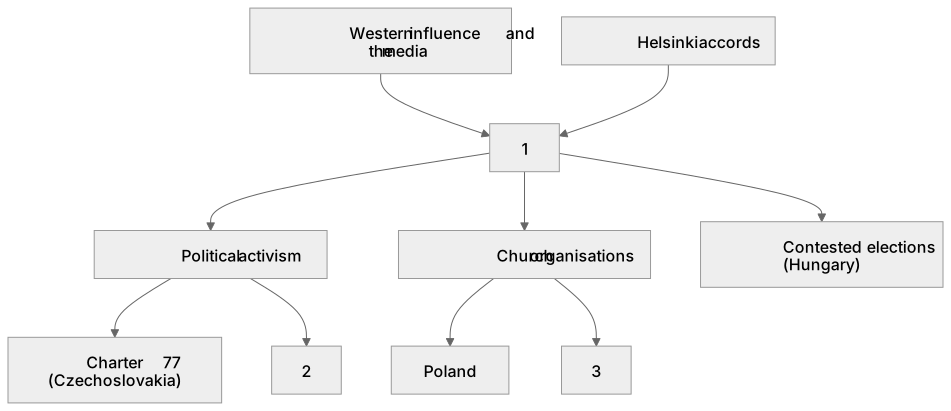
Some boxes have lost their names. Pick the right name for each number.
1Box 1
2Box 2
3Box 3
There is more to this lesson
The full lesson goes on to check your understanding and help you earn the marks. Create a free account to carry on, with your progress saved.
A week of Premium from your first lesson · Then the free plan continues · No card, no charge
Test your understanding of 2T The Crisis of Communism: The USSR and the Soviet Empire, 1953–2000 (A-level only) – 'Real existing Socialism', 1968–1980: Challenges to Soviet control in the Soviet satellite states: Western influence and the media; the impact of the Helsinki accords; political activism including Charter 77 and KOR (Czechoslovakia); Church organisations (Poland and GDR); contested elections (Hungary)
Active recall beats re-reading. Take an instant quiz now to test what you’ve learned and lock it into long-term memory.
A week of Premium from your first lesson · Then the free plan continues · No card, no charge