AQA · A-Level · History
Course version: 7042 · Version from Sept 2017
The USSR and the Soviet Empire, 1953–2000 (A-level only) – 'Real existing…
Full specification wording
2T The Crisis of Communism: The USSR and the Soviet Empire, 1953–2000 (A-level only) – 'Real existing Socialism', 1968–1980: Political developments in the satellite states of central Europe: Poland and the leadership of Gierek; Czechoslovakia and the leadership of Husak; Hungary and the leadership of Kadar; the GDR and the leadership of Honecker; policy changes and the extent of reform
Following the turbulence of 1968, central European satellite states pursued 'real existing socialism' through varied political developments and policy changes.
Checked against the AQA 7042 specification (opens in a new tab) on .
- Point 1 of 4
- 3 key terms
Study notes
From the checked teaching notes for this specification point.
The idea
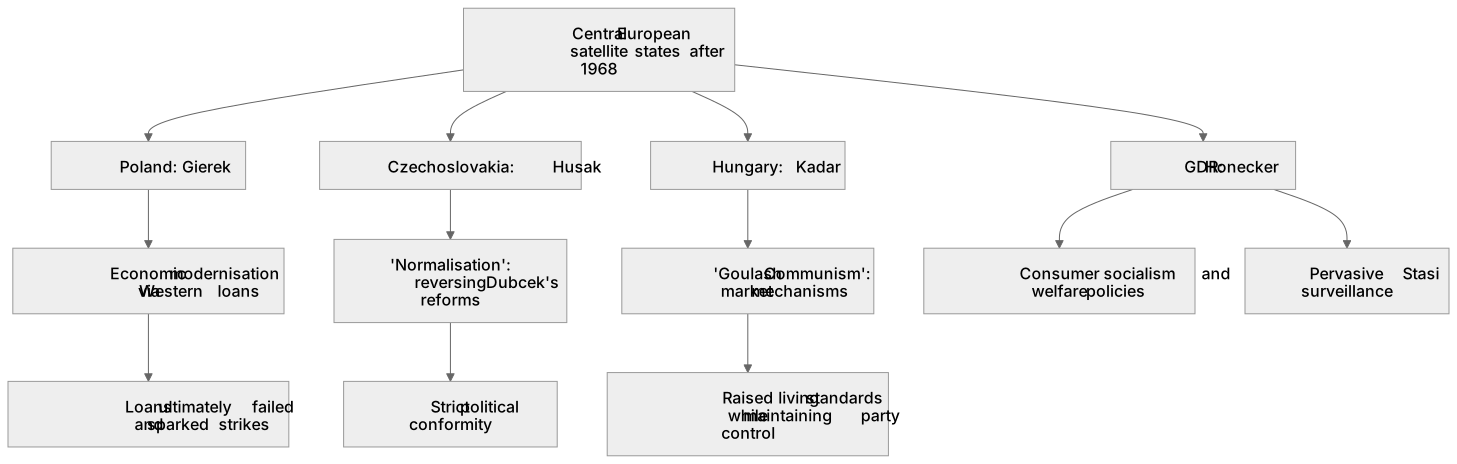
Following the turbulence of 1968, central European satellite states pursued 'real existing socialism' through varied political developments and policy changes. In Poland, Gierek attempted economic modernisation via Western loans, which ultimately failed and sparked strikes. In Czechoslovakia, Husak implemented 'normalisation', reversing Dubcek's reforms and enforcing strict political conformity. Conversely, Hungary under Kadar expanded its 'Goulash Communism', introducing market mechanisms that raised living standards while maintaining party control. In the GDR, Honecker focused on consumer socialism and welfare policies to build loyalty, alongside pervasive Stasi surveillance.
What earns the marks
- Assess Gierek's economic policies in Poland, focusing on his reliance on Western loans and the subsequent economic crises.
- Explain Husak's policy of 'normalisation' in Czechoslovakia and its role in reversing previous political reforms.
- Analyse Kadar's 'New Economic Mechanism' in Hungary and how it represented a unique extent of economic reform within the Soviet bloc.
- Evaluate Honecker's dual approach in the GDR, combining consumer socialism with intense state security apparatus.
Common mistakes and how to put them right
Treating all satellite states as having identical domestic policies.
Put it right: Highlight the distinct differences, such as Hungary's economic reforms versus Czechoslovakia's strict normalisation.
Assuming Gierek's policies in Poland were successful.
Put it right: Explain that while initially popular, his reliance on foreign debt led to severe economic crisis and the rise of opposition.
Misinterpreting Husak's normalisation as a reform movement.
Put it right: Define normalisation as a reactionary policy designed to purge reformers and restore orthodox communist control.
Exam tips
- Contrast Kadar's economic flexibility in Hungary with Husak's political rigidity in Czechoslovakia to evaluate the 'extent of reform'.
- Link Honecker's welfare policies in the GDR directly to his need to secure political legitimacy and prevent unrest.
- Use Gierek's failure in Poland as a case study for the broader economic vulnerabilities of the Soviet bloc in the 1970s.
Try the lesson
The start of the 2T The Crisis of Communism: The USSR and the Soviet Empire, 1953–2000 (A-level only) – 'Real existing Socialism', 1968–1980: Political developments in the satellite states of central Europe: Poland and the leadership of Gierek; Czechoslovakia and the leadership of Husak; Hungary and the leadership of Kadar; the GDR and the leadership of Honecker; policy changes and the extent of reform lesson, made from checked teaching notes for this specification point.
Have a go first
Which statement accurately describes the economic policy approach adopted by János Kádár in Hungary during the 1960s and 1970s?
Listen
Following the turbulence of 1968, central European satellite states pursued 'real existing socialism' through varied political developments and policy changes. In Poland, Gierek attempted economic modernisation via Western loans, which ultimately failed and sparked strikes. In Czechoslovakia, Husak implemented 'normalisation', reversing Dubcek's reforms and enforcing strict political conformity. Conversely, Hungary under Kadar expanded its 'Goulash Communism', introducing market mechanisms that raised living standards while maintaining party control. In the GDR, Honecker focused on consumer socialism and welfare policies to build loyalty, alongside pervasive Stasi surveillance. A strong answer earns marks for these points. Assess Gierek's economic policies in Poland, focusing on his reliance on Western loans and the subsequent economic crises. Explain Husak's policy of 'normalisation' in Czechoslovakia and its role in reversing previous political reforms. Analyse Kadar's 'New Economic Mechanism' in Hungary and how it represented a unique extent of economic reform within the Soviet bloc. Evaluate Honecker's dual approach in the GDR, combining consumer socialism with intense state security apparatus. A common slip: Treating all satellite states as having identical domestic policies. Instead, highlight the distinct differences, such as Hungary's economic reforms versus Czechoslovakia's strict normalisation. Exam tip: Contrast Kadar's economic flexibility in Hungary with Husak's political rigidity in Czechoslovakia to evaluate the 'extent of reform'.
See it
Key words
Say what each word means before you turn the card.
Real existing socialism
Try answering aloud or in your head before turning the card.
Normalisation
Try answering aloud or in your head before turning the card.
Goulash Communism
Try answering aloud or in your head before turning the card.
See every definition
- Real existing socialism
- The system pursued by central European satellite states after the turbulence of 1968 through varied political developments and policy changes.
- Normalisation
- Husak's reactionary policy in Czechoslovakia, reversing Dubcek's reforms, purging reformers and enforcing strict political conformity to restore orthodox communist control.
- Goulash Communism
- Kadar's expansion in Hungary, introducing market mechanisms that raised living standards while maintaining party control.
Label the diagram
Some boxes have lost their names. Pick the right name for each number.
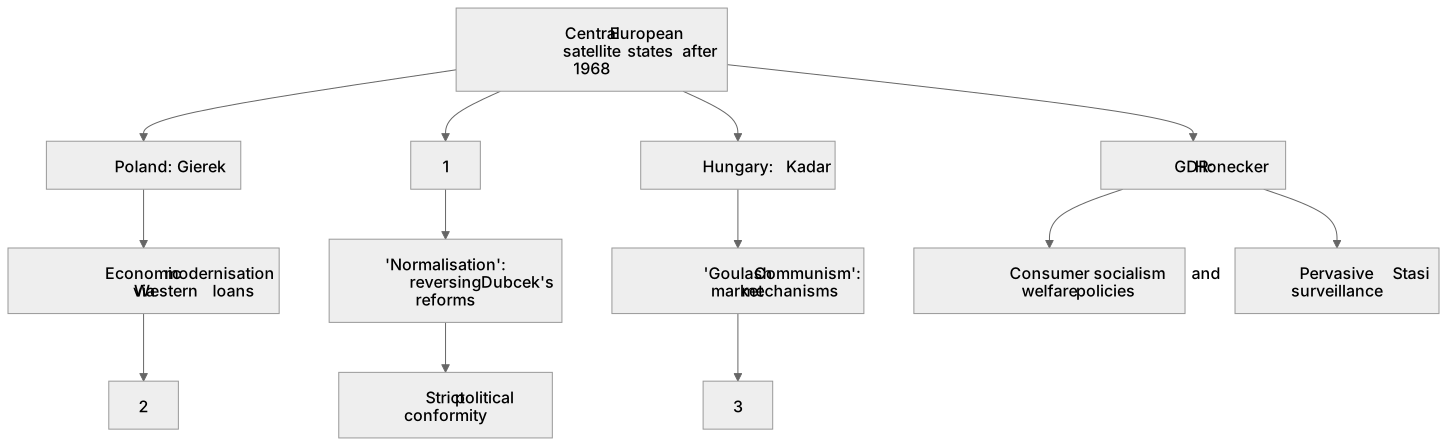
1Box 1
2Box 2
3Box 3
There is more to this lesson
The full lesson goes on to check your understanding and help you earn the marks. Create a free account to carry on, with your progress saved.
A week of Premium from your first lesson · Then the free plan continues · No card, no charge
Test your understanding of 2T The Crisis of Communism: The USSR and the Soviet Empire, 1953–2000 (A-level only) – 'Real existing Socialism', 1968–1980: Political developments in the satellite states of central Europe: Poland and the leadership of Gierek; Czechoslovakia and the leadership of Husak; Hungary and the leadership of Kadar; the GDR and the leadership of Honecker; policy changes and the extent of reform
Active recall beats re-reading. Take an instant quiz now to test what you’ve learned and lock it into long-term memory.
A week of Premium from your first lesson · Then the free plan continues · No card, no charge